


Regression testing ensures new code changes don’t hamper the existing functionality of the product. When an app scales, it’s tough to run the full suites after each change, and that’s when AI helps. The reports by World Quality Report revealed that 72% of firms report faster test automation after integrating GenAI.
AI regression testing services use ML & GenAI to support teams in detecting traditional limitations and improving testing time by 70-85%. AI has changed the way software regression QA is performed. No doubt, in 2026 & beyond, it will turn from a reactive practice to a proactive element used to make a faster release.
What Is AI Regression Testing?
➥ What Is Regression Testing?
Regression testing is a software testing method that confirms that current features continue to perform properly following code modifications, bug patches, upgrades, or integrating new functionality. Regression testing is frequently carried out after following releases, improvements, integrations, or configuration updates to make sure that new changes don’t negatively impact the functionality.
➥ What Is AI Regression Testing?
AI regression testing makes regression testing quicker and more effective by combining automated testing with AI. In contrast with traditional rule-based testing, AI intelligently chooses, prioritizes, and optimizes test execution by analyzing past data, code modifications, and problem trends. Hiring a regression testing services company reduces manual labor and improves software quality and accuracy.
➥ How AI Improves Regression Testing
QA regression testing services are enhanced by AI through self-healing automation, risk-based prioritization, intelligent test selection, and predictive failure analysis. In order to optimize next testing cycles, it continuously learns from past test executions and defect trends. Faster execution, improved error detection, reduced maintenance requirements, and more reliable software releases are the outcomes.

Why Is AI Regression Testing Important?
⮞ Challenges of Traditional Regression Testing
Large test suites are frequently run during traditional regression testing, which leads to slower response and longer release cycles. Testing expenses and effort are increased by human mistakes, repetitive execution, and manual script maintenance. Maintaining thorough regression coverage gets harder as applications get more complicated.
⮞ Why Modern Teams Need AI Regression Testing
Effective regression testing is crucial because modern development teams that adhere to Agile and DevOps release software more frequently. AI facilitates the management of complex applications and supports continuous integration and delivery. It speeds up feedback loops and helps businesses maintain high software quality without slowing down development.
⮞ How AI Solves These Challenges
AI uses predictive analytics, intelligent automation, risk-based test selection, and change effect analysis to overcome the limitations of traditional testing. Regression testing consulting reduces script maintenance, automates repetitive processes, and gives priority to high-risk regions. This increases overall program stability, reduces release cycles, and improves testing efficiency.
Also Read: The Rise of AI Assurance as a New QA Discipline
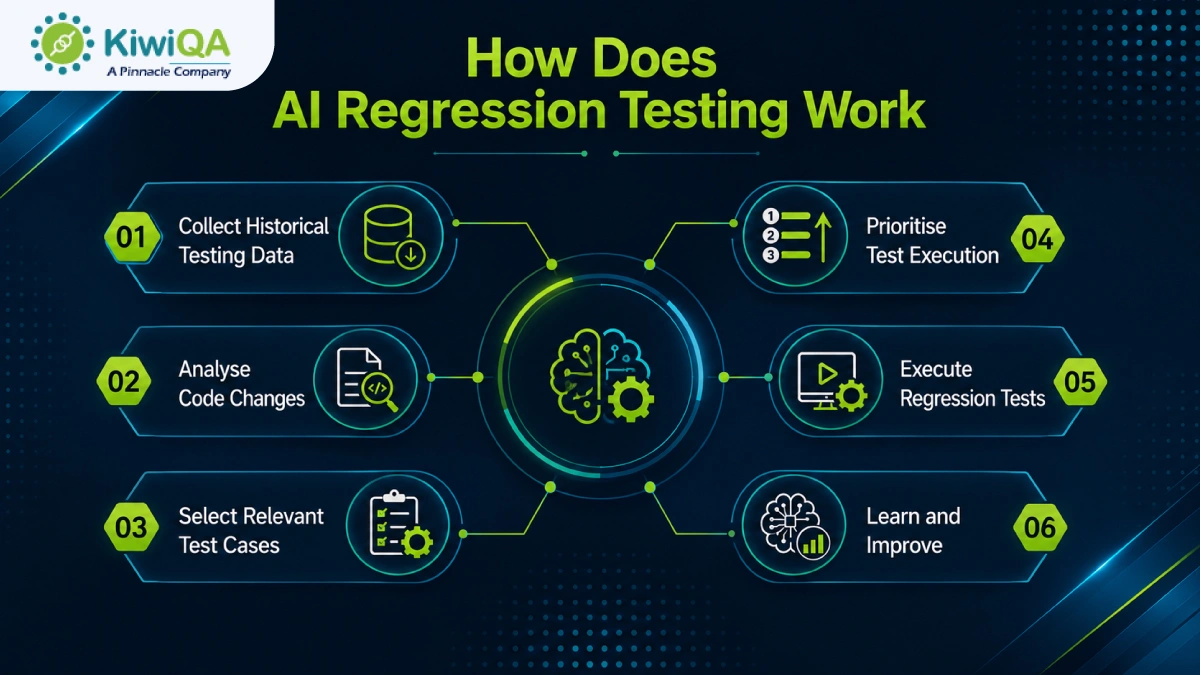

How Does AI Regression Testing Work?
➥ Step 1: Collect Historical Testing Data
The first step in QA regression consulting services is gathering testing data from earlier software releases. Test execution logs, fault histories, code commit data, application logs, and user behavior patterns are all included in this. AI analyses this data to find important business processes, frequently impacted modules, and recurrent flaws. Instead of depending on static test suites, AI may make well-informed testing decisions by building this knowledge base.
➥ Step 2: Analyze Code Changes
AI examines current source code modifications to determine their potential impacts after gathering historical data. To determine how changes impact the application, it assesses updated files, dependencies, APIs, and interconnected components. In order to determine which areas are most likely to introduce errors, AI performs impact and dependency analysis.
It evaluates the level of risk connected to each code update rather than considering them all identically. By concentrating regression testing on impacted modules, this proactive evaluation enables QA teams to minimize unnecessary testing. It enhances defect identification and facilitates quicker product delivery.
➥ Step 3: Select Relevant Test Cases
AI automatically chooses the most relevant regression test scenarios based on the code analysis. It uses smart filtering methods to find tests that are directly related to the modified components rather than running the whole test suite. AI ensures that business-critical workflows are thoroughly covered while eliminating redundant testing. This focused method drastically cuts down on testing time without sacrificing quality. Teams are able to run smaller test suites that provide quicker feedback and offer accuracy with each software release.
➥ Step 4: Prioritize Test Execution
Regression test execution is prioritized by AI, which ranks test cases based on their business impact and amount of risk. To find significant flaws as soon as possible, high-risk modules and business-critical functionalities are performed first. In order to construct an optimal execution sequence, AI also takes into account recent code modifications, application usage, and past failure trends. Development teams can get fast feedback with their smart approach. AI regression testing enables quicker fixes and supports rapid release cycles while maintaining product quality.
➥ Step 5: Execute Regression Tests
In order to identify unusual behavior, regression testing continuously tracks test progress, execution metrics, and compares current outcomes. AI helps QA teams look into problems more quickly by rapidly identifying errors and failed test cases. Every time new code is deployed, automatic execution is integrated with CI/CD pipelines. This keeps applications stable, consistent, and reliable across the development lifecycle while accelerating software delivery.
➥ Step 6: Learn and Improve
In order to improve future recommendations, AI improves its predictive models based on defect trends, new execution outcomes, and developer feedback. Prediction accuracy rises with increased data availability, allowing for smarter test selection and improved risk assessment. Continuous optimization helps in lowering false positives, increasing testing effectiveness, and adjusting to evolving applications.
Key AI Technologies Used in Regression Testing
⮞ Machine Learning
In AI-driven regression testing consulting, ML is one of the most effective technologies. It determines which modules are most likely to fail following recent updates by analyzing defect patterns, code modifications, and test execution data from the past. Smart test selection and execution are made possible by ML models’ constant improvement in prediction accuracy as more testing cycles are finished.
Defect detection rates are raised while unnecessary testing is decreased. ML helps businesses that use QA regression testing services by speeding up release cycles, enhancing software quality, and maximizing QA resources through data-driven, smart decision-making.
⮞ Natural Language Processing (NLP)
AI can comprehend and analyze human language found in functional documentation, business requirements, and bug reports thanks to NLP. It helps find inconsistent test coverage and automatically translates textual requirements into relevant test cases. In order to identify recurring problems and enhance regression testing techniques, NLP also examines issue descriptions. NLP increases testing productivity, requirement tracking, and guarantees that systems continue to meet changing business and user expectations. Overall, it minimizes manual work in test design and maintenance.
⮞ Predictive Analytics
Predictive analytics forecasts where errors are expected to arise based on past testing data, application behavior, and code modification history. AI anticipates high-risk locations and prioritizes them for regression testing rather than testing each application component equally. This smart strategy cuts down on execution time while enabling QA teams to identify important problems sooner. Firms integrating predictive analytics gain quick feedback, improved resource utilization, and enhanced release accuracy. In short, the technology is used to focus on areas that bring the highest business & technical risks.
⮞ Computer Vision
Regression testing is improved by computer vision, which verifies graphical user interfaces as users see them. In order to find layout changes, missing elements, inconsistent fonts, and visual flaws that traditional testing could miss, AI compares application displays across browsers, devices, and OS systems. Without depending exclusively on code-based validations, it also identifies UI modifications brought on by software updates. By integrating computer vision into QA regression testing services, businesses can improve visual QA, ensure a consistent user experience, and improve the accuracy of software.
⮞ Self-Healing Automation
Self-healing automation minimizes one of the largest issues in automated regression testing—script maintenance. When application pieces such as locators, IDs, or UI components change, AI automatically recognizes the changes and updates test scripts without manual effort. This dramatically decreases test failures caused by small interface changes and keeps automation suites reliable across frequent releases. By introducing self-healing features into QA regression testing services, businesses save maintenance costs, improve automation dependability, and raise test execution success rates. It enables QA teams to focus on higher-value testing tasks instead of modifying broken scripts.
Benefits of AI Regression Testing
➥ Faster Test Execution
By identifying, ranking, and running only the most relevant test cases, AI regression testing speeds up software validation. Automated decision-making reduces unnecessary test runs, minimizes feedback cycles, and enables faster releases. Teams can validate application changes fast while maintaining software quality across CI/CD pipelines.
➥ Improved Test Coverage
To maximize test coverage, AI finds high-risk locations, crucial business processes, and affected application components. It guarantees that crucial features are verified without running each test case. This innovative strategy lowers testing gaps, boosts program reliability, and increases assurance that software updates haven’t brought in unexpected flaws.
➥ Better Defect Detection
AI-driven regression testing finds problems that traditional regression testing could miss. It finds hidden vulnerabilities early in the development cycle and gives priority to high-risk regions. Early identification helps development teams fix bugs prior to release, lowers production difficulties, and enhances software stability.
➥ Reduced Test Maintenance
When app components scale, AI-powered regression QA minimizes the need for manual maintenance. It eliminates unnecessary test cases, resulting in limited maintenance expenses, improved test reliability, and QA teams may focus on key testing tasks.
➥ Lower Testing Costs
By automating repetitive processes, optimizing resource usage, and removing unnecessary test execution, AI lowers testing costs. Faster testing cycles increase productivity while requiring less manual labor. Without hampering application performance, businesses save time, cut expenses, and get better returns.
➥ Smarter Release Decisions
Before a release is deployed, teams have clear visibility into the quality of the application to ensure the software is ready to release. They approach with a data-driven strategy to reduce release risks.
AI Regression Testing vs Traditional Regression Testing
| Feature | AI Regression Testing | Traditional Regression Testing |
| Test Selection | Intelligent, risk-based selection | Manual or predefined selection |
| Test Execution | Automated and prioritized | Often executes the full test suite |
| Test Maintenance | Self-healing with minimal updates | Frequent manual maintenance |
| Test Coverage | Optimized and targeted | Broad but often inefficient |
| Accuracy | Higher through AI-driven analysis | Depends on manual planning |
| Human Effort | Low due to automation | High manual involvement |
| Learning Capability | Continuously learns from data | No learning capability |
| Scalability | Easily scales with application growth | Difficult to scale efficiently |
| Release Speed | Faster feedback and deployments | Slower release cycles |
| Cost | Lower long-term operational cost | Higher maintenance and testing cost |
Common Use Cases of AI Regression Testing
⮞ Web Application Testing
After code upgrades, feature releases, and UI modifications, AI regression testing guarantees that web apps’ performance isn’t hampered. It prioritizes test cases and verifies functionality across various browsers and devices.
⮞ Mobile Application Testing
Regression testing swiftly identifies functional problems while adjusting to regular app upgrades. By increasing test accuracy, decreasing manual labor, and preserving a flawless user experience, the regression QA team facilitates quicker mobile releases.
⮞ Enterprise Software Testing
Complex workflows, integrations, and business processes are frequently present in enterprise systems. AI regression testing verifies connected systems and finds high-risk modules. Organizations may reduce business interruptions and enhance software reliability through this.
⮞ SaaS Application Testing
Regular upgrades to SaaS platforms necessitate ongoing regression testing. With each release, regression testing assists SaaS firms in maintaining application stability, driving deployments, and providing reliable user experiences.
⮞ API Regression Testing
AI regression testing ensures that endpoints, data exchange, authentication, and integrations continue to function properly by validating APIs. It prioritizes high-risk API tests, identifies affected services, and finds errors prior to deployment.
⮞ AI & Machine Learning Application Testing
Regression testing is necessary for AI and ML systems to ensure accuracy in forecasting, data processing, and system behavior. As models continue to change, a regression testing services company guarantees that intelligent apps stay precise and prepared for production.
Challenges and Limitations of AI Regression Testing
➥ Poor Quality Training Data
For AI models to produce reliable predictions, they need precise historical testing data. Data that is inconsistent or incomplete might lower testing accuracy. It leads to poor test selection, flaws, and less successful regression testing results.
➥ High Initial Setup Cost
Investing in AI technologies, automation frameworks, infrastructure, and training is necessary to implement AI regression testing. Even though there are substantial long-term benefits, businesses with limited testing budgets may find it difficult to cover the initial setup costs.
➥ Tool Integration Challenges
Additional configuration is required to integrate AI testing solutions with current CI/CD pipelines, automation frameworks, test management platforms, and DevOps tools. Compatibility gaps increase implementation times.
➥ Limited AI Expertise
Professionals with knowledge of AI, ML, automation, and QA are needed for successful AI regression testing. Lack of skilled workers can make implementation more difficult.
➥ Explainability of AI Decisions
It’s not always simple to understand AI recommendations. Transparency and trust are crucial factors for QA teams because it can be difficult to understand why AI chose particular test cases.
➥ Human Oversight Is Still Required
Regression testing is improved by AI, but it will not replace human validation. In order to evaluate results, verify AI recommendations, look into complicated gaps, and make well-informed release decisions based on business requirements and testing results.
Step-by-Step AI Regression Testing Implementation Process
⮞ Assess Your Current Testing Process
Examine your current release workflow, system, and regression testing approach. Determine areas where AI for regression testing can increase productivity, repetitive jobs, defect trends, and testing bottlenecks. This evaluation offers a solid basis for the effective implementation of AI.
⮞ Define Testing Goals
Prior to using AI regression testing, establish certain goals. The aim must be minimizing execution time, enhancing flaw detection, expanding test coverage, and speeding up software releases. Clearly defined KPIs help in assessing the effectiveness of implementation and direct ongoing development.
⮞ Select the Right AI Testing Tool
Select an AI testing platform that satisfies your business needs, automation framework, CI/CD pipeline, and technological stack. Before making a choice, consider characteristics like test selection, self-healing automation, predictive analytics, reporting, scalability, and integration possibilities.
⮞ Prepare Historical Test Data
Gather high-quality historical data, such as test run outcomes, defect reports, source code modifications, and insights into user activity. AI models may learn more efficiently with accurate data, increasing prediction accuracy and producing more trustworthy regression testing recommendations.
⮞ Run a Pilot Project
Before using AI throughout the entire organization, start with a pilot project to verify its capabilities. Test a small application or module, compare the results to standard regression testing, and adjust the implementation plan.
⮞ Integrate with CI/CD
To automate testing following each code change or deployment, incorporate AI regression testing into your CI/CD process. It delivers faster feedback, early problem detection, and frequent software releases by continuous execution. It preserves application quality throughout the development lifecycle.
⮞ Monitor, Measure and Optimize
Use measures like execution time, defect detection rate, test coverage, and maintenance effort to track testing performance over time. To achieve long-term productivity and software quality improvements, analyze results frequently, improve AI models, and optimize test strategies.
Also Read: Top AI Chatbot QA and Testing Tools Businesses Leaders Must Use
How to Choose an AI Regression Testing Tool
Choose an AI regression testing tool that matches your organization’s goals. Assess AI capabilities, supported platforms, self-healing automation, and integration with DevOps and CI/CD tools. Consider reporting features, scalability, security, affordability, and support while collaborating with a QA team. Making an ideal choice enhances long-term software quality, lowers maintenance, and increases testing efficiency.
Metrics to Measure AI Regression Testing Success
Test execution time, Test coverage, error rates, Maintenance effort, Prediction accuracy, Automation coverage, MTTD, and MTTR are the metrics used for determining success. These indicators in AI-powered QA regression testing help in the assessment of effectiveness, quality, and ongoing development.
Ready to Modernize Your Regression Testing with AI?
AI-powered regression testing isn’t about replacing the QA team or removing human judgment. Instead, it helps QA teams limit repetitive work, manage increasing project volumes, and make better decisions with less effort. As AI continues to evolve, regression testing is enabling teams to release applications with greater confidence, speed, and accuracy. It also improves test coverage, detects issues earlier in the development cycle, and adapts to frequent application updates with minimal manual intervention. By integrating AI into regression testing, organizations can enhance software quality while reducing testing time and operational costs. To achieve faster releases and more reliable software, businesses should consider partnering with an experienced regression testing company that can effectively combine AI-driven automation with expert QA practices.