


One of the most critical platforms in business today is SAP. It drives finance, supply chain, HR, and the day-to-day functions of thousands of organizations around the world. Failure in a single SAP process can quickly create serious operational disruption.
This is precisely the reason why testing is not optional. The layer of protection is what keeps your system stable, your data accurate, and your operations running without any issues. The absence of a powerful SAP testing strategy can cause unexpected failure even out of a simple update, which is not only time-consuming and costly.
A report by Aberdeen Group suggests that even an hour of downtime may cost a medium-sized company more than $100,000. SAP testing must be a priority at the board level because of that number alone.
SAP supports the key functions that drive your business. Finance teams rely on it for accurate reporting, supply chain teams use it to manage suppliers, and HR depends on it for payroll and compliance. With reliable SAP testing services from an experienced SAP testing company, you can prevent system failures and ensure smooth operations across your organization.
This guide walks you through the types of testing in SAP that every decision maker should understand, why each one is important, and how the appropriate testing methodology keeps your business out of expensive surprises.
What is SAP Testing?
➥ Definition of SAP Testing
SAP testing refers to a methodical process of testing SAP applications to make sure they operate properly in your business systems. It spans the breadth of single code units up to the complete business process. This is to ensure that the system addresses your business needs and verifies them before the changes become active.
This includes checking that configured modules are operating as expected, that custom code is operating properly, and that integrated systems are communicating without faults. It can be regarded as a quality gateway between production and development.
➥ Why SAP Testing Matters for Enterprises
Operations within SAP systems carry significant business risk. Even one configuration mistake or a defective code transport can destroy a vital business process. Testing makes sure that does not happen.
❉ Eliminates expensive system failures prior to the manufacturing process.
❉ Enables business continuity in the process of upgrades, patches, and migrations.
❉ Facilitates regulatory compliance within finance, HR, and logistics modules.
❉ Enhances the performance of the system and user acceptance.
According to Forrester Consulting, 64 percent of organizations reported improved application performance after investing in SAP testing initiatives. Businesses that partner with a reliable SAP testing service provider and implement structured SAP testing solutions can also reduce testing efforts and costs by up to 40 percent.
❉ Less risk in operations in all SAP modules.
❉ Better system reliability/ uptime.
❉ Updates and improvements that are faster to roll out.
❉ Improved business decision-making based on the correct, reliable information.

Key Types of SAP Testing Every Enterprise Should Know
Understanding the different types of testing in SAP assists the decision makers in spending resources properly and having realistic expectations of their teams. Both types have a designated role in the testing lifecycle.
➔ Unit Testing
A strong SAP testing process is based on unit testing. It concentrates on verifying the tiniest segments of the system, e.g., custom ABAP programs, function modules, or user exits, before being engaged with the rest of the system. Primary testing domains involve:
▪ Verifying standalone program components to ensure that they work as intended.
▪ Validating separate configuration parameters inside the SAP landscape.
▪ Checking individual transactions to identify mistakes in a timely manner.
Unit-level validation is much cheaper to fix a bug at this stage as opposed to fixing it after go-live. This is the main idea of the shift-left test method, wherein testing begins as soon as possible in the project life cycle.
Also Read : Top Enterprise Software Testing Companies in India
➔ Integration Testing
SAP does not often work in a vacuum. It is linked to CRM systems, supply chain platforms, third-party middleware, and external APIs. Integration testing is used to verify that all these connections are functional and that data flows properly through all the touchpoints. The common integrations that are being tested are:
▪ SAP and CRM platforms to confirm the flow of sales and customer data.
▪ SAP of supply chain systems to verify the accuracy of inventory and procurement.
▪ SAP of the external API for real-time exchange of data.
These types of SAP testing are used to test end-to-end business processes. As an example, a Quote-to-Cash test can be used to test order entry, delivery, billing, and accounting updates in more than one module. At this level, the SAP testing process is what differentiates functional environments and environments that are enterprise-ready.
➔ Functional Testing
Functional testing in SAP validates that system components align with organizational workflows. It ensures the SAP system performs as expected and operates according to defined business requirements. Typical examples include:
▪ SD and FI module order-to-cash process validation.
▪ Procure-to-pay workflow testing between MM and FI.
▪ Accuracy of financial reporting between ledgers and cost centers.
Individual module functions are also covered in this testing. Each business has its own business rules, which are tested by functional testers: FI (Finance), MM (Material Management), and SD (Sales and Distribution). This is one of the most common SAP testing types because it shows the interaction of the users with the system on a daily basis.
➔ User Acceptance Testing (UAT)
The last testing before going live is User Acceptance Testing. The first move here is made by business users and process owners who subject the system to real-life situations that they face in their day-to-day lives. UAT is conducted by:
▪ Business users who can recognize the workflows.
▪ Process owners who determine what is right in their region.
The focus stays on real workflows and practical scenarios, not just technical behavior. The entire process of RFQ-to-invoice is tested by the procurement managers. HR teams perform payroll and leave management tests. UTAT also ensures that the system is truly production-ready and not merely functional.
➔ Regression Testing
Regression testing in SAP helps ensure that any changes in your SAP environment do not affect existing functionality. It re-tests previously working features after every update to confirm that nothing is broken. A regression test is necessary when:
▪ SAP upgrades and version migrations, including moves to S/4HANA
▪ Review of SAP testing strategy following new enhancement packages.
▪ Support packs that alter the behavior of underlying systems.
▪ System patches and hotfixes are applied to production environments.
Since regression testing is repetitive in nature, it is best suited to automation. Computerized regression procedures reduce testing timelines dramatically and prevent mistakes during repeated executions.
➔ Performance Testing
Performance testing is a test to determine how your SAP system functions in reality, under workload conditions. It extends beyond the functionality to determine the speed and stability of the system as the number of transactions increases. Key areas evaluated include:
▪ Response time of the system at peak usage times, such as the month-end close.
▪ Speed of data processing of bulk uploads and batch jobs.
▪ Evaluating system performance as user counts and transaction loads expand.
A global retailer experienced a 50 percent faster processing speed of transactions by subjecting the system to stringent SAP testing. Companies incur a 7% loss in user productivity with every second delay in SAP response time. Those seconds accumulate over time to a high rate of productivity loss and dissatisfied employees.
Cloud-related issues are also addressed by performance testing. With the increased migration of organizations to cloud-based SAP environments, network latency testing, scalability testing, and disaster recovery testing are becoming key components of the types of SAP testing required before any go-live.
➔ Security Testing
Security testing helps prevent unauthorized access to your sensitive enterprise data. SAP systems contain records of money, employees, and customers; therefore, security is a non-negotiable concern. Focus areas include:
▪ Access control confirms that the user is able to access only authorized areas.
▪ Confidentiality to counter leakages or exposure.
▪ Role-based permissions aligned with segregation-of-duties (SoD) requirements
▪ Compliance validation for standards like SOX, GDPR, and industry regulations
Research indicates that the industry average cost of a data breach is $3.86 million. Security testing within your SAP testing solutions helps you avoid being part of that statistic. It also ensures audit readiness by creating documentation trails to show that there are adequate controls in place.
➔ Automation Testing in SAP
Automation testing replaces manual testing, which is often repetitive, with scripts that execute automatically. Manual testing cannot possibly keep up with the pace and quantity of changes in rapid-paced SAP systems. The benefits are clear:
▪ Quick testing that reduces weeks of work to a few hours.
▪ Less manual work enables teams to concentrate on complex situations.
▪ Better test accuracy with repeated and consistent performance.
Widely adopted platforms support automation across different types of testing in SAP:
➥ Tricentis Tosca: A model-driven application that is most suitable for SAP GUI and Fiori testing, and which is incorporated with SAP Solution Manager.
➥ Worksoft Certify: A codeless product that is used in complex end-to-end testing of SAP business processes.
➥ Selenium: Applied in web-based SAP interfaces and integrations, where the use of browser-level testing will be applicable.
Tosca, in particular, enables teams to perform continuous testing and identify problems at the initial level. Its model-driven nature enables it to generate test cases much faster, and thus can be an effective option in large SAP landscapes with high change rates.
Also Read : End to End SAP Testing Services for Successful S/4HANA Migration Projects
How SAP Testing Impacts Business Success
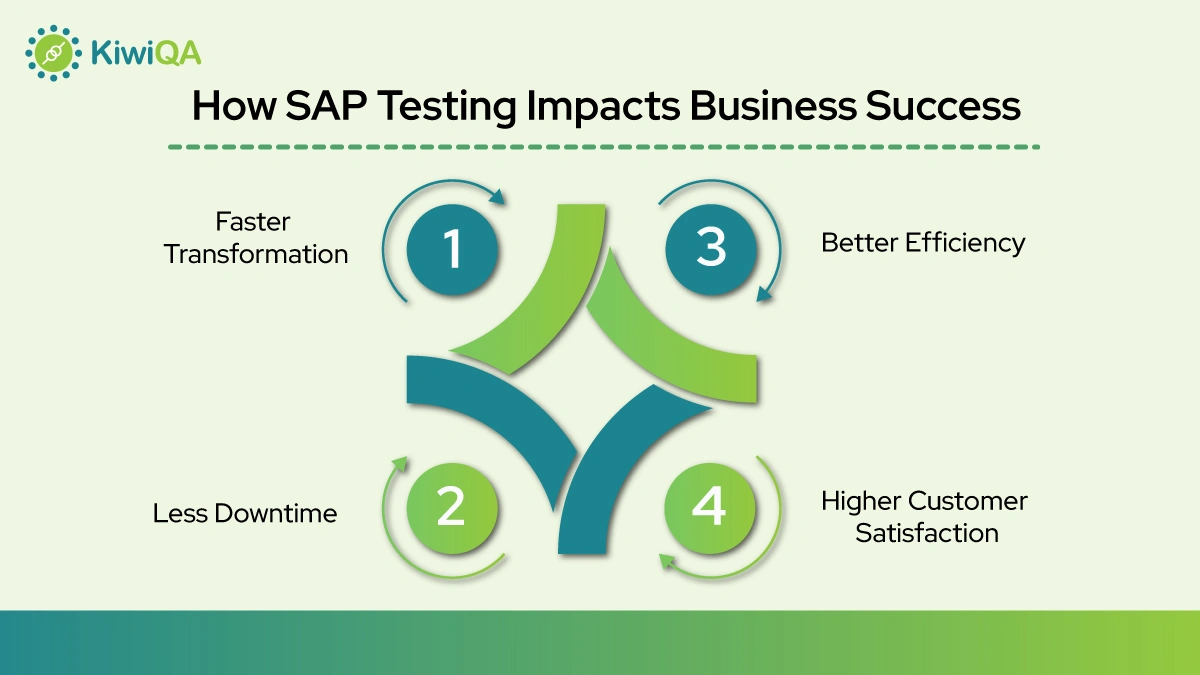

A strong SAP testing strategy is not a way to avoid failures. It actively propels business performance. Tested organizations are more likely to move more quickly, work more efficiently, and provide better experiences to their employees and their clients.
❏ Faster digital transformation: Automated continuous testing allows organizations to introduce SAP S/4HANA migrations and cloud migrations without lengthy delays.
❏ Reduced downtime: Intensive testing will ensure that failed updates do not pause the operation. Since downtime is estimated to cost more than $100,000 per hour, this protection directly and quantifiably affects your bottom line.
❏ Improved operational efficiency: Automation allows technical teams to concentrate on high-value initiatives. Reusable test scripts provide the same results on different projects and save a lot of money in the long run.
❏ Higher customer satisfaction: Stabilized, performant SAP backends provide direct support to your front-line customer experiences. With systems operating effectively, service levels increase, and trust with the partners increases.
In a study conducted by the Aberdeen Group, it was discovered that companies that have poor application quality have 33 times more delays. This translates to direct loss of productivity and frustrated teams. That cycle is broken by investing in the correct SAP testing solutions.
Ready to Improve Your SAP Systems with the Right Testing Strategy?

Enterprise stability and performance are vital for SAP testing. When decision makers have a sense of the types of testing in SAP, they gain a clear edge in planning implementations, managing upgrades, and risk protection.
The right SAP testing types provide your teams with the courage to make change without fear. They safeguard your information, your compliance status, and your business continuity on all levels of the SAP lifecycle.
A well-structured SAP testing process ensures smoother SAP implementations, upgrades, and integrations from day one. It reduces rework, shortens timelines, and builds internal trust in the system.
Organizations that invest in structured testing of different types of testing in SAP gain long-term operational advantages. They adapt faster to business changes, respond more confidently to regulatory requirements, and deliver more reliable experiences to every stakeholder who depends on SAP every day.
If your organization is preparing for an S/4HANA migration, planning a major upgrade, or improving SAP stability, the right SAP automation testing provider makes all the difference. Using reliable SAP test automation services, you can define validation scope and build a structured testing strategy.