


AI agents have become integral to everyday business processes. Automated customer support, workflow, and employee support, along with data analysis, content creation, and decision support, are all business processes that are now operational with the help of AI agents. AI agents have the capacity to retain the context of their interactions, which allows them to streamline even advanced workflows. Businesses, both small and large, are quickly learning the value of the service AI agents provide. Because of this, businesses are employing more and more AI testing services to ensure their systems function as intended.
Being an effective AI agent requires more than just making an accurate response. AI agents need to be advanced enough to understand complicated instructions, and even more so, be able to utilize integrated systems and tools to produce results, all while maintaining a good level of reliability and precision. Many industries require a great deal of oversight and governance on a corporate level. The deployment of AI systems in these regulated industries makes thorough testing of AI agents even more important.
With enterprise adoption of AI agents increasing, the need for rock-solid testing is getting more and more urgent too. By 2028, the typical Fortune 500 company should be running over 150,000 AI agents, at least on average. Still, only about 13% of organizations say they already have the governance in place to manage these systems in a practical way. This gap points to why continuous testing, monitoring, and validation are becoming essential for organizations that are rolling out autonomous AI systems at scale.
With challenges unique to testing autonomous AI, the evaluation is much more complex than conventional software testing. AI agents respond to the same prompt in many different ways. For this reason, companies need to address the consistency of the agents, the agents’ resistance to prompt injections, the protection of confidential information, the safe and appropriate use of external tools, the agents’ performance with large workloads, and the performance of many agents working simultaneously. This is also difficult to evaluate due to the need to assess on a large scale and the limitations of the infrastructure and API.
This document explains basic AI agent testing principles and common challenges faced by organizations, the critical testing platform capabilities, and the most effective AI agent testing tool solutions available today. When you finish this document, you will know the right tool to build AI solutions that are safe and effective and can operate at scale in production environments.
Understanding AI Agent Testing for Secure AI Systems
❉ What Is AI Agent Testing?
AI agent testing checks whether these autonomous AI systems can reason accurately, make dependable decisions, use their tools safely, and actually finish the task the way it was supposed to. Compared with normal software testing, it’s not only about fixed outputs; it’s more about how things behave when the environment shifts and the system adapts. That’s where effective AI testing consulting comes in; it helps companies validate the whole stack of reasoning, autonomy, and real-world performance before anything goes live in production.
❉ Why AI Agent Testing Matters
⇒ Prevents inaccurate outputs
AI agents can give inconsistent answers, hallucinations, or even make wrong decisions when they hit situations they have not seen before. With solid testing, these problems show up early, so organizations can improve the response quality, check whether the reasoning actually holds, and lower the chance of errors before agents start dealing with customers, employees, or other critical business systems.
⇒ Improves security and compliance
AI agents often reach into enterprise data, APIs, and outside services, so security testing is not optional. Regular reviews surface weak spots like prompt injection, improper or unauthorized tool usage, and the risk of sensitive data exposure. All of that also supports compliance with company requirements and the industry rules in place.
⇒ Ensures consistent user experiences
Users tend to expect reliable results no matter how they phrase a request. In AI agent testing, people verify that the answers stay accurate, relevant, and steady across different prompts, workflows, and environments, so you get a more dependable experience and more confidence in AI-based applications.
⇒ Supports production readiness
Testing also checks how these agents behave when things get real, like under realistic workloads, tangled workflows, and shifting conditions before they even get deployed. When organizations assess stability along with scalability and reliability, they can spot likely failures sooner, then launch AI systems with more certainty and less operational risk.

Common Challenges in Testing AI Agents
⮞ Non-Deterministic Behavior
Unlike traditional apps, AI agents can produce different answers to the same prompt because the output may hinge on context, reasoning paths, and model inference. That kind of variation makes failures hard to reproduce, and also annoying to debug. An effective AI agent testing tool helps teams line up and compare responses across repeated runs, so they can spot inconsistent behavior before anything ships.
⮞ Security Risks
AI agents interact with prompts, external tools, and sensitive business data, which makes this setup feel like a wider attack surface than regular apps do. Organizations should test not only for prompt injection, but also for things like unauthorized tool execution, excessive permissions, and possible data leakage. With solid security validation, teams cut down on operational risk, and agents are more likely to behave safely even in adversarial or unexpected conditions.
⮞ Scalability Issues
Things are much more complicated when testing AI agents in enterprise environments. For example, organizations may want to validate thousands of interactions at once between multiple agents, users, and workflows. Testing should confirm that AI agents will perform reliably in production, responding to users with the same quality of response with minimal latency, and that performance does not degrade even under the highest levels of demand.
⮞ Cost Management
The large-scale testing of AI models can incur substantial costs, especially when considering the extensive infrastructure needed, the frequent API calls, and the large evaluation datasets. If an organization does not develop an optimized testing strategy, the costs can be substantial as the number of tests grows. Utilizing certain AI QA services allows organizations to automate the most critical tests, remove tests that are no longer necessary, and maintain testing quality at a level that is acceptable, all while keeping the costs of testing under control.
Also Read: Everything You Need to Know About AI Regression Testing
Features to Look for in AI Agent Testing Tools
❉ Automated Test Case Generation
Testing AI agents manually is time-intensive, laborious, and poorly identifies edge cases. The use of automated test case generation expands coverage and evolves to meet the rapid changes of AI applications. It generates an assortment of prompts, workflows, and user interactions that enable teams to analyze tool and reasoning usage and the quality of responses.
❉ Security Testing Capabilities
A professional testing platform should incorporate security prompts to identify threats before the AI system is deployed. The security testing elements to look for include prompt injection testing, the detection of AI agent jailbreaks, testing for the exposure of sensitive data, validation of AI agent permissions, and the analysis of tool misuse. The confidence to deploy AI systems is increased when continuous security testing of deployed AI systems is performed.
❉ Performance Monitoring
Consistent performance monitoring should allow for the measurement of the time taken to respond, the latency of the system, how the system uses resources, the failure rate of the system, and the stability of the system. A reliable AI testing service provider will incorporate performance monitoring of the systems to maintain a consistent user experience.
❉ Evaluation Metrics
Evaluation metrics should encompass more than just accuracy. High-quality testing tools look at correctness, the reasoning behind the answer, completion of the task, hallucination, the ease of use for the end user, and their satisfaction. This data allows an organization to assess different versions of a model, confirm improvements, and make deployment decisions grounded in measurable performance.
❉ CI/CD Integration
AI agent testing should integrate seamlessly into existing CI/CD pipelines to automate quality checks throughout development. Evaluating quality after every code or model change allows teams to easily identify issues and regressions and enables a more rapid development pace, while maintaining quality control of safety, performance, and reliability of new features before moving them to production.
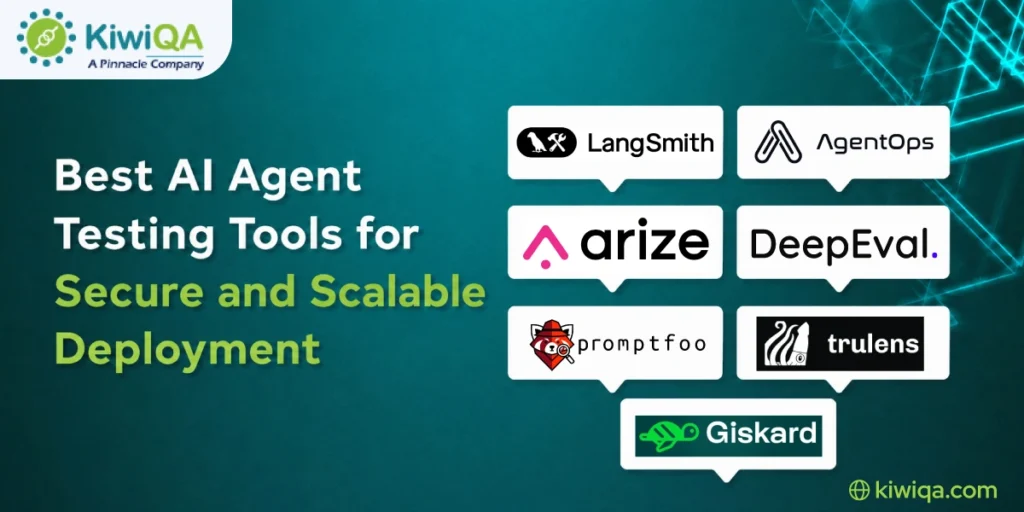
Best AI Agent Testing Tools for Secure and Scalable Deployment
1. LangSmith


LangSmith is a development and evaluation platform that helps teams trace, debug, and assess AI agent behavior through the full end-to-end workflows. It is broadly viewed as one of the best AI agent testing tools, which helps teams improve the quality and reliability of LLM-powered applications.
⇒ Key Features
LangSmith gives you detailed prompt tracing, plus automated evaluation pipelines and workflow debugging, which helps developers look at how the agent executes, spot reasoning failures, and then compare performance across prompts, models, and even different app versions.
⇒ Pros
The platform simplifies experiment tracking through centralized observability, and it fits in with LangChain really well. It lets developers watch changes, compare the outcomes, and keep improving the AI agent performance all the way through the development lifecycle.
⇒ Limitations
LangSmith is most beneficial for applications that are developed using the LangChain framework. Teams that end up using other AI orchestration frameworks might need extra integrations, or even extra external tools, to reach a similar level of testing and visibility in observability.
2. AgentOps

AgentOps is an observability platform built to monitor, debug, and optimize AI agents while they are running in production. It gives development teams end-to-end visibility into how an agent is executing, so it becomes one of the best tools for AI agent testing and operational monitoring.
⇒ Key Features
AgentOps records full agent sessions, captures execution problems, and delivers performance analytics too, so developers can spot where things fail, understand how the agent behaves, and then optimize the workflows with very fine runtime insights.
⇒ Pros
This platform gives you solid operational visibility, with constant production monitoring that helps teams spot anomalies earlier, then troubleshoot issues faster. It also helps keep the AI agent performance dependable in real-time environments.
⇒ Limitations
While AgentOps does focus on observability and monitoring, it offers fewer built-in features for adversarial testing, prompt security checks, and compliance-focused reviews than more dedicated AI security platforms do.
3. Arize Phoenix

Arize Phoenix is a useful open-source AI observability tool that has potential as an AI agent testing tool. It helps teams see, track, and solve problems with Large Language Model (LLM) applications and is capable of offering insights into the behavior of models in production.
⇒ Key Features
Arize combines LLM tracing with dataset evaluation and root cause analysis. This offers teams the ability to view failures and compare model outputs as well as assess retrieval and refine AI agents in a more reliable manner.
⇒ Pros
Its advanced analytics simplify debugging and evaluating a model’s performance. The open-source framework offers the development teams the ability to customize and build workflows and integrate observability into AI development pipelines.
⇒ Limitations
More configuration and specialized know-how are needed to bring more advanced evaluation workflows into effect within Phoenix. This can be more challenging for teams that do not have a dedicated AI Engineering team.
4. DeepEval

DeepEval is an open-source framework for assessing the quality and reliability of LLM applications and AI agents. It automates quality assessments using customizable benchmarks, making it a practical option among the best tools for AI agent testing.
⇒ Key Features
The framework lets you use custom evaluation metrics, do hallucination detection, and run benchmark tests, so developers can measure response quality, compare model performance, and notice reliability issues while building it and even during deployment.
⇒ Pros
DeepEval is developer-friendly; it comes with flexible evaluation metrics, so teams can adjust their testing criteria for different AI applications. It also helps bring automated assessments right into existing development workflows, without much friction.
⇒ Limitations
Even though it is flexible, DeepEval still needs a bit more setup, especially for enterprise-scale use, particularly when you’re dealing with governance, massive datasets, and automated evaluation pipelines across multiple live environments.
5. Promptfoo

Promptfoo is an open-source framework that is generally a good aid for testing prompts as well as AI agents and LLM apps. Because of its High Level of automation, Promptfoo works very well for regression testing. Hence, it is a reliable tool for testing AI agent performance.
⇒ Key Features
Promptfoo allows for the evaluation of several prompts, and through automated evaluation, it can spot changes in output. Further, it can identify latency in performance and can help maintain output consistency even after the prompt or the model has been updated.
⇒ Pros
Promptfoo is lightweight in terms of design. This means that it has a small footprint. This small footprint allows Promptfoo to integrate easily with pre-existing CI/CD work infrastructure and test AI agents very quickly and promptly.
⇒ Limitations
Promptfoo mainly focuses on prompt evaluation and offers limited capabilities for production monitoring, runtime observability, and advanced AI agent behavior analysis.
6. TruLens

TruLens is an open-source framework designed to assess the evaluative criteria of quality, reliability, and trustworthiness of LLM applications. As a best tool for AI agent monitoring, it provides particular advantages for retrieval-augmented generation (RAG) systems.
⇒ Key Features
TruLens considers groundedness, retrieval quality, and feedback metrics of your choice to confirm that AI answers are correct, relevant, and justified by information that has been retrieved.
⇒ Pros
TruLens Software gives in-depth information to RAG application developers on how to use frameworks and tools to enhance the accuracy of information retrieval, improve response quality, and increase the reliability of AI systems.
⇒ Limitations
TruLens has a steep learning curve, and the configuration of advanced evaluation workflows is especially a challenge for teams who are new to the concept of AI observability and quality assessment.
7. Giskard

Giskard is an AI quality assurance platform that helps organizations test, validate, and secure AI models before they’re deployed. It offers comprehensive risk assessments, so it is a reliable AI agent testing tool for enterprise AI applications.
⇒ Key Features
Giskard merges vulnerability detection, bias testing, and model validation to uncover security weaknesses, surface fairness problems, and double-check if AI systems work dependably across assorted datasets and real-world scenarios.
⇒ Pros
The platform delivers robust security testing, along with a wide-ranging AI evaluation, so development teams can spot potential risks, refine model quality, and gain higher confidence before pushing AI agents into production.
⇒ Limitations
Some advanced governance, collaboration, and enterprise-scale capabilities show up only in higher-tier offerings, and that makes them a better fit for organizations that are running big AI deployments and also dealing with tricky, multi-layer compliance needs.
How to Choose the Right AI Agent Testing Tool
⮞ Consider Your AI Stack
Start with an evaluation of an AI testing platform’s fit in your stack. Confirm support for your preferred LLMs, orchestration, vector databases, APIs, and your deployment environment. The appropriate selection guarantees less integration work, faster implementation, and allows testing to be consistent during the entire AI development lifecycle.
⮞ Evaluate Security Needs
Security requirements differ based on the data and flows used by your AI Agents. Look for Prompt Injection testing, unauthorized tool execution, data leakage, access control, and other security testing and compliance tool gaps. Adequate security testing protects enterprise systems and reduces operational and regulatory risks.
⮞ Assess Scalability
Select a solution that can accommodate the growth of your AI initiatives. The platform you choose should sustain high performance even as large evaluation datasets are processed; many users, agents, and workflows are managed; and many requests are handled. Testing scalability offers assurance on the quality of the product as AI applications are integrated across various teams, departments, and production environments.
⮞ Budget Considerations
Evaluate the total cost of ownership instead of focusing on the license cost alone. Analyze the cost of API calls and the infrastructure and automation required, as well as the maintenance and scalability. A well-designed testing platform should balance the advancement of AI testing and the improvement of AI quality with the management of operational costs over an extended period.
Best Practices for Secure and Scalable AI Agent Testing
❉ Test Early and Continuously
Testing should remain an ongoing part of development rather than being performed only at the end before launch. The shifting-left approach introduces testing earlier in the development lifecycle and helps to discover logic deficiencies, workflow disruptions, and integration bugs sooner. Automated regression tests combined with AI QA services offer great testing coverage for each iteration of the software.
❉ Include Adversarial Testing
When AI agents are deployed, they must be resilient to various forms of attack. Adversarial testing is the best way to discover vulnerabilities to prompt injection attacks, jailbreak attempts, bad actor inputs, and aberrant user behavior. Resiliency to these forms of attack will give agents the same level of consistent and secure operation that is expected during normal operating conditions.
❉ Monitor in Production
AI agents must be monitored in production. Because agents evolve based on changing data, prompts, and user interactions, testing must continue post-deployment. Tools for continuous evaluation and performance dashboards allow teams to track degradation in quality and pinpoint failures to ensure dependable performance and minimize interruption to the business.
❉ Build Comprehensive Test Suites
A successful testing strategy includes a singular framework encompassing testing for functionality, security, and performance, as well as reliability and human assessment. Full test suites examine the breadth of possible behaviors displayed by a deployed AI agent. This testing includes agent behavior in highly loaded situations. With test suites of this breadth, AI agents will be performing in a reliable manner across an abundance of scenarios that will be encountered in the real world.
Also Read: Top AI Chatbot QA and Testing Tools Businesses Leaders Must Use
Future Trends in AI Agent Testing for Enterprises
⮞ AI-Powered Test Automation
More and more AI-powered testing platforms are working towards the automation of intricate tasks by using minimal human input to create test cases, find gaps in test coverage, and discover behavioral anomalies. As enterprise AI systems evolve, intelligent automation will aid in achieving faster testing cycles with a notable boost in the quality of the software being tested, along with better accuracy in testing.
⮞ Multi-Agent Evaluation
Multiple AI agents, which work in collaboration to accomplish complex tasks, are being implemented more and more by organizations. New testing methods will likely be devised for evaluating multiple agents working together in a system for testing the consistency of decisions, communication, and task coordination, as well as the resolution of conflicts. This wider approach to testing will ensure that a system that contains multiple autonomous agents will continue to perform reliably.
⮞ Enhanced Security Testing
Security testing has moved on from the superficial identification of vulnerabilities and begun incorporating new threats posed by the development of artificial intelligence. Future platforms will offer extensive evaluation capabilities to analyze the security of AI agents against prompt injections, jailbreak techniques, privilege escalation, information leaks, tool exploitation, and other concerns, allowing organizations to enhance the security of their AI agents and mitigate threats impacting their production systems.
⮞ Compliance-Driven Testing
With the advancement of AI-related legislation throughout the world, testing frameworks will be designed to offer verification tests for regulatory compliance and integrate the evaluation of testing processes as well. Companies will use automated tools to assess their AI systems for safety compliance, display accountability, and be prepared for audits in order to affirm their AI systems are operating in a justified manner and within the bounds of applicable regulations and industry standards.
Ready to Secure and Scale Your AI Agent Deployments?
Start with the defined intent and scope of your AI agent. This includes the context of use, risk appetite, and priorities for testing. Establishing a clear framework will allow you to choose tools to perform validation on quality, security, and performance that are meaningful to you.
Choose a testing solution that remains compatible with your preferred AI architectures, but also has the capacity for new models, integrations, and a rapidly growing user base in the future.
Security, reliability, and continuous validation must be considered as long-term commitments after the first effort. The risks of AI are constantly changing, and the performance of your solutions is also changing throughout the lifecycle of the application, requiring frequent testing to keep up.
Build a testing strategy that aligns with your long-term business objectives with the assistance of an experienced AI testing partner who will appreciate the nuances of enterprise AI systems and the governance and security challenges that evolve.
Automated testing complemented by human assessment enables assessment of reasoning quality and contextual accuracy. It also enables the assessment of tricky edge cases that may be consistently overlooked by automated assessments alone.
The combination of enhanced testing coverage, reduced risk of deployment, and reliable, secure, and scalable AI agent solutions that organizations can confidently offer is the result of partnering with AI specialists and the accelerated pace at which they can bring their solutions to market.