


Salesforce Agentforce is changing how organizations manage customer interactions by using AI agents. These AI agents can understand users’ requests, take action, and work directly within the Salesforce ecosystem. However, unlike traditional Salesforce features, these AI agents make independent decisions, and therefore they need to go through various testing stages before going live. The Gartner report predicts that 33% of enterprise software applications include Agentic AI capabilities by the end of 2028.
The traditional Salesforce testing approaches are designed for fixed workflows and expected outcomes, and therefore, they aren’t able to detect the risks. This is when hiring an experienced Salesforce testing company matters. The experts know how to validate AI agent accuracy, performance, security, and functionality and keep them ready to deploy.
A well-defined testing plan before deployment helps firms to address issues early, and avoid costly modifications. Readers can check below salesforce agentforce testing guide to scale Agentforce with confidence.
What Is Salesforce Agentforce Testing?
❉ Understanding Salesforce Agentforce
Salesforce Agentforce is an AI agent platform that helps organizations develop and deploy AI agents for tasks like customer support, service, and sales. It can use Salesforce CRM data to access business information and customer data. Salesforce Data Cloud helps to offer unified data that agents can use to understand user needs and give relevant responses. Agentforce can also connect with workflows to follow defined business processes and update records. Salesforce agentforce testing checks whether the agents understand users, integrate accurate data, follow workflows, and complete actions accurately.
❉ What Makes Agentforce Testing Different From Traditional Salesforce Testing?
Traditional Salesforce testing checks fixed workflows and predictable outputs, whereas Agentforce testing goes beyond that. It deals with AI, which thinks and responds on its own. The QA team must check the agent’s decision-making to check if it chooses the best action in various situations, and not a fixed path. Natural language responses require review for clarity, tone, and accuracy. Agent behavior must be tested across various scenarios involving edge cases and unexpected user inputs. Integrations with Salesforce ecosystems must be verified for smooth data flow. At the end, we can say that traditional Salesforce testing verifies fixed, rule-based code and workflows, whereas Salesforce Agentforce testing works on non-deterministic AI decisions.

Why Salesforce Agentforce Testing Is Important for Businesses
✦ Ensuring Accurate AI Responses
Agentforce interacts directly with users, so its responses must be accurate and relevant. Testing allows businesses to check whether AI agents offer accurate answers based on customer and business information. Agentforce testing services help businesses to identify inaccurate suggestions, outdated details, and incorrect user information before these errors affect users. Regular testing allows teams to maintain response quality and build improved confidence in AI-powered customer interactions across various use cases.
✦ Improving Customer Experience
An organized Agentforce implementation can make customer interactions faster, personalized, and smooth. Partnering with agentforce testing company supports businesses in checking whether the agent understands various customer queries and responds across various user journeys. Teams can test conversations from simple requests to more complex scenarios and ensure the agent manages context. It helps to identify gaps in conversational flows and build a more consistent customer experience across sales, support, and service interactions.
✦ Reducing Business and Compliance Risks
Agentforce testing allows businesses to monitor security and compliance errors before they create major issues. Teams can check for unauthorized data access, vulnerabilities, and incorrect data handling. Testing verifies whether customer data is safeguarded and managed according to regulations and privacy requirements. Using Salesforce testing services, the QA team can offer structured testing across security, integrations, data access, and compliance-related scenarios. It helps organizations to reduce operational and regulatory risks.
Also Read: Salesforce Testing Tools Business Leaders Should Know
Key Areas to Test in Salesforce Agentforce
❉ Functional Testing
Functional testing is performed to determine whether Agentforce performs the tasks it is assigned to manage. The Salesforce QA team tests agent actions and workflows to ensure each step is working as expected. It is used to check whether prompts trigger the right responses and whether organizations’ processes are automated accurately. It is used for testing how the agent interacts with Salesforce objects, such as updating, creating, or retrieving records. API and 3rd-party integrations must be tested to verify data moves accurately between Salesforce and connected systems.
❉ Conversational AI Testing
Conversational AI testing focuses on how well Agentorce understands and responds to users. It is performed to check whether it can understand natural language, recognize various user intents, and offer relevant answers. The QA team tests how well the agent remembers context during conversations and responds when users change topics or offer incomplete data. The experts include various ways of asking similar queries to identify gaps. Test error handling ensures the agent responds appropriately when it can’t understand or complete a request.
❉ Data Accuracy Testing
Data accuracy testing verifies that Agentforce provides accurate and reliable data. Through this, the QA team can check whether the agent retrieves accurate customer and CRM data from Salesforce. Compare responses with actual records to measure missing, outdated, or incorrect data. Test whether data remains consistent across various Salesforce and connected systems. Review responses against knowledge articles to verify the contents are approved. Additionally, it is used to validate that responses are accurately associated with Salesforce Data Cloud information and don’t rely on unsupported data.
❉ Security and Compliance Testing
Security and compliance testing ensures Agentforce manages business and customer data safely. The agentforce testing companies run this to test user authentication and verify that only authorized users can access specific data or actions. It checks permission-based access across various roles and Salesforce security settings. Additionally, the QA team uses this to make sure sensitive data is protected when Agentforce interacts with CRM records or external systems. They check whether security configurations work as intended and review audit controls. This testing verifies that the Agentforce implementations follow regulatory, privacy, and organizational compliance requirements.
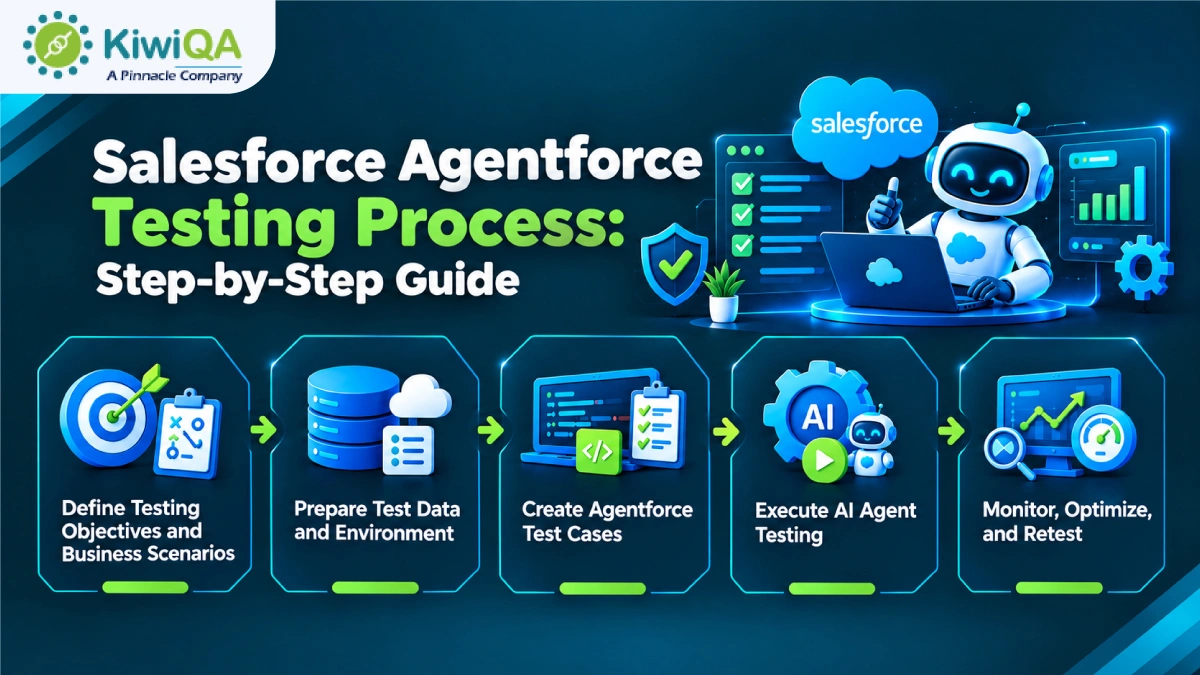

Salesforce Agentforce Testing Process: Step-by-Step Guide
✦ Step 1: Define Testing Objectives and Business Scenarios
First, define what your Agentforce implementation goals are. How will performance be measured? Determine key Agentforce use cases, such as lead qualification, customer support, and service requests. Establish the expected outcomes for each scenario and develop business-focused test cases. It helps testing teams to verify whether the AI agent delivers accurate outcomes, follows expected workflows, and matches defined business requirements.
✦ Step 2: Prepare Test Data and Environment
Prepare test data and environment before executing Agentforce tests. Set up a Salesforce sandbox that mimics relevant production configurations without impacting live operations. Prepare realistic customer data while managing appropriate privacy controls. Configure user roles and permissions to validate access across various users. Establish the necessary integration environment, including external apps, workflows, and connected Salesforce services, to test end-to-end behavior accurately.
✦ Step 3: Create Agentforce Test Cases
Develop comprehensive Agentforce test cases depending on real interactions and business workflows. Test cases must cover basic and complex customer queries, expected agent responses, and automated actions. The team integrates escalation scenarios to verify when to transfer conversations to human agents. Error-handling cases should test how Agentforce responds to unclear inputs, integration failures, and unexpected user requests.
✦ Step 4: Execute AI Agent Testing
Integrate the prepared test cases across various scenarios, user roles, and input variations. Perform functional testing to validate that Agentforce follows configured workflows and completes intended actions. QA team validates AI-generated responses for relevance, accuracy, and consistency. Users may phrase the same requests and measure agent behavior under expected conditions. Salesforce qa testing services can support structured validation and detect errors associated with configuration and workflow changes.
✦ Step 5: Monitor, Optimize, and Retest
After testing, continue to monitor Agentforce performance to detect recurring errors, respond to quality errors, and address workflow gaps. Use test results to improve prompts, knowledge, sources, and automation workflows where necessary. The QA team retests the scenario after every significant configuration and integration. Continuous validation ensures that Agentforce remains reliable as business processes, customer needs, Salesforce configurations, and connected system changes.
Salesforce Agentforce Testing Checklist for 2026–27
❉ Functional Testing Checklist
Functional testing verifies Agentforce behaves as configured across real business scenarios. The QA team should verify agent activation occurs accurately across channels, and the configuration settings match expected use cases. Workflows and actions must be tested end-to-end to make the outcomes accurate. CRM data access requires validation to ensure agents retrieve, update, and sync records accurately without errors. Automation execution must be checked under changing conditions to maintain reliability.
❉ AI Response Testing Checklist
AI response testing verifies Agentforce allows smart and reliable interactions. Response accuracy needs to be measured against expected outcomes across diverse query types and business contexts. Response testing checks whether the agent retains and applies relevant data across multi-turn conversations. Response testing validates that similar queries offer stable and predictable answers over repeated attempts. Managing incomplete queries determines how well the agent clarifies intent rather than making assumptions. Fallback responses must be tested to ensure the agent passes the chat to a real person smoothly and offers answers.
❉ Security Testing Checklist
The Salesforce QA team checks whether Agentforce can access only the Salesforce data and features that each user is allowed to use. Test user permissions, API connections, login controls, and data access. They will make sure sensitive customer data isn’t shown in logs, responses, or connected systems. In addition, they test how the agent manages unauthorized requests, unusual inputs, and prompt injection attempts. Review the audit logs and data safety measures before migrating Agentforce to production.
❉ Performance Testing Checklist
The Salesforce QA experts test how quickly Agentforce responds to user queries and completes assigned actions. The agents are tested during normal usage as well as scenarios where more users are involved. They check response time, API performance, Salesforce resource usage, and integration speed. Additionally, test what happens when a system or integration becomes slow. After making changes to prompts, integrations, and workflows, run the test again to ensure Agentforce continues to perform smoothly.
Best Practices for Salesforce Agentforce Testing
✦ Combine Automation Testing With Human Validation
To quickly and reliably verify recurring Agentforce scenarios, use automated testing. Teams may test common queries, procedures, and responses at scale with the help of this. However, in complex conversations where tone and context are vital, human assessment is still crucial. To improve overall testing quality, Salesforce QA services can help with both expert validation and automated inspections.
✦ Implement Continuous Testing Approach
Every time Agentforce’s processes, integrations, configurations, or prompts are modified, they should be tested. Teams can find problems before they impact customers by doing routine testing. Companies should also focus on production results and evaluate agent reactions over time. As customer demands and corporate procedures evolve, a continuous testing strategy helps guarantee that Agentforce stays consistent.
✦ Focus on Real-World Customer Scenarios
Instead of depending on pre-made questions, test Agentforce using realistic client journeys. Integrate frequently asked questions, various approaches to the same subject, and multi-step interactions. Additionally, teams should test unexpected requests, unclear inputs, and edge cases. This helps in determining the agent’s performance in scenarios that might arise during real-world client contacts.
✦ Maintain AI Governance Standards
Before installing Agentforce, establish clear AI governance principles and periodically review them. Specify what can be done by agents, how customer data should be handled, and when human interaction is necessary. Teams should also focus on privacy, security, and compliance regulations. Frequent governance assessments lower the risks related to automated judgments and client interactions while assisting companies in maintaining acceptable AI practices.
Salesforce Agentforce Testing Metrics to Track
❉ AI Accuracy Metrics
AI accuracy indicates how consistently Agentforce comprehends and reacts to users. Monitor the task completion rate, intent recognition rate, and response accuracy. These metrics help organisations identify inaccurate responses, errors, and tasks that the agent is unable to properly execute.
❉ Performance Metrics
Performance metrics help in evaluating Agentforce’s operational effectiveness. To find out how soon consumers receive answers, monitor response times. Keep an eye on the failure rate to identify unsuccessful interactions and agent availability to ensure system availability.
❉ Customer Experience Metrics
It displays the user reactions to Agentforce interactions. Track the escalation rate, resolution rate, and Customer Satisfaction rate. These metrics help companies determine if clients receive satisfactory responses, successfully resolve problems, or require assistance from customer support agents.
Also Read: Salesforce Testing Strategy for Large Enterprise Implementations
Future of Salesforce Agentforce Testing in 2026–27
✦ Rise of Autonomous AI Testing
AI-based autonomous testing is expected to improve the adoption of Agentforce testing. AI-driven testing assistants help to develop automated test cases, identify unusual agent behavior, and compare outcomes. Automated test generation can reduce manual effort, while a self-learning testing framework can adapt to changing conversations, workflows, and customer scenarios.
✦ Increased Focus on AI Governance
As organizations are using AI agents for tasks, governance and security will become an important part of testing. Teams will focus on strong security controls, data safety, and access management. They also look for transparent ways to monitor AI decisions, making it easier to review agent actions and identify potential errors.
✦ Continuous AI Quality Management
Agentforce testing will shift towards frequent quality management instead of one-time testing. Real-time monitoring allows teams to identify response errors, failed actions, and changing customer behavior quickly. Organizations can use these metrics to optimize prompts, workflows, and agent configurations. It helps to manage consistent AI performance with changing requirements.
Ready to Improve Your Salesforce Agentforce Testing?
An AI agent that is not tested can put your customer experience at risk. It is suggested to test the Agentforce deployment for security, accuracy, and performance before problems are visible to users. Identify the risks early and fix them before they cause costly issues. Partnering with a trusted Salesforce testing service provider, businesses can get support at every stage. To deploy Agentforce successfully, talk with the expert today.