


As various organizational systems face various problems, strong yet robust API testing services act as the foundation. It unifies the management of disparate systems, uncovers actionable metrics, and offers automation of complex systems. Businesses currently use various virtual tools to manage data, productivity, customers, and operations.
This is why Salesforce API integration acts as the center of modern enterprise technology. It enables businesses to connect external systems, share real-time data, and automate processes with minimal manual effort. According to the Salesforce Connectivity Benchmark Report, organizations use an average of 1,061 business applications, yet only 29% are integrated, meaning nearly 70% of applications remain disconnected. This highlights the growing need for seamless API integration to eliminate data silos and improve operational efficiency.
Salesforce API testing is the methodology of validating the reliability, functionality, and security of Salesforce APIs by sending requests directly to endpoints and measuring the response. The QA team of an API testing company prioritizes underlying business logic, data management, and system integrations. The testing ensures the data flows accurately between Salesforce and connected apps while managing performance and compliance standards. This blog presents the basics of API testing services and advanced terms.
Understanding Salesforce APIs and Their Role in Data Integration
➥ What Are Salesforce APIs?
• REST API: The API testing service provider provides scalable, lightweight integration for web and mobile apps with JSON or XML data formats utilizing traditional HTTP techniques.
• SOAP API: It offers strong security, standardized communication, and compatibility with legacy business systems while supporting enterprise-level integrations via XML-based messaging.
• Bulk API: It is perfect for data migrations and bulk modifications; this API effectively handles massive amounts of Salesforce records using asynchronous batch operations.
• Metadata API: It supports deployments, customization, and environment synchronization by managing Salesforce metadata and configurations.
• Streaming API: Applications can receive real-time event alerts from Salesforce through the streaming API, which eliminates the need for constant platform monitoring.
➥ How Salesforce APIs Enable Seamless Data Exchange
Salesforce APIs link the CRM with external apps to provide smooth data interchange. By conveying data without human intervention, they automate corporate operations, increasing productivity and lowering errors. Additionally, API testing consulting provides batch and real-time data synchronization, guaranteeing that business apps are updated with correct data. This facilitates reliable communication between corporate systems, quicker decision-making, and consistent workflows.
⤷ Key Takeaways
Salesforce API testing services companies facilitate safe, reliable, and automatic data transmission between Salesforce and external applications, which forms the basis of contemporary corporate connections. Whether for real-time integrations, bulk data processing, metadata management, or the creation of custom applications, many Salesforce APIs are made to satisfy particular business needs. Organizations may increase scalability, integration performance, operational efficiency, and overall business agility by choosing the right API.

Why Salesforce API Testing Is Essential
➥ Ensuring Data Accuracy Across Systems
Maintaining correct and consistent data across linked business apps is made easier with Salesforce API testing. It avoids duplicate records and data inconsistencies while confirming that records are properly produced, updated, and synchronized. In order to guarantee that data is accurate throughout each transaction, the API testing service provider additionally verifies field mappings and business rules. Precise data facilitates improved client interactions, enhances reporting, and allows firms to make valuable decisions.
➥ Improving Integration Reliability
Reliable API testing lowers the risk of system failures and business interruptions by identifying integration problems before they reach production. Organizations can identify issues prior to deployment by verifying API functioning, authentication, response handling, and error recovery. Extensive testing guarantees smooth communication between Salesforce and external systems, reduces outage risks, and enhances application stability. This proactive strategy promotes reliable business operations and improves operational continuity.
➥ Enhancing User Experience
Faster data availability and reliable application performance are provided by a well-tested Salesforce API, improving user experience. API testing services ensure consumers obtain accurate and timely information by verifying response times, data accuracy, and system dependability under various workloads. Stable interconnections facilitate efficient corporate processes, cut down on delays, and avoid unforeseen mistakes. Customers and staff gain from a responsive, reliable, and virtual experience as a solution.
Also Read: Strategic Benefits of API Testing in Enterprise Digital Transformation
Key Components to Validate During Salesforce API Testing
⮞ Authentication and Authorization
Testing for authorization and authentication ensures that Salesforce APIs can be accessed by authorized users. To guarantee safe access, verify OAuth processes, token creation, refresh procedures, and token expiration management. Role-based permissions, access scopes, and authentication failure responses should all be verified during testing. Sensitive company information is safeguarded, illegal access is stopped, and secure communication between Salesforce and integrated apps is ensured by proper validation.
⮞ Data Integrity
Throughout API exchanges, data integrity testing guarantees that data is accurate. To ensure that data is transferred accurately, validate field mapping between Salesforce and linked systems. During integration, data transformation checks should verify computations, formatting, and business rules. Comprehensive integrity testing helps eliminate duplicate records, missing values, and synchronization issues, ensuring trustworthy reporting and efficient business operations across corporate applications.
⮞ Error Handling
The way Salesforce APIs react to incorrect requests, unsuccessful authentication, missing resources, and server exceptions is validated by effective error handling. To guarantee that applications recover gracefully from errors, a skilled API testing service provider confirms response code validity, appropriate error messages, and exception management. In order to maintain reliable integrations, make troubleshooting easier, and minimize operational disruptions, testing should also validate retry mechanisms, logging, and fallback procedures.
⮞ API Rate Limits
Limit validation is a crucial component of testing since Salesforce implements API rate restrictions to preserve platform stability. To comprehend API consumption and spot possible bottlenecks during periods of high usage, keep an eye on governor limitations. To ensure that big data transactions go smoothly without going above platform limitations, bulk operation handling should also be checked. Appropriate validation guarantees reliable performance under growing workloads, enhances scalability, and avoids service disruptions.
⮞ Testing Checklist
• Request validation: To guarantee precise and effective Salesforce API connectivity, check API endpoints, request methods, headers, parameters, and payload formats.
• Response validation: Verify that status codes, response payloads, schema compliance, and the accuracy of the data returned match the anticipated functional and business needs.
• Authentication testing: Verify OAuth authentication, access tokens, permissions, authorization rules, and secure access control for every API call.
• Data mapping verification: Make sure that there is no data loss, duplication, or formatting mistakes when mapping fields between Salesforce and linked systems.
• Error scenario testing: To confirm reliable API behavior, test invalid inputs, authentication failures, missing resources, timeout circumstances, and exception handling.
• Performance monitoring: To guarantee scalability, track response times, throughput, resource usage, and API stability under typical and high-workload scenarios.
Common Salesforce API Testing Challenges and Solutions
➥ Handling Large Data Volumes
Large datasets might slow down execution, lengthen processing times, and affect system performance when testing Salesforce APIs. High-volume records can be processed effectively while lowering API calls by using bulk API optimization techniques. Test teams should check data accuracy following imports or changes, monitor response times, and validate batch processing. As business data grows, performance testing with realistic data volumes guarantees that APIs are reliable, scalable, and stable.
➥ Managing API Limits
If Salesforce’s API usage limits are exceeded, integrations may be disrupted. Monitoring utilization thresholds and verifying error handling when limitations are reached are components of effective testing. Reducing pointless API calls can be achieved by putting effective request techniques into practice, such as batching requests, caching responses, and query optimization. These procedures aid in preserving steady performance while avoiding service disruptions brought on by going above daily API limits.
➥ Testing Across Multiple Environments
To find configuration discrepancies prior to deployment, Salesforce API behavior should be verified in both sandbox and production environments. Testing ensures that custom objects, permissions, associated apps, authentication settings, and integrations operate uniformly across all environments. While production validation verifies deployment readiness, sandbox testing facilitates safe experimentation. Retaining environment-specific test data and configurations lowers deployment risks and guarantees seamless post-release API functioning.
➥ Maintaining Data Consistency
Data accuracy and synchronization between Salesforce and related apps should be verified through API testing. During data exchanges, synchronization validation algorithms confirm record creation, updates, removals, and conflict resolution. To avoid inconsistencies, test scenarios should incorporate rollback validation, transaction failures, and duplicate identification. Frequent data integrity checks facilitate smooth cross-platform connections, enhance reporting accuracy, and help organizations keep trustworthy business information.
➥ Solutions at a Glance
To increase quality and dependability, successful Salesforce API testing solutions use verified methods and techniques. Regression testing is expedited by automated testing frameworks, and validation is made possible without the need for live systems through mock APIs. By monitoring gaps in SDLC, continuous integration testing lowers the risk of deployment. Performance monitoring solutions help teams maintain stable, high-performing Salesforce environments and optimize integrations by tracking response times, API health, and resource utilization.
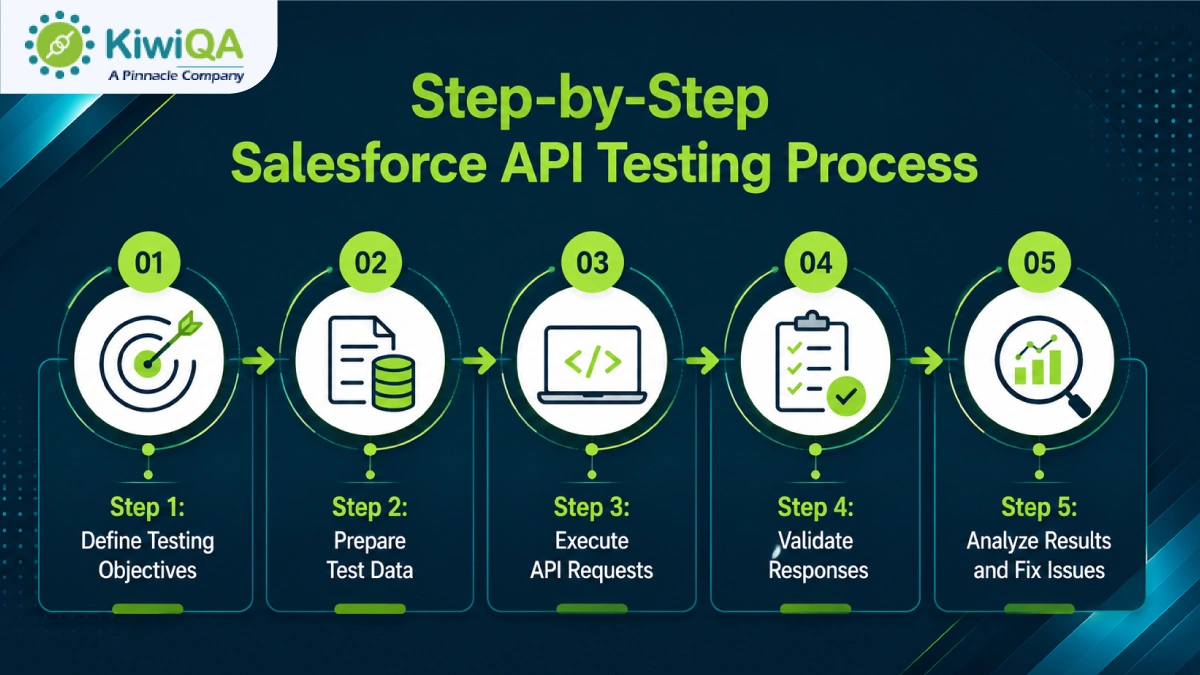

Step-by-Step Salesforce API Testing Process
⮞ Step 1: Define Testing Objectives
Start by defining precise testing goals that are in line with integration objectives and business needs. Determine the security requirements, performance benchmarks, expected functionality, and APIs that need to be tested. Establish success criteria for system dependability, response accuracy, and data exchange. Clear goals make it easier to generate targeted test cases and guarantee that Salesforce interfaces successfully support business operations during development and deployment.
⮞ Step 2: Prepare Test Data
To assess various API scenarios, create thorough test data that contains both valid and faulty datasets. To confirm how the system behaves under minimum, maximum, and unexpected input values, include boundary test cases. Sensitive information should be protected while test data reflects actual business situations. In addition to increasing test coverage and identifying validation problems, a proper API testing services company guarantees that APIs manage a variety of queries without sacrificing data integrity.
⮞ Step 3: Execute API Requests
Use the GET, POST, PUT, PATCH, and DELETE HTTP methods to carry out Salesforce API requests. Make sure every action—such as retrieving, creating, updating, or removing records—performs as expected. To guarantee effective communication, test headers, payload formats, request parameters, and authentication. Before production deployment, functional problems, performance bottlenecks, and integration faults can be found by running thorough request scenarios.
⮞ Step 4: Validate Responses
Verify each return for accuracy and precision after completing API queries. Verify that status codes correspond to anticipated results, check response payloads for accurate data, and confirm data consistency between Salesforce and related systems. Response times, error messages, and schema compliance should all be assessed during testing. Comprehensive response validation guarantees that APIs maintain smooth interfaces between business applications and provide accurate information.
⮞ Step 5: Analyze Results and Fix Issues
Examine test findings to find integration issues, performance issues, and functional flaws. To do root cause analysis, look into error logs, response specifics, and system behavior. Sort problems according to how they will affect the company, then work with development teams to put solutions in place. Retesting following resolution increases overall API reliability and deployment confidence by confirming that adjustments are effective and preventing recurring issues.
⮞ Step 6: Automate Repetitive Tests
Efficiency, consistency, and long-term quality assurance are all improved by automating repetitive Salesforce API testing. Defects can be found early in the development lifecycle by using continuous testing, which enables automated execution with each code change. While regular test runs provide quicker releases, less manual labor, and reliable API performance across changing Salesforce connectors, automated regression testing confirms that current functionality is unaffected by modifications.
Best Practices for Salesforce API Testing
➥ Use Realistic Test Data
Salesforce API testing is more accurate when realistic test data is used to emulate real-world business scenarios. To confirm API functionality under various circumstances, the API testing services company builds representative datasets with valid, incorrect, and edge-case records. This method ensures that sensitive information is hidden or anonymized to preserve compliance and data security while identifying problems with data validation, integration mistakes, and performance bottlenecks.
➥ Automate Frequently Executed Tests
Efficiency, consistency, and release speed are all increased by automating regularly run API tests. Every time a code change is made, regression, smoke, and integration tests can be automatically executed to help find errors prior to release. Automation boosts test coverage, decreases manual labor, and provides development teams with faster feedback. Organizations may maintain application quality and guarantee stable Salesforce integrations by incorporating automated API tests into CI/CD pipelines.
➥ Monitor API Performance Continuously
Monitoring API performance continuously helps in locating delays, bottlenecks, and unforeseen issues before they have an impact on consumers. To assess the health of the API under various workloads, monitor response times, throughput, error rates, and resource usage. Additionally, continuous monitoring identifies trends that need to be optimized and verifies service-level goals. As business demands rise, proactive performance monitoring guarantees that APIs continue to provide constant performance, reduces downtime, and promotes reliable Salesforce interactions.
➥ Test Security Scenarios Thoroughly
To safeguard sensitive corporate data and Salesforce APIs, security testing by top API testing companies is crucial. Verify token management, encryption, role-based access permissions, authorization restrictions, and authentication methods. Check for vulnerabilities such as incorrect error handling. Thorough security testing guarantees that APIs adhere to corporate security guidelines, protect private data, and lower the possibility of data breaches among interconnected apps.
➥ Validate End-to-End Data Flow
End-to-end data flow validation verifies that data is sent accurately, without loss or duplication, between Salesforce and related systems. All integration points should be tested to confirm data creation, updates, synchronization, and error recovery. Throughout the process, teams should also verify that workflows and business rules are carried out correctly. Extensive validation guarantees smooth communication between enterprise systems, increases reporting accuracy, and improves data integrity.
➥ Maintain Detailed Test Documentation
Collaboration and long-term maintenance of Salesforce API testing initiatives are all enhanced by thorough test documentation. In a central repository, keep track of test cases, execution outcomes, API specifications, environment configurations, known problems, and actions for fixing them. In addition to supporting compliance requirements and facilitating quicker troubleshooting, well-maintained documentation makes onboarding easier. Additionally, it offers insightful historical data that helps teams maintain consistent integration quality and optimize upcoming testing cycles.
Also Read: Best Automation Tools for Salesforce Testing in 2026
How Salesforce API Testing Supports Business Growth
⮞ Faster Digital Transformation
Salesforce API testing ensures that integrations function dependably prior to launch, which speeds up digital transformation. Extensive testing verifies workflow automation, application compatibility, and data interchange across business systems. This minimizes post-deployment problems, shortens implementation times, and gives organizations more confidence when implementing new technology. Reliable APIs enable businesses to scale digital projects while maintaining consistent performance and providing seamless consumer experiences. They also facilitate quick innovation and optimize corporate operations.
⮞ Improved Customer Data Accuracy
Sales, marketing, and customer service activities all depend on accurate customer data. Salesforce API testing confirms that records are accurately created, updated, and synchronized among linked platforms without data loss or duplication. Testing enhances the consistency and quality of information by verifying data mappings and business rules. Long-term customer satisfaction and growth are facilitated by personalized engagement, improved reporting, stronger compliance, and more informed business decisions made possible by reliable customer data.
⮞ Reduced Integration Failures
Thorough API testing service finds compatibility issues, configuration mistakes, and functional problems before they impact production environments. Integration errors between Salesforce and related apps are less likely when API calls, responses, authentication, and exception handling are validated. Stable integrations boost user confidence, save expensive downtime, and guarantee continuous business operations. As business needs change, proactively resolving possible problems also reduces maintenance costs and promotes more reliable system operation.
⮞ Enhanced Operational Efficiency
Salesforce APIs that have been thoroughly vetted reduce manual involvement and repetitive processes by automating business workflows and data sharing. By guaranteeing that data is continually accessible across systems, reliable interconnections enhance departmental cooperation. Workers can concentrate on higher-value tasks since they don’t have to spend as much time fixing mistakes or balancing data. Enhanced operational efficiency boosts output and facilitates quicker service delivery. The automated API testing company helps companies in resource optimization while preserving steady business performance.
⮞ Better Decision-Making Through Reliable Data
To make strategic decisions, business executives depend on fast and reliable information. Data completeness, consistency, and synchronization across CRM, ERP, analytics, and other linked platforms are guaranteed by the Salesforce API testing company. By removing disparities brought on by unsuccessful data transfers, reliable integrations enhance forecasting, performance analysis, and reporting accuracy. Organizations can spot opportunities, react swiftly to changes in the market, and make decisions that promote long-term growth with the help of reliable business data.
Ready to Achieve Reliable Data Flow with Expert Salesforce API Testing?
Automating Salesforce API testing is the game-changer for firms looking to streamline their QA process and ensure the APIs are accessing accurately. Organizations can validate the functionality, security, and performance of APIs by leveraging the ideal automation tools and test practices. Partnering with an API testing company can help businesses implement effective testing strategies and achieve reliable results. To follow the step-by-step process of Salesforce API testing, connect with an API testing company.