



Software testing is rapidly growing because firms need to validate complex AI-driven operations, secure microservices, and manage automated CI/CD pipelines. It is driven by quick release cycles and rising expectations around quality and security. The testing market is expected to reach 61.48 billion USD in 2027. Organizations can no longer treat QA as the last step. Breaches and poor user experience can harm financial and reputational values. Thorough testing has become a competitive necessity for businesses, and that’s why the demand for software testing services providers is increasing.
With them, businesses can scale quality assurance without hampering delivery timelines. At the same time, AI and automation are reshaping modern QA, managing repetitive tests and script creation and maintenance, whereas human testers focus on risk analysis and strategy. So, it not only changes how testing is done but also what it costs.
So, how much should your actual budget be? The pricing depends on the testing type, team location, engagement model, and project complexity. As an approximate value, the average QA testing cost is 10 to 25% of the total software development budget. The guide describes each of the cost factors involved in software testing in 2027.
♦ How Much Does Software Testing Cost in 2027?
Software testing costs in 2027 mostly range from $15 to $150+ per hour, based on scope. Small projects cost $500-$5000, and mid-size projects cost $5,000 to $30,000, whereas enterprise projects cost $30,000-$150,000+ yearly.
Manual testing costs less, but it is generally not preferable due to poor repeatability, whereas automated testing at software testing agency costs more initially, but it minimizes the long-term expenses.
In-house QA adds overhead and salary, whereas outsourced software testing services allow flexible pricing with less product context. Ultimately, there is no fixed cost because it may vary based on project size, testing type, team location, and compliance needs.
⇒ Estimated Software Testing Cost by Project Size
• Small applications – Small applications mostly cost $500-$5,000 to test, which covers basic manual functional checks, core user flows, and device compatibility for simple apps.
• Mid-sized software products – Testing these products costs $5,000 to $30,000. It covers combining manual exploratory testing with automation for regression testing, integration, and API- validation.
• Enterprise applications –Enterprise software testing cost $ 30,000- $ 100,000 yearly. Here, testing includes extensive automation, security and performance testing, and compliance requirements across large and complex systems.
• Complex SaaS platforms – These platforms reach $50,000- $150,000 and more. The testing is driven by continuous CI/CD testing, microservices validation, large-scale performance testing, and a compliance QA process.

♦ What Factors Affect Software Testing Costs?
1. Project Size and Complexity
Large and complex software needs more testing effort, that increase the overall costs. The number of integrations, features, user roles, workloads, and dependencies can impact testing scope. Apps with complex business logic and multiple modules need more test cases, resources, and testing cycles compared to small-sized projects.
2. Type of Software Testing Required
The software testing companies charges high cost based on the type of testing needed. Some common types of testing are performance, security, functional, compatibility, API testing, regression, and compatibility testing. Different testing requires different tools and expertise; therefore, a project requiring multiple testing types costs more.
3. Manual vs. Automation Testing
Manual testing needs more testers and testing hours because of repetitive scenarios, whereas automation includes an initial investment in frameworks, tools, and scripts. The best approach depends on project needs, testing frequency, and app stability. Some projects may require a combination of manual and automated testing to manage speed and cost.
4. Number of Platforms and Devices
Testing across various browsers, screen sizes, OS, and mobile devices increases the testing scope. Applications that support both Android and iOS may require additional compatibility testing. Cloud-based device labs and testing tools help teams to access various environments without managing physical devices.
5. Testing Team Location
The testing team location can influence cost because it varies across regions. Onshore teams may have high hourly charges, whereas offshore teams offer various cost structures. Businesses must consider communication, time-zone differences, collaboration needs, and project management when comparing locations.
6. Tester Experience and Skill Level
The expertise in software testing services company also adds the final testing cost. To manage specialized technologies and complex project requirements, businesses need to invest more to hire experts. They ask for higher rates, but they are capable of managing advanced testing scenarios, identifying errors, and reducing rework. Projects involving security, automation, and performance may require a testing team with specific skills.
7. Testing Timeline
A shorter testing timeline can increase costs when additional testers, extended working hours, or parallel testing are required to match deadlines. The longer schedule may allow teams to distribute testing activities effectively. However, delayed testing can also increase the risks if errors are discovered late in development or before release.
Also Read : Top Enterprise Software Testing Companies in India
♦ Software Testing Pricing Models and Costs
⇒ Hourly Pricing
Hourly pricing for software testing costs $15-$150/hour based on region and skill level. This model is best for short-term projects and software testing consulting where scope isn’t fully defined. Additionally, it offers flexibility but is tough to measure the budget accurately because the cost depends on how long the testing takes to complete.
⇒ Fixed-Price Testing
Fixed-price testing refers to a single agreed cost for a clearly defined scope. It is ideal for smaller apps and one-time audits with stable requirements. Clients know the total cost upfront that simplifies budgeting. However, any scope changes mostly require renegotiation, making the model less flexible for project requirements that scale during testing.
⇒ Dedicated QA Team
In this model, a dedicated QA team is hired on a monthly or quarterly basis, giving you a consistent testing team for your long-term project. This software testing cost estimation ranges from $2,500 to $10,000+ monthly based on location and seniority. The model is best suited for ongoing products with frequent releases, offers brief product knowledge, and is compared to project-based models.
⇒ Testing as a Service
This model offers ongoing QA support without requiring businesses to manage a permanent testing team. Testing resources can be scaled based on project demands, release cycles, and workload. The model can support continuous testing, automation, regression testing, along with other QA activities throughout the STLC.

♦ Software Testing Cost by Testing Type
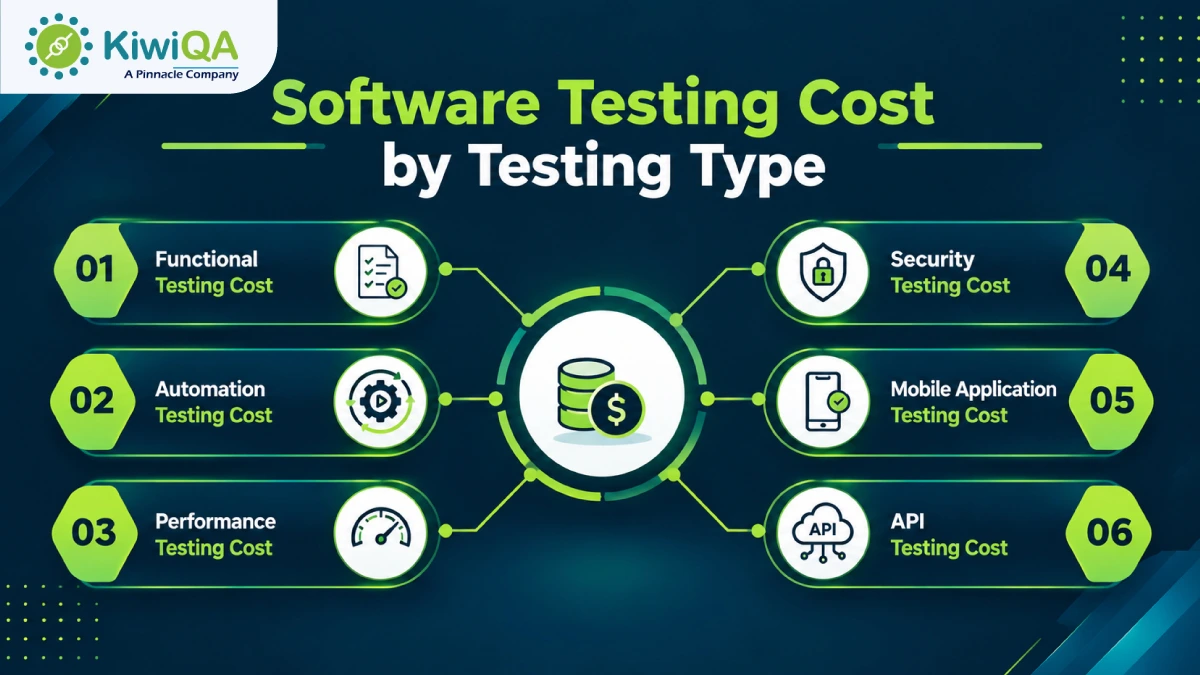
⇒ Functional Testing Cost
This is the most basic type of testing, and the software testing price around $20-$40 an hour. The testing team checks that every feature actually works the way it’s expected to. It checks through real user workflows to ensure nothing is affected. If you are releasing product updates soon, regular regression testing adds time.
⇒ Automation Testing Cost
Automation testing costs more upfront, mostly $30-$60/hour, because it requires creating and setting up test scripts early. Once the framework is in place, it requires upkeep as your app changes. It is a little costlier initially, but it saves money over multiple testing cycles.
⇒ Performance Testing Cost
Performance testing costs $35-$70 per hour, since it requires specialized testing tools and setups. Load testing estimates how systems behave under heavy traffic, whereas scalability testing checks how performance is consistent when user volumes grow. Complex, high-traffic apps and enterprise SaaS platforms require this testing type.
⇒ Security Testing Cost
Security testing costs $40-$75/hour, due to high popularity and specialized skills. Error assessment scans for common gaps across the applications, whereas penetration and app security testing simulates real attacks to reveal major errors. Industries such as healthcare and fintech usually require this testing frequently.
⇒ Mobile Application Testing Cost
Mobile testing costs $25-$50/hour, depends on devices and OS compatibility testing across Android and iOS versions, screen sizes, and hardware. Network and usability testing determines performance under various conditions and real-world user experience. Broad device coverage and various OS versions increase both testing time and cost.
⇒ API Testing Cost
API software testing budget costs around $25-$55/hour and covers API functionality and integration testing. It validates that endpoints behave accurately and connect accurately across services. Performance and security validation checks response times under load and screens for errors. Costs rise with the number of endpoints and microservices included.
♦ In-House vs Outsourced Software Testing Cost
⇒ Cost of Building an In-House QA Team
Partnering with an in-house testing team means paying full-time salaries, which increase even before testing starts. For this, you need to invest in tools, infrastructure, testing devices, and ongoing training to keep the team’s skills updated. The upfront costs are high, but you connect with a team that deeply understands your product.
⇒ Cost of Outsourcing Software Testing
The cost of outsourcing software testing depends mainly on your project scope and testing requirements. The more complex the app, the more you will pay. Location also matters, so hiring testers overseas is usually cheap, whereas specialized expertise like security testing costs more no matter where. Here you pay for the work you need only.
⇒ Which Model Makes Financial Sense?
Well, it depends on the testing requirement timeframe, and team expertise. Short projects or one-time releases make outsourcing cheap, whereas products with frequent, ongoing releases cost more. The budget and team skills matter. If your team manages basic testing well, you may need to outsource specialized work. If you have little QA experience in-house, outsourcing some tasks can save you from hiring and training costs.
♦ How to Estimate Your Software Testing Budget
Step 1: Define the Testing Scope
Determine the features, modules, platforms, integrations, and anticipated testing coverage of the application first. Determining the necessary resources and effort is made easier with a clear scope. Before determining the budget, companies can develop realistic needs, identify potential risks, and define testing objectives by working with a software testing consultancy.
Step 2: Select Required Testing Types
Based on the functionality and business risks of your software, decide what kinds of testing it needs. Functional, regression, performance, security, usability, compatibility, API, and automation testing are a few examples of these. Choosing relevant testing tasks guarantee that all performance and quality standards are appropriately me.
Step 3: Estimate Testing Hours
Calculate how many hours will be necessary for test preparation, test case development, environment setup, execution, defect reporting, retesting, and final validation. When estimating effort, take team experience, test coverage, and application complexity into account. The more accurate cost estimation in software testing can estimated with the use of past project data and testing metrics.
Step 4: Choose Your QA Engagement Model
Choose an engagement model that fits your project’s needs and financial limits. Hourly testing, fixed-price projects, specialized QA teams, and Testing as a Service are some options. When selecting the best pricing structure, take into account variables like project duration, scope flexibility, necessary experience, and anticipated effort.
Step 5: Calculate the Total Testing Cost
Calculate the predicted testing hours by the relevant testing rate. Then include extra software testing costs for elements like infrastructure, device laboratories, automation tools, and specialized testing services. A more realistic overall testing budget can be produced for scope modifications or unexpected defects.
♦ Hidden Software Testing Costs Businesses Should Consider
⇒ Test environment setup- Developing an individual environment to safely perform tests without hampering live systems takes both time and money.
⇒ Testing tool licenses– Many automation and management tools have ongoing subscription costs, adds to your overall testing budget monthly.
⇒ Device and browser infrastructure– Testing across various browsers, devices, and OS means buying devices or paying for cloud testing access.
⇒ Test data preparation- Developing realistic, safe sample data for testing takes extra effort, especially when managing sensitive data.
⇒ Automation script maintenance– Scripts need maintenance when your app changes, requiring ongoing updates so automated tests keep working accurately over time.
⇒ Retesting and regression testing- Each error fixing require retesting, and regression testing repeats frequently to make sure nothing else is affected.
⇒ Integration testing- Checking for various systems and services working together smoothly adds extra testing cycles in complex environments.
⇒ Documentation and reporting- Recording test cases and bug reports takes time, but it is necessary for tracking progress and compliance.
Also Read : Top Software Testing Trends Every Business Must Prepare for in 2026
♦ How AI Is Changing Software Testing Costs in 2027
⇒ AI-assisted test case creation– AI generates test cases automatically, reducing the manual planning time testers already spent writing them from scratch.
⇒ Intelligent test automation– AI-driven automation adapts to UI changes on its own, limiting the constant script rewrites traditional automation usually requires.
⇒ Faster regression testing – AI prioritizes which tests matter most after changing codes, preferring regression cycles instead of rerunning every test manually.
⇒ Predictive defect detection – AI measures patterns in code and existing bugs to address problematic areas before they cause big issues.
⇒ Reduced repetitive testing effort– Routine and repetitive checks are widely managed by AI, allowing human testers to focus on other tasks which needs manual touch.
⇒ AI testing platform and implementation costs– The AI tools increase licensing and setup costs upfront, but most teams see savings once tests scale.
♦ Ready to Build a Smarter Software Testing Budget?
An advanced software testing budget starts with understanding a brief about what your project actually requires. The testing cost depends on elements such as application complexity, testing scope, team location, necessary expertise, and engagement model. Instead of focusing on the price alone, consider the overall value, expertise of software testing service provider, testing coverage, and long-term quality of software.
A reliable software testing company helps identify the right testing practices and allocate resources effectively. Automation and AI-driven testing can also improve efficiency when they match your application and testing requirements. Overall, choose a QA strategy that aligns with budget, development timeline, tech requirements, and quality goals. To deploy stable and reliable software, talk with testing experts and estimate your budget by describing your requirements.