


We are staying in an environment where users decide the credibility of a business. Managing customers effectively isn’t essential for business growth, but it ensures your business’s survival. CRM acts as the backbone for customer relationship management & addresses pain points. It owns most of the shares in today’s software market. However, because of the vast demand, the quality of software isn’t the same. The reports said that some CRM systems failed to match the user expectations and hampered the user experience.
Any glitch in CRM signifies a technical error since it represents a failure of the customer relationship. It could cause revenue loss and frustration among users. This is when CRM testing services come to resolve the errors in software. CRM testing has evolved as a necessary requirement for business operations. The rising complications among CRM platforms require a proven testing approach to maintain smooth business operations.
A report by Fortune Business Insights said the global CRM market size is going to reach a CAGR of 12.1% by 2028. The CRM platform you use must act as the core system that controls customer relationships within the business environment. Businesses depend on their CRM system to store the necessary data, such as support requests, customer data, sales pipeline, and marketing intelligence.
Reports by Gartner also revealed that the adoption rate of CRM software will increase to 85% by 2027. The CRM testing services validate the system’s ability to deliver a seamless experience to users early in release cycles. To know a bit about CRM testing services, read this article. This article also represents the basics about CRM testing, its importance, and how to choose a specific service for business in 2026.
What is CRM Testing?
CRM testing is the approach used to maintain the firm’s interaction with its current & potential users. It’s beneficial to maintain business relationships, including users’ data and interactions. As the CRM market is continuously rising, the demand for testing also rises. CRM testing is used to perform various testing practices to ensure the CRM software is operating correctly. It ensures the data is being saved and retrieved accurately. It validates the accuracy of reports and can be integrated with other software in a secure way.
The testing is performed in a step-by-step process that involves consulting, development, integration, and test automation. The process is crucial and needs to be carried out by an experienced team, since they know the way to deal with complex situations. The aim of CRM testing is to easily obtain the CRM data accurately across all channels. It gives users a bug-free experience and error-free outcomes. It encourages prioritizing modern trends in various integrating systems. Designing a better user experience, verifying system reliability, safeguarding users’ data, and validating workflows are the major goals.
CRM platforms come in various types, where each is customized to support the vast demands of firms. Salesforce offers enterprise-level features for sales, marketing, and customer service. Professional Salesforce testing services help ensure reliable performance and a seamless user experience. Similarly, HubSpot is necessary for its user-friendly interface and inbound marketing tools, making it an ideal tool for small to mid-size businesses. Microsoft D365 allows swift integration with the CRMs & offer robust analytics and automation capabilities. The CRM testing tools also help firms to manage customer interactions, obtain insights, and enhance user experience efficiently.

Why CRM Testing is More Important Than Ever in 2026
⮞ Rise of AI-driven CRM features
Testing becomes critical for platforms like Salesforce, since it’s integrating AI, chatbots, and automation. The AI-powered features must be validated for accuracy, bias, and reliability. Poorly tested AI can cause incorrect insights and decision-making, impact user relationships, and affect business outcomes.
⮞ Increasing data privacy regulations
The increasing regulations worldwide require robust data protection in the CRM system. The platforms like HubSpot manage crucial user data, making compliance testing crucial. Testing ensures accurate encryption, access control, and data handling practices. It supports firms to avoid legal penalties and manage user trust in a privacy-focused environment.
⮞ Omnichannel customer engagement
Advanced CRMs integrate various channels like social media, email, etc. Testing ensures a consistent user experience throughout the journey. Systems such as Zoho CRM must synchronize data in real time to avoid communications errors. Without accurate testing, firms risk fragmented interactions and limited user satisfaction.
⮞ High cost of CRM failures
CRM failure can cause lost sales, bad user retention, and operational errors. The malfunctioning system can hamper the complete business workflow. Thorough CRM automation testing reduces risks, ensures reliability, and supports firms in avoiding costly downtime or reputational damage.
⮞ Need for seamless third-party integrations
CRMs often integrate with marketing tools, payment systems, and analytical platforms. Testing verifies these integrations work smoothly without data loss or error. Salesforce integration must be validated for performance and compatibility. Testing validates a unified ecosystem, validates efficiency, and allows improved decision-making across business functions.
Also Read: Complete List of Security Testing Services for Web & Mobile Applications
Key Types of CRM Testing Services
⇒ Functional Testing
Functional CRM testing companies validate the fundamental features and workflows of a CRM system to ensure that everything works as planned. It validates essential modules like lead management, contact management, and account administration. For platforms such as Salesforce, testers ensure that leads are recorded, assigned, and processed correctly.
It also ensures that business rules, automation triggers, and user activities run without error. Functional testing identifies flaws early on, ensuring that day-to-day activities run smoothly. Validating functionality guarantees that the CRM efficiently supports business operations while providing a uniform user experience.
⇒ Integration Testing
Integration CRM test automation guarantees that the CRM system integrates seamlessly with other systems and technologies. This test verifies data interchange, API functionality, and system compatibility. Testers ensure that information flows correctly between systems, without delays or loss. Poor integration can disrupt workflows and cause data inconsistency. Thorough integration testing ensures that all connected systems work together as a coherent ecosystem. It increases operational efficiency and allows for better decision-making across departments.
⇒ Performance Testing
Performance CRM testing services assess how a CRM system performs under various workloads and user scenarios. Apache JMeter simulates real-world traffic and tracks system performance. This testing helps in the identification of bottlenecks, slow processes, and system constraints. Performance testing is critical for large firms that manage crucial information. It ensures that the CRM is scalable and performs well during peak traffic. Professional Performance testing services help identify bottlenecks and maintain a seamless user experience under heavy workloads.
⇒ Security Testing
The security CRM testing process is critical for safeguarding sensitive customer information held in CRM systems. This testing provides proper data encryption and secure access restrictions. Security testing helps firms comply with regulations and prevent data breaches. Experienced Security testing firms identify vulnerabilities early to protect systems and maintain customer trust.
⇒ Usability Testing
Usability testing determines whether a CRM system is simple and intuitive for end users. It focuses on user experience components like navigation, interface design, and accessibility. Testers monitor user interactions to discover problems or inefficiencies. A well-tested interface boosts productivity, shortens training time, and increases user pleasure. Usability testing ensures that the CRM is both functional and user-friendly, allowing teams to work more efficiently and effectively.
⇒ Automation Testing
CRM automation testing involves using scripts and tools to quickly execute repetitive test cases. Selenium, a widely-used tool for CRM automation testing, helps boost efficiency by enabling faster execution, reducing human error, and supporting continuous testing in agile environments.
Automation is very effective for regression testing when the CRM is frequently updated. It promotes uniformity and accelerates release timelines. Automation testing allows firms to increase testing coverage, improve accuracy, and ensure faster delivery of high-quality CRM solutions.
⇒ Data Migration Testing
Data migration testing guarantees that data is accurate and shared through one platform to another during release. For example, transferring data to Salesforce necessitates validation of data integrity, consistency, and accuracy. Testers ensure that no data is lost or corrupted throughout the process.
They also verify the data mapping and transformation rules. This testing is crucial for assuring company continuity and providing accurate reporting. Proper data migration testing reduces risks and guarantees that the new CRM system runs smoothly with accurate historical data.
⇒ Mobile CRM Testing
Mobile CRM testing verifies the functionality and usability of CRM apps on mobile platforms. Platforms such as HubSpot provide mobile apps that must work properly on smartphones and tablets. Testing focuses on cross-device compatibility, screen responsiveness, and offline functionality. It ensures that users may access and update data without difficulty. Mobile testing evaluates app performance under different network conditions to ensure a reliable user experience. Professional Mobile testing solutions help maintain consistent app performance as mobile usage grows.
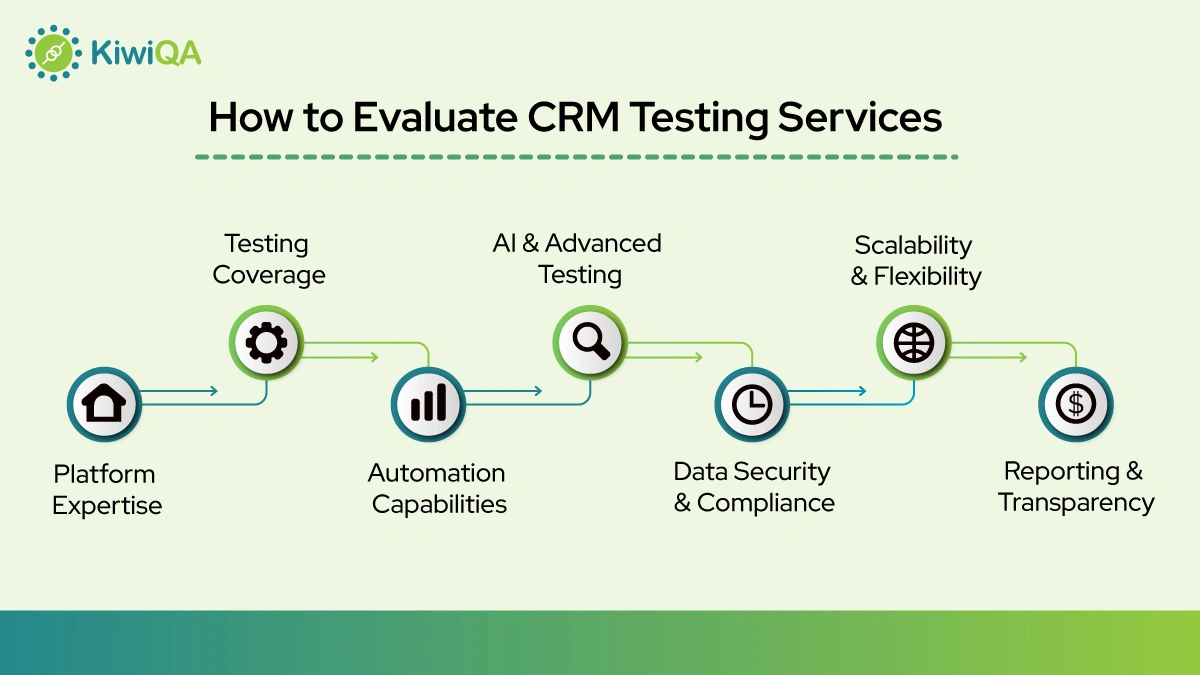

How to Evaluate CRM Testing Services (Expert Checklist for 2026)
⮞ Platform Expertise
A reputable CRM testing company should have extensive experience with top platforms such as Salesforce, HubSpot, and Microsoft Dynamics 365. Each platform has its own architecture, workflows, integrations, and customization capabilities; hands-on expertise is vital. Look for qualified professionals or official partnerships that prove their technological expertise.
Experienced providers can swiftly identify platform-specific hazards, develop customized testing procedures, and ensure a seamless implementation. Their expertise with platform updates and ecosystem changes helps to shorten testing time while increasing accuracy. Choosing an expert with extensive platform experience results in fewer errors. They help with faster issue resolution and more effective long-term maintenance for your CRM infrastructure.
⮞ Testing Coverage
When assessing CRM test automation and CRM testing services, it is vital to ensure comprehensive testing coverage. A competent supplier should provide functional testing to validate workflows, integration testing to ensure smooth communication between systems, security testing to protect sensitive client data, and performance testing to evaluate system behavior under load.
CRM platforms, such as Zoho CRM, frequently have various modules and third-party connectors, making end-to-end validation critical. Limited testing scope might result in important gaps, causing system breakdowns and poor client experiences. A provider with extensive testing capabilities ensures that all components of your CRM are fully evaluated. This complete strategy increases reliability, decreases downtime, and promotes easier day-to-day business operations.
⮞ Automation Capabilities
Automation is critical in modern CRM testing, and that’s why it is crucial to consider the proficiency of a QA professional. They should use advanced technologies such as Selenium, Provar, and Copado to automate repetitive testing processes. Strong automation capabilities save manual work, enhance consistency, and speed up release cycles.
Support for CI/CD integration allows for continuous testing throughout development, resulting in faster issue discovery. This is especially crucial in dynamic CRM settings that require continuous updates and customizations. Providers with sophisticated automation methods can provide faster turnaround times, lower operational costs, and increased testing efficiency, making them an important long-term partner.
⮞ AI & Advanced Testing
In 2026, AI-driven testing will be a major differentiation among CRM testing vendors. Leading services employ artificial intelligence to generate automated test cases, analyze forecast defects, create self-healing scripts, and optimize tests intelligently. These improved capabilities help in the early detection of faults and the efficiency with which tests are conducted.
Platforms like Salesforce are progressively incorporating AI-powered functionality, necessitating enhanced validation. AI-driven insights help to reduce human error, expand coverage, and prioritize high-risk locations. Choosing a vendor with AI capabilities ensures that your CRM testing strategy is future-ready. It also enables firms to respond to rapid technological changes while preserving system stability and providing consistent client experiences.
⮞ Data Security & Compliance
When choosing CRM testing services, data security should be the first priority. CRM systems frequently contain highly sensitive customer information, and many organizations must comply with standards like GDPR and HIPAA. A reputable CRM testing experts team should follow strict security practices, including encryption validation, secure test environments, data masking, and role-based access control.
They must also comprehend industry-specific compliance standards. Proper consumer data management decreases the likelihood of breaches, legal penalties, and reputational harm. Choosing a vendor with significant compliance knowledge protects your company while fostering confidence with customers and stakeholders.
⮞ Scalability & Flexibility
As a company grows, its CRM system becomes more complicated, with more users, more databases, and integrations. A strong CRM testing supplier should give scalable solutions that broaden your firm’s demands. They should also offer flexible engagement models, including project-based testing, dedicated teams, and on-demand support.
Platforms such as Microsoft Dynamics 365 frequently require adaptive techniques to accommodate ongoing expansion. Scalability guarantees that testing efforts are effective even as workloads increase. Businesses can modify resources based on project requirements, budgets, and timeframes. This versatility assures long-term value and minimizes interruptions as CRM systems evolve.
⮞ Reporting & Transparency
As a business expands, its CRM system becomes more complex, with additional users, databases, and integrations. A reliable CRM testing provider delivers solutions that can evolve with the growth of your firm. They should also provide flexible engagement models, including project-based testing, dedicated teams, and on-demand support.
Platforms like Microsoft Dynamics 365 usually require adaptive solutions to allow continuous growth. Scalability ensures that testing efforts remain successful as workloads increase. Businesses might change resources based on project needs, budgets, and timelines. This mobility ensures long-term value and reduces interruptions as CRM systems improve.
⮞ Client Success & Case Studies
The most flexible method to determine a provider’s reliability is to examine their previous performance. Look for CRM testing organizations that have demonstrated success in industries comparable to yours. Case studies illustrate their capacity to tackle real-world problems, whereas client comments reflect service excellence and professionalism.
Experience with technologies such as Salesforce or Zoho CRM provides great credibility. Pay attention to measurable outcomes like fewer faults, faster deployments, better performance, and more compliance. A provider with a successful history allows consistent results. Reviewing client success stories provides useful information about their skills and long-term business impact.
How to Choose the Right CRM Testing Service
⇒ Define your business needs
Before choosing a CRM testing service, it’s necessary to identify your business demands, goals, and expected outcomes. Evaluate whether you require automation, performance, and functional testing or security validation. Consider the CRM challenges, user base, and integrations. For platforms such as HubSpot and Salesforce, the demands might vary based on customization levels. The well-defined scope assists in selecting a provider that aligns with your goals, verifies an efficient testing process, and improves ROI.
⇒ Evaluate provider expertise in your CRM platform
To pick the accurate service, select a provider first. So, look for a QA team that has proven expertise in CRM platforms. They must have prior experience and knowledge in effective testing strategies. Various systems, such as Zoho CRM and Microsoft Dynamics, have unique architectures and customization abilities.
The skilled provider knows platform-specific challenges, tools & best practices. When you hire experts, they have the potential to design accurate testing strategies, minimize risks, and verify smooth implementation. Lack of skills may cause inefficiencies, gaps that hamper user experience and performance.
⇒ Consider: Budget, Scalability, Automation capabilities
When selecting the CRM testing service, take care of your budget and values. Measure whether the QA team is able to scale services as your firm grows and CRM complications increase. The automation capabilities are also essential. Choose experts who have access to modern tools such as Selenium that can limit time and enhance efficiency. Make sure the provider delivers flexible pricing, advanced automation tools, and scalable solutions. It helps to manage long-term cost efficiency while managing frequent updates in CRM systems.
⇒ Check client reviews and case studies
Client reviews and case studies also offer valuable insights about the specific CRM testing service. It assesses the provider’s ability and performance to deal with the challenges. You must always take service from the experts who have a successful track record with CRM platforms such as Salesforce.
Reviewing case studies evaluates the real-world problem-solving capability. It highlights the quality they served. This practice helps to understand the provider’s experience, strength, and ability to deliver results. Choosing the best provider helps to minimize the risks involved and guarantee a scalable testing partnership.
Also Read: Best SAP QA Testing Companies in the USA for S/4HANA Migration Projects
Tools Commonly Used in CRM Testing
⮞ Selenium
This is the most used open-source tool for testing web-based CRM apps. These tools support vast programming languages and are scalable for QA. Selenium allows automated functional & regression testing, and verifies that CRM workflows perform as expected. It integrates well with the CI/CD pipelines and supports the team to opt for faster release. However, it demands brief coding expertise, accurate framework setup, and implementation efforts.
⮞ TestComplete
This is another popular automated UI CRM testing tool designed for web, desktop, and mobile apps, including CRM systems. It enables scriptless and script-based testing, making it suitable for both beginners and advanced QA. With support for various scripting languages, it streamlines test creation & maintenance. TestComplete offers robust reporting features, allowing the team to smartly track defects. The scalability and accessibility rank this tool as ideal for complicated CRM environments.
⮞ Katalon Studio
This is an all-in-one automation testing platform that supports API, desktop, web, and mobile testing. It is beneficial for CRM testing because of its simple interface and customization. Katalon delivers built-in keywords, reusable test cases, and integration with tools. The tool limits the requirement for extensive coding while enabling customization for advanced users. The balance makes it a popular choice for teams aiming to drive CRM testing efficiently.
⮞ JMeter
Apache JMeter is a free tool used for load & performance testing of CRM apps. It supports the QA team to determine how CRM systems behave under excessive user loads and large data volumes. JMeter supports testing of web services, databases, APIS, making the tool perfect for comprehensive performance QA. By simulating various users, it tracks errors, response time errors, and system errors, ensuring the CRM manages real-world operations effectively.
⮞ Postman
This is one of the popular CRM automation testing tools for API testing, necessary for the CRM system, which depends on various integrations. It enables the QA team to design, send, and validate API requests seamlessly. Postman supports environment variables, automation, and collaboration features, making it effective for teams. It allows seamless data exchange between CRM systems and external systems. It limits the risk of integration failure & enhance system reliability.
⮞ Salesforce Testing Tools (Provar, Copado)
This CRM testing tool, such as Copado, is designed for testing Salesforce environments. These tools offer native support for Salesforce features, allowing reliable and faster test automation. It allows management of test data, supports CI/CD integration, and ensures easy release. By focusing on Salesforce-specific demands, they limit testing complexity and enhance accuracy in customized CRM implementations.
Challenges in CRM Testing
⇒ Complex integrations
The advanced CRM platforms, such as Microsoft and Salesforce, mostly depend on 3rd party integration tools. These tools could be payment gateways, marketing automation systems, and analytical platforms. Testing these integrations is challenging since each system may have various formats, APIs, and release cycles. A small glitch in a system could disrupt the full operation. The QA team must validate the data flow, synchronization, and error handling across systems. It ensures seamless communication and avoids inconsistent data.
⇒ Frequent updates and customizations
CRM systems are frequently evolving with advanced features and integrations designed for individual firms. Platforms such as HubSpot often release updates that can unintentionally hamper current functionalities. Heavy customization makes it tough to manage stable test environments. Every update demands extensive regression testing. It becomes time-consuming to manage testing custom workflows, version control, and user-specific configuration. It also hampers the scalable CRM system maintenance.
⇒ Data privacy compliance
With rising worldwide regulations around data safety, ensuring compliance has become a challenge in CRM testing. Systems such as Zoho CRM keep crucial user information, including personal & financial data. The QA team must validate the encryption, RBA, and secure data storage practices. Compliance demands such as GDPR and other laws demand a strict validation process. Any gap leads to legal penalties and reputational damage, making security and compliance testing an ongoing responsibility.
⇒ Handling large datasets
The CRM systems maintain an array of users’ data, which involves communication, behavioral, and transactional data. Performance testing under huge datasets is tough, since it can hamper the speed and responsiveness of the system. The platforms, such as SAP customer experience, must be tested for scalability to verify they perform efficiently under heavy load. QA team must simulate real-world data conditions, validate database performance, and report. Poor management of datasets causes slow systems, breakdowns, and unreliable business insights.
Ready to Optimize Your CRM? Let’s Get It Right
An optimized CRM can rank your business as a leader in the competitive landscape. By verifying the quality of the CRM system, you can simply increase the lead volume and support the marketing team to find new users faster. Whether it’s about business management, predictive analysis, or measuring potential users, CRM is the ideal solution. It helps to get customer feedback faster, measure sales, perform integration, and target markets. To navigate all these practices safely, CRM testing is required.
CRM app testing is necessary to measure its performance. It helps customers to store their data in one place. It assures the data will flow properly, and organizations can benefit from user retention and communication. CRM testing detects more than a bug; it ensures a flawless user relationship.
Firms can obtain improved ROI and user engagement while limiting the cost disruptions. By hiring the experts, businesses can design an organized strategy. The CRM testing companies combine functional expertise with advanced testing tools to verify the CRM performance. So, no need to wait for your CRM failure, optimize it today by hiring experts and evolve growth.