

The IT world has been upgrading over time. With the introduction of cloud tech, the chances of software program distribution have seen a shift to the SaaS format. Every day, a SaaS app is released in the market, but does it really match users’ expectations? Here, the necessity of SaaS Testing Services comes into play. In the quick competitive market, app deployment without testing is risky. In this rapid virtual age, SaaS has become an integral part of business worldwide. The market size is estimated to be over $462 billion by 2028.
SaaS platforms update faster and bring new challenges. A single bug in software can impact thousands of users, cause outages, lost revenues, and reputational damage. QA team verifies performance, scalability, security & trust, which are frequently evolving. SaaS teams always struggle between security, compatibility, performance & usability.
To navigate these challenges, a comprehensive practice is necessary for SaaS QA. The software industry is witnessing a strong shift. The SaaS market is expected to reach $908.21 billion by 2030. SaaS apps deliver firms a range of benefits from scalability to efficient and seamless navigation. Validating the SaaS app delivers an impressive customer experience.
Are you in doubt about the values of cloud testing? Take a few seconds to understand the primary benefits. One of the major benefits of designing a SaaS testing strategy is user satisfaction. Organized SaaS testing to help you track and navigate mistakes before they turn into costly errors. It supports user satisfaction & retention rates, and meets their needs.
Security breaches can cause significant economic & reputational damage. SaaS QA rigorously uncovers and fixes errors, safeguarding your platform. Addressing errors early in the development cycle is cost-effective compared to finding and resolving them in the later stages. Consistent QA ensures that errors are caught early. SaaS testing validates the brand reputation and enhances trustworthiness.
This guide breaks down the steps to support you through the necessary steps required in SaaS testing. By following these SaaS Testing Services steps, businesses can guarantee that the SaaS app functions flawlessly and offers exceptional value to users. Following these practices helps to build trust and long-term success in the market.
Understand the SaaS Application Requirements
✦ Define Business Goals
Before you start the SaaS QA process with a SaaS testing company, the firm must smoothly define its vision, target audience, and expected outcomes. Knowing who will use the app supports the QA team in designing realistic test scenarios that reflect actual user behavior.
Different users may interact with the platform in unique ways, so identifying user expectations is necessary for delivering a seamless user experience. Forms must estimate the core operations of the app, like onboarding, data sharing, reporting, and payment processing. It verifies that QA covers all crucial features that directly hamper user satisfaction and operational efficiency.
SaaS application testing aims must always align with overall business outcomes. If a business aims to enhance user retention, QA must focus on usability, reliability, and performance. If scalability is the priority, load & stress QA become crucial for the QA strategy. Businesses define their vision to the QA team to support prioritizing the testing efforts, minimizing the testing cycle, and enhancing release timelines. Organizations can design effective and focused strategies by understanding both technical & organizational demands. With them, business can support long-term product growth, user trust, and continuous testing.
✦ Review Functional and Compliance Requirements
This compliance demand is a crucial step in SaaS app testing because it verifies that the platform operates securely and accurately. Functional QA must validate key features like authorization, authentication, and subscription management. It also verifies user roles, notifications, and integration, as well as data synchronization.
Authentication & authorization QA support for confirming that users can securely access the system while avoiding unauthorized access to safeguard crucial data. Subscription & billing QA is necessary for a SaaS platform because errors in recurring payments and invoices can directly hamper revenue and user trust.
Compliance QA is necessary for industries that manage crucial user data. Organizations must verify their SaaS apps comply with the standards, such as GDPR and HIPAA. GDPR QA focuses on user consent, data privacy, and safe data management. HIPAA practice testing is crucial for healthcare-related SaaS platforms to safeguard data and manage confidentiality.
Similarly, other testing is performed to evaluate how secure the user information is and how it is managed through security controls and monitoring. Thorough review of functional & compliance data supports firms to minimize security risks, avoid legal penalties, and manage user confidence in the app.
Validate APIs and Third-Party Service Integrations
❋ Test API Performance and Reliability
API SaaS testing strategy plays a strong role in verifying that SaaS apps deliver a stable, secure, and responsive user experience. The advanced SaaS platform depends heavily on APIs for communication between services. Validating API performance and reliability is crucial for smooth system operations.
The QA SaaS security testing team must begin by performing response validation to validate that APIs return accurate data. It confirms the accuracy of the status code and expected outputs under various conditions. It assists in identifying inconsistencies, data-related errors, and broken endpoints before they impact users.
Authentication & authorization QA is another crucial area because APIs often manage crucial users and business data. Testers must validate token validation, API keys, OAuth workflows, and session management to verify secure access control. Rate-limitations QA assist support avoids abuse, server overload, and denial of service risks. Error management scenarios must be carefully validated to ensure APIs respond during failures such as invalid requests, timeouts, server crashes, or network interruptions. Proper error messages & feedback responses improve system stability and simplify errors for developers.
Performance QA must measure API response time, scalability, and reliability under heavy traffic conditions. Frequent API tracking & automated QA further support maintaining service quality, limit downtime, and seamless communication between connected SaaS components and external services.
❋ Verify Third-Party Integrations
3rd-party integration is a core part of many SaaS apps because they allow firms to extend functionality & streamline operations. However, these integrations can also introduce performance, compatibility, and security errors if not properly tested. QA SaaS automated testing team must thoroughly validate that all connected services work across various environments, user scenarios, and devices.
Payment gateway testing is necessary for a SaaS platform that manages subscriptions, online transactions, and recurring billing. The QA team must validate payment processing, refund, and failed transactions, along with the transaction security and invoice generation.
CRM & ERP integration must be verified to confirm data synchronization accuracy between systems. Firms rely on these integrations for sales tracking, customer management, and inventory updates, reporting, and workflow automation. Any error in data synchronization can hamper organizational operations and impact decision-making. Email & notification services QA support that users receive alerts, billing reminders, and password reset links. It also validates the onboarding mails and notifications for transactions without errors.
Testing must also include API dependency errors, network disruption, and version compatibility errors, as well as service downtime scenarios. By thoroughly identifying the 3rd-party integrations, firms can enhance app reliability and manage seamless workflows. It limits operational risks and delivers a consistent user experience.
Also Read: End-to-End Testing Strategy for Enterprise Cloud Platforms
Perform Security and Compliance Testing Thoroughly
❋ Identify Vulnerabilities and Security Risks
Since cloud-based services frequently handle sensitive consumer, financial, and corporate data, security testing is an essential component of SaaS quality assurance. Organizations can avoid data breaches, illegal access, and system exploitation by identifying vulnerabilities early. SQL injection testing should be done by QA and security teams to find out if attackers can alter database queries by using unsafe input fields. In order to lower these risks and improve application security, proper input validation, parameterized queries, and safe coding techniques are used.
Because malicious scripts inserted into web pages might compromise user sessions, steal passwords, or alter application behavior, XSS testing is equally crucial. Testers should confirm that all user input is properly encoded across dynamic content regions, URLs, and forms. Protecting authenticated user actions also heavily relies on CSRF and session security checks. Token validation, secure cookie management, session timeout behavior, and defense against unauthorized requests made from outside sources should all be verified by QA teams.
To find hidden vulnerabilities, security testing should incorporate both manual penetration testing and automated vulnerability assessments. As the program develops, patch management and routine monitoring help to obtain a secure environment. Organizations may increase consumer trust, lower operational risks, and manage SaaS infrastructure from emerging cyberattacks by proactively detecting security issues.
❋ Verify Data Protection and Compliance
SaaS applications are guaranteed to securely handle client data while adhering to legal and industry-specific regulatory standards, thanks to data protection and compliance testing. Organizations must confirm that all sensitive data is appropriately protected during storage and transfer because SaaS systems frequently handle private, sensitive commercial, and financial data. In order to prevent unauthorized data exposure, encryption validation helps verify that protocols like SSL/TLS, secure APIs, encrypted databases, and secured file storage mechanisms are operating as intended.
Another crucial element of compliance verification is saas security testing, particularly in backup and recovery testing. QA teams should assess if backups are regularly created, safely stored, and recoverable within reasonable recovery time goals. To guarantee company continuity in the event of system failures, cyberattacks, or unintentional data loss, disaster recovery scenarios should also be tested. A dependable backup plan reduces downtime and shields businesses from interruptions in operations.
Verification of regulatory compliance helps companies in upholding standards and other industry rules. User permission management, access controls, audit logging, data retention guidelines, and privacy protections should all be tested. The alignment of security controls with legal requirements is further ensured by compliance audits and documentation checks. Extensive testing for data protection and compliance lowers legal risks. It boosts operational resilience and increases consumer trust in the SaaS platform.
Conduct Performance and Scalability Testing
✦ Measure Speed and System Responsiveness
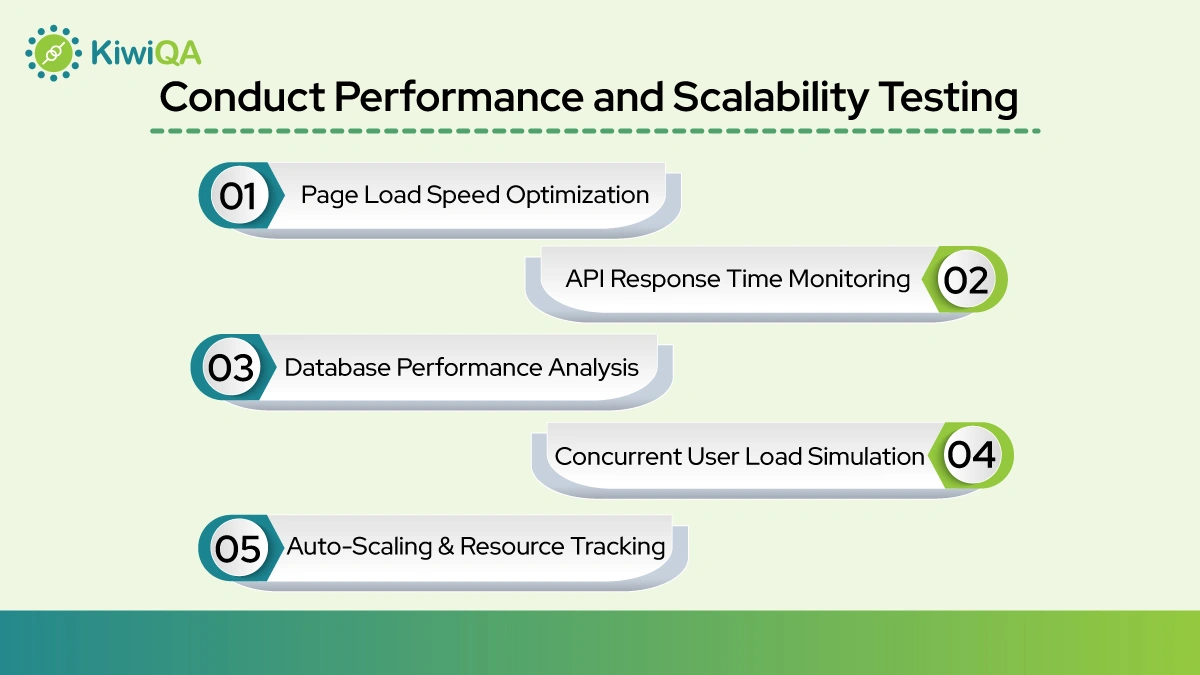
Performance is necessary for validating that the SaaS app delivers faster, smoother, and more reliable user experience across devices and networking choices. The SaaS testing platform is designed to accurately cover frequent tracking of page speed, database performance, and API responsiveness.
It supports monitoring errors prior to the user’s dissatisfaction. Page loading test supports the evaluation of how quickly dashboards, reports, and login components perform against peak traffic. Slow loading page speed limits user engagement, impacts customer satisfaction, and improves bounce rate.
Analyzing API response on time is equally necessary because SaaS platforms rely on APIs for communication between 3rd-party tools & services. The testing team must measure response time, throughput, timeout, and latency to ensure APIs remain responsive against various workloads. Database performance testing plays a strong role in maintaining system efficiency. QA team must validate indexing performance, query execution speed, and transaction management to avoid slowdowns during high-traffic operations.
Performance QA must be performed across vast devices, OS, and cloud environments to verify consistent responsiveness. The monitoring tools support team monitors memory leaks, network errors, and CPU changes that might impact scalability. By frequently measuring speed & responsiveness, firms can enhance app stability, drive user satisfaction, and support long-term growth.
✦ Run Load and Stress Testing Scenarios
Load & stress QA support SaaS firms analyze how their app performs in high traffic conditions and unexpected usage spikes. These QA are necessary for verifying scalability, stability, and reliability before releasing updates. The QA team must simulate concurrent users performing real-world activities. It supports evaluating how well the system manages during a vast workload while managing response time.
Stress QA goes beyond normal usage limits to determine the app’s breaking point and recovery capabilities. It supports the team to understand how the platform behaves throughout sudden traffic, server failures, and infrastructure disruptions. SaaS apps hosted in a cloud environment must also undergo auto-scaling validation. It ensures resources expand and contract efficiently depending on popularity. The auto-scaling supports avoiding downtime, performance errors, and infrastructure costs.
Resource monitoring utilization is also necessary for scalability testing. The team must track memory consumption, CPU usage, bandwidth utilization, and server health during testing scenarios. Evaluation of resource errors prior helps to support infrastructure optimization planning and enhance app resilience. Quality load & stress QA enables firms to deliver consistent performance, support rising user demands, and manage a stable customer experience even in peak periods.
Also Read: Top 12 Salesforce QA & Testing Companies in India (Edition 2026)
Automate Regression Testing Within CI/CD Pipelines
✦ Build Automated Regression Test Suites
The stability and reliability of modern SaaS platforms that regularly issue updates depend on automated regression testing. Existing functionalities may accidentally break as applications change as a result of code modifications, integrations, or infrastructure upgrades. Creating automated regression test suites enables teams to find errors fast and keep product quality constant throughout the development process. Smoke testing automation should be a part of a robust SaaS application testing strategy in order to verify important application features. Smoke tests help in the early detection of significant errors and stop unstable releases from moving further in the pipeline.
Because SaaS platforms frequently include intricate user journeys, end-to-end workflow testing is equally crucial. Automated tests guarantee that these processes continue to operate correctly following upgrades. By automatically executing preset test suites throughout each development cycle, continuous regression validation enhances release confidence even more. This increases overall productivity, speeds up defect identification, and decreases the need for manual testing.
When creating regression suites, teams should give priority to high-risk business scenarios and commonly used features. Faster feedback loops and issue resolution are further supported by integrating automated testing tools with CI/CD infrastructures. Organizations may lower release risks, increase software stability, and serve a personalized, scalable user experience.
✦ Integrate Testing into DevOps Workflows
SaaS companies may provide software updates more quickly while upholding quality standards by including testing in DevOps operations. Continuous integration and delivery techniques are necessary in modern SaaS setups to enable quick development cycles without sacrificing application stability. By including testing activities earlier in the software development lifecycle, shift-left testing techniques are crucial to this process. To find problems before they become costly production issues, developers, testers, and operations teams work together from the start.
Another crucial element of DevOps-driven testing is automated deployment checks. Before deployments reach production settings, these checks verify builds, configurations, APIs, integrations, and infrastructure modifications. Automated verification ensures consistent release quality across environments, increases deployment accuracy, and decreases human mistakes. Faster feedback is also provided by ongoing testing and monitoring across the pipeline, enabling teams to retain development momentum and swiftly fix errors.
One of the main benefits of incorporating testing into DevOps workflows is faster release cycle management. Automated pipelines facilitate more frequent software releases, eliminate manual involvement, and shorten testing schedules. This makes it possible for SaaS companies to react swiftly to security updates, market shifts, and client demands. Organizations can boost software stability, speed up delivery, and improve collaboration. They can build a more agile and effective development ecosystem by integrating testing into DevOps operations.
Monitor SaaS Performance After Deployment Continuously
❋ Implement Real-Time Monitoring Solutions
Maintaining the performance, security, and reliability of SaaS applications in production settings requires ongoing monitoring after deployment. Applications may encounter unforeseen problems even after successful testing and deployment due to traffic surges, infrastructure malfunctions, integration mistakes, or shifting user behavior.
By integrating real-time tracking tools, firms can find and fix these issues before they affect clients. Key performance indicators such as application uptime, server health, response times, API latency, database activity, and error rates should be tracked by monitoring tools throughout the SaaS ecosystem.
Performance bottlenecks, memory leaks, unusual traffic patterns, and problems with infrastructure resources can all be found with the assistance of real-time monitoring. When certain criteria are exceeded, DevOps and support teams may react thanks to automated alerts and notifications instantly. Teams may diagnose problems more quickly and increase operational efficiency by using application performance monitoring solutions, which can offer comprehensive visibility into user transactions, backend services, and cloud resource utilization.
For real-time detection of potential vulnerabilities, suspicious activity, and unauthorized access attempts, security monitoring is equally crucial. Processes for incident management and troubleshooting are further enhanced by log analysis and centralized monitoring dashboards. SaaS companies may lower downtime, increase system dependability, preserve client confidence, and guarantee constant application performance in dynamic cloud settings by putting continuous monitoring solutions into place.
❋ Optimize Based on User Feedback and Analytics
After an application is deployed, SaaS companies can continuously enhance it with the help of performance metrics and user feedback. To know the way users engage with the platform or where they encounter difficulties, technical metrics monitoring is insufficient. Businesses can find usability problems, feature gaps, and performance issues that could impact customer happiness and retention. It is obtained by gathering feedback through surveys, support requests, reviews, and customer interactions.
Tracking user behavior, feature uptake, session duration, navigation patterns, and conversion rates throughout the application is made easier with the use of analytics tools. Teams can use these data to determine which functions are popular and areas that require optimization. Companies can use this data to prioritize upcoming product changes based on actual consumer demands, streamline operations, improve onboarding experiences, and simplify interfaces.
Additionally, slow-loading websites, unsuccessful transactions, API problems, and system failures that affect the user experience can be found with performance analytics. Teams can assess new features and UI modifications prior to full-scale adoption by combining analytics with A/B testing.
Better decision-making, quicker problem-solving, and higher-quality products are all supported by ongoing optimization based on actual usage patterns. SaaS companies may improve user satisfaction and boost client loyalty. It can keep a competitive edge in quickly changing digital markets by utilizing consumer feedback and analytics.

Transform Your Cloud Testing Process with Smarter QA Solutions
A SaaS testing service is necessary to verify that the product is bug-free and free from all usability errors that could negatively impact user experience. Without thorough testing, your product could fail to match the user expectations and damage brand reputation. It can result in limited conversion, lost business opportunities, and revenues. SaaS QA comes with its own set of complexities because of the distinct characteristics of cloud-based systems.
This is why QA demands a specialized practice to validate the performance & product quality. The key to successful SaaS app testing is following the quality approaches that match the product’s unique requirements and navigate the distinct complexities of cloud-driven solutions. By addressing these errors directly, businesses can meet expectations and thrive in the current competitive market. The comprehensive testing approach focuses more on performance, stability, and user experience. It helps resolve potential errors before they hamper users.
Overall, we can say that SaaS is a multifaceted strategy but an investment that embraces significant benefits. By following the comprehensive checklist mentioned above, businesses can validate that the SaaS app delivers exceptional value to users. It fosters loyalty, trust, and long-term success. However, avoiding these complications of SaaS testing might be tough; that’s when you can collaborate with the SaaS testing company.
When you hire the experts, they will smooth the QA process and allow you to prioritize what matters most. They support serving an impressive SaaS experience to customers.
Robust SaaS QA team implements best tools and focuses on automation and compliance. They help businesses obtain faster, secure, and scalable integration solutions. Get ready to streamline your QA workflow by following the SaaS testing checklist described above.