
Summarize this blog post with:


- Top 10 Agentic AI Testing Companies in India for 2026
- What Is Agentic AI Testing?
- Why Agentic AI Testing Matters for Businesses in 2026
- ❊ Reduces unexpected AI behavior
- ❊ Improves trust and reliability
- ❊ Protects sensitive business data
- ❊ Supports scalable AI deployment
- Top 10 Agentic AI Testing Companies in India for 2026
- 1. KiwiQA
- 2. TestingXperts
- 3. BugRaptors
- 4. Neuramonks
- 5. STAR Systems
- 6. Qualitrix
- 7. Enhops
- 8. Testvox
- 9. Vervali Systems
- 10. SunTec India
- What Services Should You Expect from an Agentic AI Testing Company?
- ❈ AI Model and LLM Testing
- ❈ Autonomous Agent Testing
- ❈ AI Security Testing
- ❈ API and Tool Integration Testing
- ❈ Performance and Scalability Testing
- How We Selected the Top Agentic AI Testing Companies in India
- ❊ Agentic AI testing expertise
- ❊ AI/ML testing capabilities
- ❊ Security testing
- ❊ API and integration testing
- ❊ Industry experience
- ❊ Client portfolio
- ❊ Scalability
- ❊ Pricing/value proposition
- Emerging Trends in Agentic AI Testing for 2026
- ❈ Autonomous testing agents
- ❈ Continuous AI testing
- ❈ LLM-as-a-judge evaluation
- ❈ AI-driven test generation
- ❈ Synthetic test data
- ❈ AI security and red teaming
- ❈ Multi-agent system testing
- Ready to Choose an Agentic AI Testing Partner?
Top 10 Agentic AI Testing Companies in India for 2026
Agentic AI is gaining popularity in 2026 as firms adopt autonomous systems capable of planning tasks, making decisions, and completing multi-step workflows. Reports by McKinsey said that 62% of firms are already experimenting with AI agents. As traditional software testing alone can’t fully evaluate dynamic AI behavior, firms are increasingly relying on Agentic AI testing services. It is more dynamic because of its responses and actions.
Traditional testing remains necessary, but it needs to be powered with AI-specific evaluation methods designed for autonomous systems. Testing is necessary for ensuring reliability, accuracy, safeguarding sensitive data, validating API interactions, and managing performance. The blog highlights the 10 Agentic AI testing companies in India, chosen based on their security, expertise, experience, industry experience, and client portfolio.
What Is Agentic AI Testing?
Agentic AI testing determines whether autonomous AI agents can complete tasks reliably within defined boundaries. Unlike traditional software testing, it determines dynamic decision-making and unpredictable AI behavior rather than just predefined input and output. Traditional testing focuses on whether predefined inputs produce expected outputs, whereas Agentic testing determines dynamic behavior, planning, tool selection, and security. Agentic AI in testing covers planning, reasoning, tool usage, security, accuracy, error handling, and end-to-end task execution.
Why Agentic AI Testing Matters for Businesses in 2026
❊ Reduces unexpected AI behavior
With little help from humans, agentic systems are able to use agentic AI testing tools, make decisions, and carry out tasks. Before deployment, testing helps in identifying unexpected actions and workflow failures. Companies can monitor behavior and verify autonomous workflows by using agentic AI testing tools.
❊ Improves trust and reliability
Businesses can determine whether AI agents consistently follow instructions, complete tasks correctly, and react appropriately to changing conditions by conducting thorough testing. Employee and customer confidence in AI-driven applications is increased when decisions, outputs, and end-to-end workflows are validated.
❊ Protects sensitive business data
AI agents may communicate with private databases, apps, client data, and internal systems. By identifying threats like unauthorized access, prompt injection, data leakage, and excessive permissions, security-focused testing can help companies strengthen controls over sensitive data.
❊ Supports scalable AI deployment
AI testing services guarantee that agents can manage growing workloads, users, integrations, and complex workflows as companies increase the use of AI. Organizations can find issues early and deploy AI systems more confidently in larger business environments through testing.
Also Read: Everything You Need to Know About AI Regression Testing
Top 10 Agentic AI Testing Companies in India for 2026
1. KiwiQA
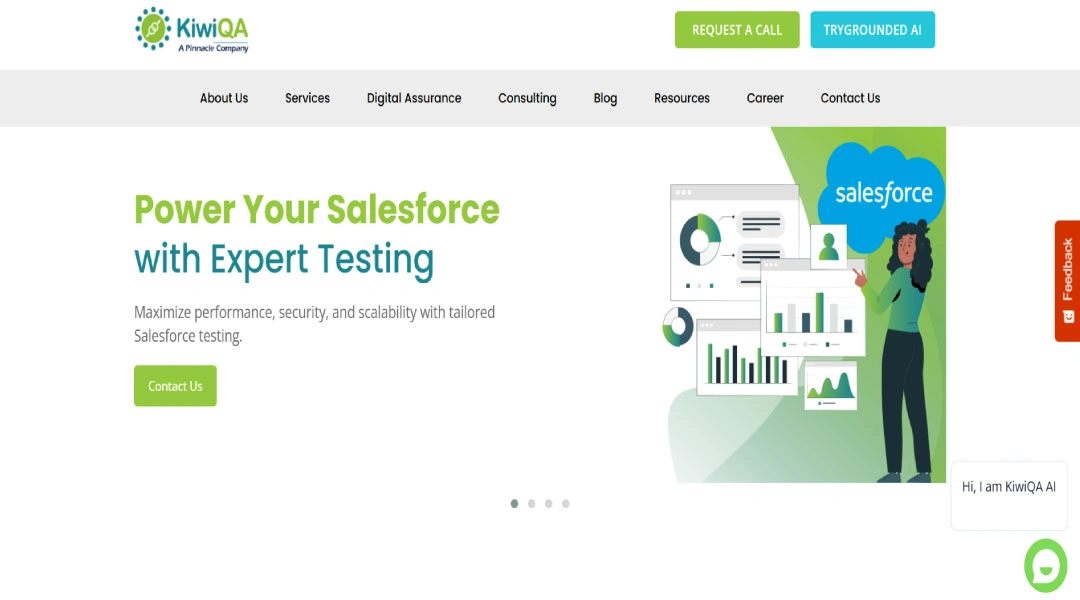
To evaluate how autonomous AI systems function in real-world business settings, KiwiQA provides specialized Agentic AI Testing Services. Key agentic capabilities like autonomy, goal-oriented behavior, learning, multi-agent interactions, system conversations, environment interaction, and workflow optimization are all included in their testing methodology. Additionally, this trusted agentic AI testing company integrates agentic testing with its wider expertise in AI testing and software quality assurance.
Test planning, environment setup, functional-area identification, execution, performance monitoring, and reporting are all part of its methodology. Additionally, KiwiQA tests complex AI workflows and autonomous decision-making using automation frameworks and AI simulators.
KiwiQA also strengthens its AI testing capabilities through TryGrounded AI, Enginuity, and QMFactory. TryGrounded AI supports AI-response and hallucination validation, Enginuity enables AI-powered no-code test automation, while QMFactory provides centralized test management, reporting, and test asset management.
| Key Points | Services Provided |
|---|---|
| Founded Year: 2009 | AI Testing Services |
| Number of Employees: 51-200 | SEO Testing |
| Location: India | Big Data & Analytics Testing |
| LinkedIn: View Profile | CRM Testing |
| Website: KiwiQA | Salesforce Testing |
2. TestingXperts
To test AI agents and autonomous systems, TestingXperts has set up a specialized Agentic AI Testing practice. Its methodology automates testing tasks and improves testing efficiency at scale by integrating AI agents into quality engineering. The business also deals with issues like agentic governance, compliance, privacy, security, and ongoing monitoring, all of which are crucial when AI systems are able to reason and carry out tasks with minimal assistance from humans.
LLM validation, data quality, bias detection, adversarial testing, and AI performance issues are all included in their more comprehensive AI testing services. TestingXperts provides a more comprehensive quality engineering framework around agentic AI adoption for businesses transitioning from traditional automation to autonomous testing and AI-driven workflows.
| Key Points | Services Provided |
|---|---|
| Founded Year: 2013 | Agentic AI Services |
| Number of Employees: 1,001-5,000 | AI-Enabled Testing |
| Location: India | AI Assurance |
| LinkedIn: View Profile | AI Integration Testing |
3. BugRaptors
To validate machine-learning models and AI-powered applications, BugRaptors offers AI and ML testing services. They offer data validation, model evaluation, functional testing, performance evaluation, and security-focused testing. The focus of the company’s agentic
AI testing solutions is to find problems that may affect the accuracy and user experience of AI-enabled applications.
These features can offer a vital foundation for verifying the underlying models, application behavior, and data quality for businesses creating AI agents. Additionally, BugRaptors integrates its wider software testing experience into AI projects, allowing businesses to integrate AI/ML validation with well-established functional and automation testing procedures.
| Key Points | Services Provided |
|---|---|
| Founded Year: 2010 | AI testing |
| Number of Employees: 501-1,000 | Automation Testing |
| Location: India | Web Testing |
| LinkedIn: View Profile | CRM Testing |
4. Neuramonks
NeuraMonks is an AI-focused technology company that provides services related to model evaluation, AI implementation, proof-of-concept development, and AI consulting. Evaluating AI models for prediction accuracy, bias, model drift, security, and compliance is one of its AI consulting services. During AI proof-of-concept engagements, the company also uses performance evaluation and structured testing to determine whether an AI solution can satisfy specified technical and business requirements.
Through the selection of AI system architecture and frameworks, its expertise in AI extends to agentic workflows. NeuraMonks can assist early-stage validation, model evaluation, performance benchmarking, and controlled testing prior to production deployment for businesses investigating agentic AI. Instead of providing a specific agentic testing service, it offers more general AI engineering and validation.
| Key Points | Services Provided |
|---|---|
| Founded Year: 2019 | Agentic AI Services |
| Number of Employees: 11-50 | Generative AI Development |
| Location: India | AI Consulting |
| LinkedIn: View Profile | Machine Learning |
5. STAR Systems
AI-powered automation testing services from STAR Systems are designed to improve the flexibility and effectiveness of software testing. Its methodology combines traditional automation with intelligent test insights, such as AI-driven testing meant to optimize test coverage, support self-healing scripts, and predict failures. By integrating testing into CI/CD environments and utilizing well-established automation technologies, the company allows teams to receive feedback during development more quickly.
Organizations updating their QA procedures and implementing intelligent automation for routine testing tasks will find its AI-driven capabilities especially useful. Additionally, STAR Systems can manage general automation needs and web application testing. STAR Systems helps teams find quality problems early in the delivery lifecycle by integrating testing into development and CI/CD processes.
| Key Points | Services Provided |
|---|---|
| Founded Year: 2011 | Agentic AI Development |
| Number of Employees: 51-200 | AI Testing Services |
| Location: India | AI Native |
| LinkedIn: View Profile | Web Development |
6. Qualitrix
Qualitrix places a high priority on responsible AI assurance, GenAI testing, and AI/ML testing. They offer services such as Model accuracy, performance, scalability, security, bias detection, model drift, and regulatory considerations. In order to help businesses incorporate intelligent testing into more comprehensive quality engineering programs, the company also provides automated AI test frameworks and AI-driven codeless automation.
It conducts AI/ML testing in a variety of sectors, including retail, healthcare, financial services, and autonomous systems. Businesses that need to verify AI systems’ reliability, security, and responsible-use requirements in addition to their basic functionality will find Qualitrix especially useful.
| Key Points | Services Provided |
|---|---|
| Founded Year: 2016 | AI in Testing |
| Number of Employees: 201-500 | AI/ML Testing |
| Location: India | User Testing |
| LinkedIn: View Profile | Security Testing |
7. Enhops
Enhops provides AI-driven testing services with the goals of increasing test coverage, decreasing manual labor, and speeding up software releases. AI-generated test cases, self-healing automation, and agentic QA frameworks are specifically mentioned in its current AI testing offering. The organization supports AI-based test generation, requirement-driven testing, analysis, and reporting, as well as ongoing test accuracy improvement using past data and user input.
Additionally, Enhops integrates with a variety of testing frameworks and tools, allowing AI-driven capabilities to enhance current enterprise QA environments. Organizations with large test suites, maintenance issues, distributed testing expertise, and limited QA capacity can benefit from its methodology. The business presents AI-driven testing as an effective way to transition from traditional automation to more intelligent and autonomous quality engineering.
| Key Points | Services Provided |
|---|---|
| Founded Year: 2015 | AI-Driven Testing |
| Number of Employees: 501-1,000 | Gen AI Testing |
| Location: India | Test Automation |
| LinkedIn: View Profile | ERP Testing |
8. Testvox
Testvox combines functional, automation, performance, and AI-powered testing to offer software testing services for startups and SMEs. Its AI-powered testing capability relies on AI-driven insights to support more intelligent automation, improve test accuracy, and identify risks. In order to evaluate test results instead of depending only on automated outputs, the company also integrates automated testing with human review.
Testvox supports customers in several nations and has experience with web, mobile, IoT, and other digital products. Additionally, Testvox has shown practical expertise in testing AI-native applications. The company has excellence in verifying AI agents, agent workflows, model configurations, permissions, and approval processes. Testvox can help companies assess modern AI-driven applications and autonomous workflows by combining automation, AI-assisted testing, and human QA expertise.
| Key Points | Services Provided |
|---|---|
| Founded Year: 2017 | AI Powered Testing |
| Number of Employees: 11-50 | Security Testing |
| Location: India | Automation Testing |
| LinkedIn: View Profile | Game Testing |
9. Vervali Systems
Vervali Systems helps companies increase software reliability and release speed by combining quality engineering with AI-powered automation. AI-based test-case generation, self-healing automation, flaky-test detection, visual validation, and predictive defect identification are some of its AI-powered test automation services. The company incorporates AI-driven QA into CI/CD pipelines and supports testing in web, mobile, and API environments.
Functional, automation, performance, security, and compliance testing are all included in their service portfolio. Additionally, Vervali works in a variety of sectors, including travel, SaaS, retail, healthcare, and BFSI. Its use of intelligent automation and self-healing capabilities makes it relevant for organizations moving towards more autonomous testing models.
| Key Points | Services Provided |
|---|---|
| Founded Year: 2010 | AI & Machine Learning Testing |
| Number of Employees: 51-200 | API Testing |
| Location: India | Accessibility Testing |
| LinkedIn: View Profile | Application Testing |
10. SunTec India
SunTec India offers services for testing and validating AI models in computer vision, NLP, AI systems, and AI agents. In order to assess model behavior, reliability, security, and commercial readiness, its testing methodology integrates automated validation with human monitoring. Additionally, SunTec India facilitates continuous validation via continuous model quality monitoring and CI/CD.
Its AI capabilities include human-in-the-loop workflows, multi-agent orchestration, tool use, autonomous task planning, and agentic AI development. With this combination, the company can test AI agents and the models and infrastructure that support them in a way that is relevant to organizations.
| Key Points | Services Provided |
|---|---|
| Founded Year: 1999 | AI Agent Development |
| Number of Employees: 1,001-5,000 | Generative AI Application Development |
| Location: India | API & Integration Testing |
| LinkedIn: View Profile | AI Model Testing |
What Services Should You Expect from an Agentic AI Testing Company?
❈ AI Model and LLM Testing
An AI system’s ability to generate precise, relevant, consistent, and reliable results across various inputs and scenarios is assessed through AI model and LLM testing. Response quality, hallucinations, prompt adherence, context handling, bias, and model behavior under edge cases are all evaluated by testing teams.
Platforms such as TryGrounded AI by KiwiQA can add a dedicated validation layer for detecting hallucinations, grounding issues, inconsistencies, and reliability problems in LLM and AI-agent responses.
Testing can also address the quality of generated responses and retrieval accuracy for RAG-based applications. When models, prompts, datasets, or configurations change, regression testing becomes crucial. A reputable testing partner should create measurable quality criteria that assist teams in determining LLM quality. It is possible to combine automated evaluations with human review when appropriate.
❈ Autonomous Agent Testing
The goal of an agentic AI testing company is to evaluate the potential of an AI agent to plan, make decisions, integrate tools, and complete tasks without human involvement. Complete workflows, such as task planning, decision-making, error recovery, and multi-step execution, should be tested rather than individual responses.
Additionally, testers can assess whether agents adhere to business rules. Testing should look at coordination and communication between individual agents in multi-agent environments. This makes it easier to identify situations in which an agent takes an incorrect action.
❈ AI Security Testing
AI security testing finds flaws that could lead an autonomous agent or AI model to generate inaccurate results or reveal private data. Security evaluations should also look at memory, identity, authorization boundaries, tool permissions, and data-access controls for agentic applications.
The service can be used to test the system’s resistance to manipulation by simulating malicious prompts and attack scenarios. These evaluations are crucial since an autonomous agent might have access to sensitive data, business systems, tools, or APIs.
❈ API and Tool Integration Testing
Testing for API and tool integration determines whether an AI agent can reliably and safely communicate with the external systems on which it depends. Testing API requests, authentication, authorization, input and output formats, error handling, rate limits, timeouts, and integration failures are all included in this.
Testers should go one step further for agentic systems by confirming that the agent chooses the right tool. They must provide the right parameters, manage inaccurate responses, and avoid unauthorized tools. This keeps autonomous actions predictable, under control, and aligns with business needs.
❈ Performance and Scalability Testing
Testing for performance and scalability establishes whether AI agents can sustain reliable performance as workloads, users, conversations, and concurrent tasks grow. Response latency, throughput, time-to-first-response, resource consumption, token usage, and total task-completion time can all be measured through testing.
Teams should also look at how autonomous agents perform in longer workflows, high-volume requests, concurrent executions, and repeated tool calls. Problems in models, databases, APIs, retrieval systems, or orchestration layers may be found through load and stress testing. Making an agent react fast is not the only objective; it is also important to maintain stable performance and control costs.
How We Selected the Top Agentic AI Testing Companies in India
❊ Agentic AI testing expertise
We ranked agentic AI testing companies with real-world experience testing autonomous AI agents in areas such as decision-making, task execution, multi-agent interactions, and end-to-end agentic workflows. We also took into account how well they manage the particular testing quality issues associated with agentic AI in testing.
❊ AI/ML testing capabilities
The ability of businesses to test AI and machine-learning models for precision, reliability, bias, data quality, model behavior, and overall output consistency across various use cases was evaluated.
❊ Security testing
We took into account expertise in recognizing security risks, such as prompt injection, data leakage, unauthorized actions, model manipulation, and vulnerabilities resulting from agents interacting with external systems.
❊ API and integration testing
We evaluated businesses based on their capacity to test databases, third-party tools, APIs, and other systems interacting with AI agents. Validating authentication, data exchange, error handling, and end-to-end workflows all depend on reliable integration testing.
❊ Industry experience
Experience in a variety of sectors, including banking, healthcare, retail, e-commerce, SaaS, and financial services, was taken into account. Businesses in a variety of industries show that they can modify AI testing techniques to meet changing business needs and regulatory requirements.
❊ Client portfolio
We took into account the experience of agentic AI testing companies working with startups, mid-sized companies, and large enterprises, as well as the scope and quality of their clients. Experience managing various technologies, testing environments, and project complexity can be indicated by a diverse portfolio.
❊ Scalability
As the number of users, data volume, integrations, and workflow complexity of AI applications increases, we evaluate whether businesses can support testing. Important factors included automation frameworks, scalable testing procedures, and continuous testing capabilities.
❊ Pricing/value proposition
We took into account the total value provided by testing expertise, automation capabilities, technology coverage, flexibility, support, and potential long-term benefits for companies investing in AI testing consulting and quality assurance rather than partners asking for the lowest price.
Also Read: Best AI Agent Testing Tools for Secure and Scalable Deployment
Emerging Trends in Agentic AI Testing for 2026
❈ Autonomous testing agents
With minimal assistance from humans, autonomous testing agents are able to assess requirements, create test scenarios, carry out tests, find flaws, and suggest improvements. In 2026, they are assisting QA teams in increasing test coverage across intricate agentic workflows while decreasing repetitive work.
❈ Continuous AI testing
Throughout the development and deployment lifecycle, models and agent behavior are assessed through continuous AI testing. When applications, datasets, or integrations are updated, teams can quickly detect unexpected behavior by continuously monitoring responses, prompts, performance, workflows, and model changes. In this process, Enginuity can support scalable AI-driven test automation, while QMFactory can help teams centrally manage test assets, execution, reporting, and overall quality visibility across continuous testing activities.
❈ LLM-as-a-judge evaluation
LLM-as-a-judge compares the results of one AI model to predetermined standards. It is helpful for more effectively evaluating large volumes of AI-generated responses because it can evaluate relevance, accuracy, and consistency.
❈ AI-driven test generation
Test cases are automatically generated by AI-driven test generation using requirements, code, user stories, or application behavior. It can produce scenarios for prompts, choices, workflows, and edge cases for agentic applications. It assists teams in increasing coverage while lowering the amount of manual test-design work.
❈ Synthetic test data
Teams can create realistic datasets without disclosing private client information by using synthetic test data. In order to support privacy requirements, increase test coverage, and assess AI models and agents under various conditions, testers can generate a variety of incomplete scenarios.
❈ AI security and red teaming
Red teaming and AI security testing mimic attacks such as prompt injection, data leaks, and illegal access. These evaluations assist companies in identifying errors in AI agents and improving security measures before vulnerabilities can impact operational systems.
❈ Multi-agent system testing
Multi-agent system testing assesses the coordination, communication, and failure recovery of several AI agents. Testing helps organizations find communication gaps, unexpected decisions, and workflow failures.
Ready to Choose an Agentic AI Testing Partner?
When selecting among Agentic AI testing companies, prioritize reliability, security, scalability, and proven expertise. Review the provider’s QA methodologies, industry experience, automation capabilities, AI testing frameworks, and ability to handle complex agentic workflows. The right testing partner should not only meet your current requirements but also adapt as your AI systems become more autonomous and sophisticated.
A reliable partner should support continuous testing, frequent monitoring, security validation, performance testing, and compliance checks throughout the AI lifecycle. Look for companies that can identify unexpected agent behavior, validate decision-making, test integrations, and ensure consistent performance across real-world scenarios. Choosing the right partner can help reduce risks, improve AI reliability, accelerate deployment, and build greater trust in your agentic AI solutions.