
Summarize this blog post with:


Quick Summary
AI agents can help businesses automate tasks, improve customer interactions, and streamline operations, but deploying them without proper performance testing can create significant business risks. Slow response times, system failures during peak workloads, high infrastructure costs, reduced productivity, scalability challenges, loss of customer trust, and potential revenue losses can all affect business performance. Performance testing helps businesses evaluate AI agents under realistic workloads, test end to end workflows and integrations, identify bottlenecks, and measure important metrics such as response time, throughput, task completion, error rates, resource utilisation, and cost per task.
- 7 Business Risks of Deploying AI Agents Without Performance Testing
- What Is AI Agent Performance Testing?
- Common AI Agent Performance Issues Businesses Often Overlook
- Why Is Performance Testing Important Before Deploying AI Agents?
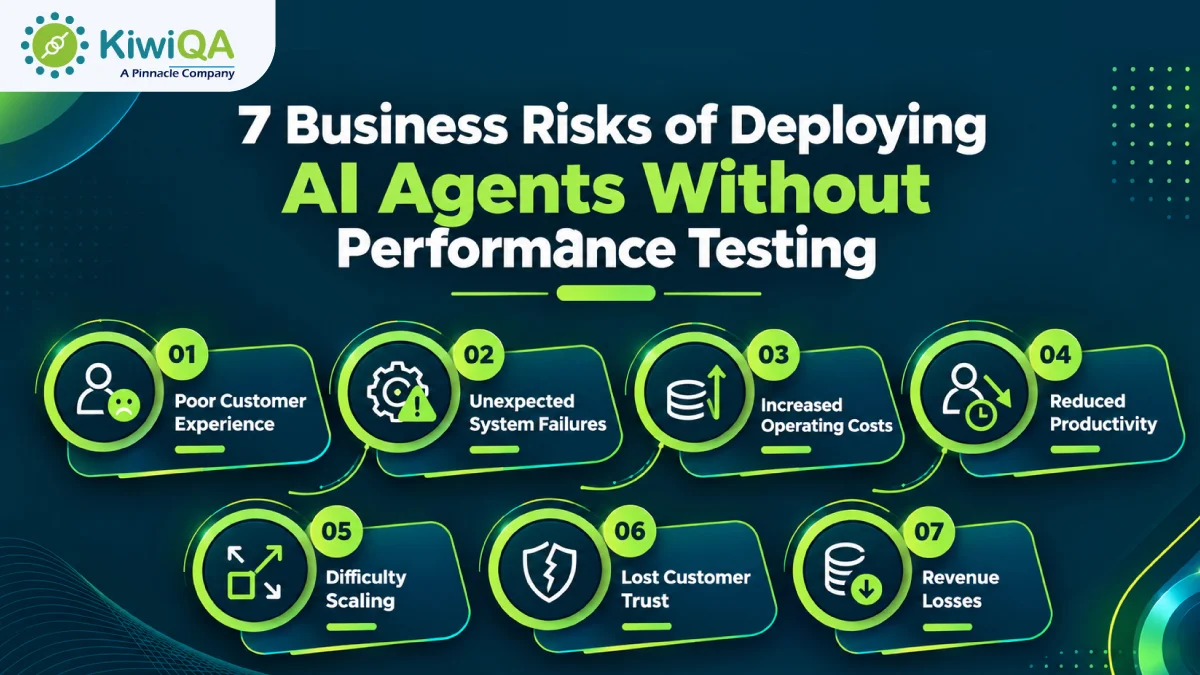
- 7 Major Business Risks of Deploying AI Agents Without Performance Testing
- 1. Poor Customer Experience Due to Slow AI Responses
- 2. Unexpected System Failures During High Traffic
- 3. Increased Operational and Infrastructure Costs
- 4. Reduced Business Productivity and Workflow Efficiency
- 5. Difficulty Scaling AI Agents With Business Growth
- 6. Loss of Customer Trust and Brand Reputation
- 7. Revenue Losses From Unreliable AI-Powered Operations
- When Should Businesses Perform AI Agent Performance Testing?
- How Can Businesses Reduce AI Agent Performance Risks?
- ⮚ Set Clear Performance Testing Goals
- ⮚ Perform Load and Stress Testing
- ⮚ Test AI Agent Integrations and Workflows
- ⮚ Monitor AI Agent Performance Continuously
- ⮚ Optimize AI Agent Performance Before Scaling
- Key Metrics to Evaluate During AI Agent Performance Testing
- Best Practices for Reliable AI Agent Performance Testing
- Ready to Deploy AI Agents Without Performance Risks?
7 Business Risks of Deploying AI Agents Without Performance Testing
AI agents help businesses automate tasks, answer customer questions, and improve daily operations. But what if an AI agent slows down, crashes during rush hours or is unable to perform crucial tasks? These issues may impact customer satisfaction, customer business and revenue. Performance testing services are used prior to deployment, improving the system’s reliability. Not every well-designed AI agent performs reliably in the real world without proper testing. Only 21% of organisations report having mature governance for agentic AI, highlighting the need for robust performance testing.
What Is AI Agent Performance Testing?
AI agent performance testing assesses the performance of AI systems under various workloads and conditions. Records response times, task completion, resource usage, system stability.
AI agents can rely on language models, APIs, databases, and various tools to accomplish a specific mission, unlike traditional software that has limited capabilities. As a result, it’s important to test AI agent performance not only on the speed of one application but on the entire workflow.
Realistic testing enables businesses to identify bottlenecks before customers do. If you hire a professional performance testing service provider, you can find out where your performance is lacking and make necessary changes.
Common AI Agent Performance Issues Businesses Often Overlook
While businesses concentrate on specific AI capabilities, they might not be aware of performance issues that hinder daily operations. Common issues include:
➾ Slow reactions in complicated activities.
➾ Delays caused by third-party API integrations.
➾ High peak load resource use.
➾ Regular interruptions and dead work.
➾ Unpredictability in response to various workloads.
Businesses can identify these issues early with the help of reliable performance testing service providers. AI agent performance testing services can also assess the collaborative performance of models, tools, and integrations.
Also Read: Enhancing Logistics & Transportation with Accessibility and Performance Testing
Why Is Performance Testing Important Before Deploying AI Agents?
Performance testing can be used to determine if an AI agent is capable of meeting the needs of a business. It can pinpoint system bottlenecks, minimizing unanticipated breakdowns and aiding resource planning.
Testing also assists companies to be ready when there are more users demanding. Using the right performance testing services can help businesses minimize response times, manage infrastructure costs, and ensure business continuity.
7 Major Business Risks of Deploying AI Agents Without Performance Testing
1. Poor Customer Experience Due to Slow AI Responses
Customers expect quick answers when interacting with AI-powered chatbots and virtual assistants. Users may leave before receiving the help they want as the AI agent may take too long to respond.
Slow responses can have a negative impact on customer satisfaction and abandonment rates. Companies that overlook AI agent performance testing risk having a lackluster experience during the rush.
Evaluating latency with workloads enables companies to pinpoint delays and enhance customer interactions.
2. Unexpected System Failures During High Traffic
An AI agent can be efficient for a limited user base, but not as efficient when the number of users is growing. Servers, APIs, databases, and model endpoints can become overwhelmed with high traffic.
These failures can disrupt customer service, cause business transactions to be delayed and impact critical services. A dependable performance testing provider can reproduce heavy workloads to find the system’s restrictions prior to deployment.
Businesses can prepare their infrastructure for peak demand, and minimize disruption, through early testing.
3. Increased Operational and Infrastructure Costs
AI agents can be more resource-intensive than anticipated for some more complex tasks. If the API calls are repeated, consuming too many tokens, making unnecessary retries, and inefficient workflows, the operational costs can escalate.
Businesses could end up paying for more cloud resources and are not necessarily getting more in return.
An established AI agent performance testing agency can help determine the inefficient processes and optimize resource utilization. Effective tests can also help companies to understand the expenses associated with each specific task and better plan their budget.
4. Reduced Business Productivity and Workflow Efficiency
AI agents can automate various processes, including data handling, reporting, customer support, and order processing. If these systems react slowly or don’t manage to finish workflows, employees might have to intervene and solve issues manually.
This diminishes the time saved by automation and boosts workload of internal teams.
Businesses can optimize their workflows by utilizing AI agent performance testing solutions to detect workflow delays, repeatable actions, and integration issues. Addressing these issues will enable employees to channel their energies into higher value activities rather than rectifying system failures.
5. Difficulty Scaling AI Agents With Business Growth
As the business expands, AI agents can be required to manage more users, larger data sets, and more tasks. The system that works fine now, may not work when demand spikes.
If not tested properly, companies will have to pay for their systems to go to a maximum capacity, have a delayed response period, and incur additional scaling fees.
Professional load and performance testing services simulate increasing amounts of work and identify infrastructure capacity limits. These tests ensure more effective capacity planning and reduce the risk of unexpected issues when scaling AI systems.
6. Loss of Customer Trust and Brand Reputation
People want the AI services that they use to work like a reliable tool. Constantly putting off deadlines, failing transactions and giving conflicting answers can raise doubts in users’ minds if they feel the business will not satisfy their requirements.
When a business fails to perform well, it can also result in a poor reputation and loss of repeat business.
When a company’s needs match the best performance testing agency, they can uncover performance shortcomings that could negatively impact customer relationships. It is important for businesses to maintain a consistent service delivery, which is made easy by regular testing, and to safeguard their reputation.
7. Revenue Losses From Unreliable AI-Powered Operations
The AI agents can assist in sales, lead qualification, online orders, and customer service. In case an agent fails in an important touchpoint, a potential customer may leave a purchase or pick a different provider.
Incomplete workflows and downtime can also cause revenue-generation to be interrupted and payments to be delayed.
Businesses can gain valuable insights into potential risks that could disrupt critical transactions by investing in AI agent performance testing services. More efficient performance planning can minimize unnecessary losses and lead to more reliable operations.
When Should Businesses Perform AI Agent Performance Testing?
AI agents should be tested at key milestones of their development and implementation, such as:
➛ Before you put your AI agent into production.
➛ When significant software changes or updates are applied.
➛ In the event of introducing new APIs, databases or other external tools.
➛ Prior to adding more users, or workloads.
➛ On a regular basis when response times drop or there are failures.
An established performance testing provider can assist determine a regular testing program. Businesses can leverage AI agent performance testing solutions at these stages to identify performance shifts that could impact day-to-day operations.
How Can Businesses Reduce AI Agent Performance Risks?
⮚ Set Clear Performance Testing Goals
Set acceptable time, error and task completion goals. Clarity of benchmarks makes it easier to measure results and points out problems.
⮚ Perform Load and Stress Testing
Represent normal traffic, peak demand and workloads in excess of expected. These tests will show how an AI agent reacts to stress.
⮚ Test AI Agent Integrations and Workflows
Review external APIs, databases, model endpoints and other connect tools. Whole workflow testing uncovers delays not found in individual component testing.
⮚ Monitor AI Agent Performance Continuously
Monitor Latency, Errors, Throughput, Resource Usage and Task Completion Rates. Teams can easily spot problems through continuous monitoring.
⮚ Optimize AI Agent Performance Before Scaling
Minimize unnecessary API calls, optimize retries and resource management. Businesses can work with specialized teams of AI agent performance test experts to prioritize performance improvements based on metrics.
Key Metrics to Evaluate During AI Agent Performance Testing
There are many performance indicators that businesses should measure:
➾ Response Time: How quickly the AI agent responds.
➾ Throughput: Number of requests the system handles in a unit of time.
➾ Task Completion Rate: Percent of tasks that are successfully completed.
➾ Error Rate: Frequency of request and/or workflow failures.
➾ Resource Utilization: resource use; computing power, memory.
➾ Cost per Task: The approximation of the costs for each task.
It is crucial to a business to choose the best performance testing agency that can provide good metrics and insights into how the results will impact system reliability, operating costs, and user experience.
Also Read: Importance of Performance Testing for Retail Apps During Peak Seasons
Best Practices for Reliable AI Agent Performance Testing
Here are some best practices to enhance test results:
➛ Simulate user behavior and realistic workloads for testing AI agents.
➛ Represent a variety of traffic conditions, including peak demand.
➛ Review end-to-end processes, external integrations.
➛ Monitor response times, errors, and resource usage.
➛ Re-test following key system changes.
➛ Check performance data before scaling up deployments.
To help develop a testing plan, experienced performance testing service providers can provide assistance. The correct tool for AI agent performance testing should also take into consideration model response time, tool usage, and the expense of re-running operations.
Ready to Deploy AI Agents Without Performance Risks?
Without performance testing, AI agents can cause a lack of customer satisfaction, system crashes, cost overruns, decreased productivity, scalability issues, loss of trust, and revenue loss.
To mitigate these risks, organizations should conduct tests on their AI systems prior to deployment and continually track their performance as demands evolve. By investing in load and performance testing services, companies can discover areas for improvement, enhance reliability, and ensure they are ready for growth.
Select a reputable AI agent performance testing company with experience in understanding your workflows, integrations, and business objectives. By leveraging AI agent performance testing services, your organization can create more reliable AI-powered operations, run AI operations cost-efficiently, and provide customers with a great experience.
key-takeaways
- Test Before Deployment: Identify performance bottlenecks and potential failures before the AI agent reaches production.
- Perform Load and Stress Testing: Test AI agents under normal, peak, and excessive workloads to understand how they perform under pressure.
- Test End-to-End Workflows: Evaluate the complete AI workflow, including models, APIs, databases, external tools, and integrations.
- Monitor Key Performance Metrics: Track response time, throughput, task completion rate, error rate, resource usage, and cost per task.
- Monitor Performance Continuously: Re-test and monitor AI agents after updates, new integrations, workload increases, or performance issues.
- Optimise Before Scaling: Improve resource usage, API calls, retries, and overall performance before increasing workloads or scaling the AI agent.