

As software is supplied more quickly than ever before, automation testing services will be required to maintain quality without impeding releases. Traditional testing may encounter difficulties in keeping up with rapid development and the growing complexity of applications.
By harnessing AI in testing, the speed, precision, and scope of tests can be significantly enhanced, manual efforts reduced, and issues discovered at an earlier stage, leading to releases done with more certainty.
For CEOs and business leaders, AI-driven testing is more than a technology upgrade—it’s a strategic investment in quality, efficiency, and customer experience. According to Gartner, organizations using AI across the software development lifecycle could achieve up to 30% productivity gains by 2028. Even businesses already using test automation services can unlock greater value by adopting the right AI tools, processes, and skilled teams.
Why AI-Driven Testing Matters to Business Leaders
AI-driven testing is a lot more than just updating QA. It plays a direct role in facilitating business development and achieving digital transformation targets.
Software reliability, in fact, is one of the most critical factors for running a modern business. Customers have come to demand that apps perform flawlessly across all sorts of devices and browsers. The slightest faults can result in loss of brand image and customers’ trust.
Thanks to AI testing, organizations can enhance their software production and release, as well as reduce risks. Intelligent systems can assist in thoroughly inspecting the app, executing feature testing automatically rather than spending days validating features manually.
• Rapid releases provide an edge over competitors.
• Fewer defects in production lead to more satisfied customers.
• Higher quality results in lower support and maintenance costs.
• More transparency leads to better release planning and decisions.
Companies that have invested in automated software testing services are able to boost their time-to-market even as they maintain robust quality standards. Also, companies that use QA automation testing services gain a deeper understanding of the software’s health and release readiness.
Besides, many leaders depend on automated testing companies to introduce advanced AI capabilities into their quality programs without increasing their internal complexity.
With digital products continuously changing, AI testing is turning into a business necessity rather than a technical option.
How AI Testing Improves Business Outcomes
AI-driven testing has the potential to bring value to businesses in several measurable ways.
1. Faster Release Cycles
AI is capable of auto-generating, prioritizing, and executing test cases. This results in fewer testing bottlenecks and gives teams the freedom to release updates more rapidly.
Companies working with automated software testing services often report that their testing time is significantly shorter than that of traditional methods.
2. Reduced Testing Costs Over Time
Adopting AI, of course, involves an initial cost, but the savings on a long-term basis will be quite considerable. Teams will be able to devote less time to writing and updating scripts.
Companies using test automation services normally witness a decrease in operational costs as the level of automation increases.
3. Better Defect Prediction
AI programs scan old data, learn patterns of those disturbances that are indicative of faults, and make predictions to prioritize probable high-risk areas.
This predictive capacity is one of the reasons QA automation testing services are chosen by many leaders when it comes to large-scale projects.
4. Improved Test Coverage
AI has the ability to work through the user journeys, scenarios, and edge cases that traditional methods can miss.
Companies using automated software testing services frequently report a significant increase in their test coverage across various applications.
5. Lower Production Failure Risk
By identifying defects at an early stage, it is possible to substantially minimize the risk of critical and severe failures after the product has been deployed.
Many firms garner support from an automated software testing company as a way of augmenting their confidence in releases and, at the same time, reducing the instances of production incidents.
6. Stronger Customer Confidence
Trust is a consequence of dependable software. When products persistently perform well, customers are far more likely to stay loyal.
In this way, AI testing directly impacts customer retention and business growth.
What AI-Driven Automation Testing Includes
Tools that use AI in performing automation testing are able to ramp up the quality of software, lessen the manpower needed, and accelerate the speed of production.
❒ Intelligent Test Case Generation
By studying requirements, user behavior, and application changes, AI can generate relevant test cases on its own, which results in better coverage and more time saved by the team.
❒ Self-Healing Test Scripts
When applications undergo changes, AI-assisted systems make the necessary changes to test scripts to avoid the need for testing personnel to spend time on maintenance, thus improving the overall reliability of testing. Most companies have adopted these functionalities after consulting automation testing service providers with deep implementation experience.
❒ Predictive Defect Analytics
Built on the knowledge gathered by studying defects over time, AI predicts the highest-risk components, enabling risk-oriented testing.
❒ Smart Test Prioritization
Based on business impact and recent changes in software, AI schedules the tests that matter most while ensuring that quality is not compromised.
❒ Visual Testing and Anomaly Detection
AI, being the observer of the team, has the ability to notice the sudden and unexpected changes in the visuals of the software and the behavior of the application that is not a regular one, helping the team in delivering the end user experience at the best level.
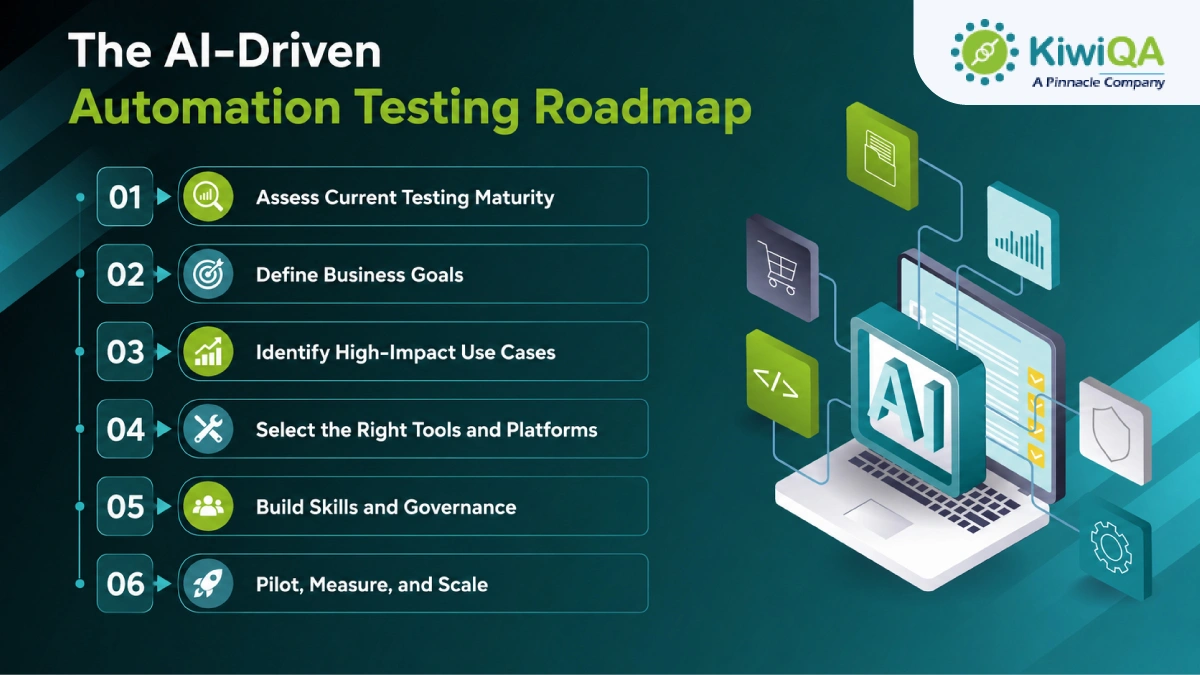
The AI-Driven Automation Testing Roadmap
It is highly recommended that organizations follow a defined path to integrate AI-driven testing into their test functions to ensure control and measurement of the change. Rather than deploying AI in all areas of the test function at the same time, businesses should take one step at a time to reduce risks and generate the greatest value.
⮞ Phase 1: Assess Current Testing Maturity
Begin by determining the extent of testing and automation in the company and the space within which future AI can work. First, the business leaders should consider the testing methods in use, the time spent on script maintenance, the skills of the teams, and the tools used for testing.
This will point the team to the areas where significant improvements can be achieved by introducing AI. For example, teams might find that the time dedicated to regression testing is excessive or that the resources that are spent on script maintenance are too high.
In order to better visualize the capabilities and objectives, both current and future, many companies go ahead and map out their automation testing strategy at this point in the process. Those organizations that are just embarking on automation find that an automation testing roadmap for beginners serves as a guide through their transition to AI-led quality engineering.
Additionally, many large organizations use automation testing roadmap templates to map out their procedures, priorities, and intended results in a clear and organized manner.
⮞ Phase 2: Define Business Goals
Technology trends should not be leading the way in AI adoption, but business objectives instead. Therefore, even before deciding on tools or building automation frameworks, a leader must have a clear picture of what a successful implementation would look like.
One organization is interested in minimizing the time to market, another one is focusing on reducing costs, and a third is improving customer retention. In the case of highly regulated industries, one could imagine that the main objective is to minimize the risk of going to production.
Having clearly defined objectives will not only help in setting a budget but also in measuring progress over time. Shorter testing cycles, better success in defect detection, and launch stability are typical examples of success indicators.
QA automation testing roadmap is a communication tool that assists a company by mapping out the initiative in the context of the overall business priorities and desired results with measurable outcomes.
⮞ Phase 3: Identify High-Impact Use Cases
Once the objectives have been identified, the next step is to select the test cases where the use of AI will bring the greatest return and where it is possible to go from idea to realization rapidly.
To this end, regression testing, API validation, cross-browser testing, repetitive data verification, and user journey exposure will be the beginning. The time and resources associated with these types of testing make them attractive candidates for AI.
Many organizations find that consulting an experienced automation testing service provider to conduct their preliminary assessment of the automation potential of their organization is a good first step.
Also, large enterprises with the assistance of dedicated test automation service providers are where the collaboration and prioritization take place, which leads to the wins that create the go-ahead for increased business and transformation.
⮞ Phase 4: Select the Right Tools and Platforms
Having a superb collection of tools and technology is what is needed to enable the AI-driven testing strategy to work well. There is a very big variety of AI testing solutions on the market, each with a different set of features and levels of maturity.
Business leaders must scrutinize each tool being considered for adoption in terms of its ability to scale, ease of integration, reporting capabilities, security standards, and the level of vendor support. Besides having smooth integrations with the existing development pipelines and quality processes, the platform must be the best fit for the overall strategy.
Rather than deciding just on current needs, one should also think about the future, as well as the business growth of the company. What works for a single product today may not be scalable across the entire company tomorrow.
Most companies often prepare a comparison of the different automated testing companies’ offerings before making a final decision on the tool to adopt. Besides this, the choice of qualified partners is sometimes the element that cuts implementation risks and shortens deployment timelines.
⮞ Phase 5: Build Skills and Governance
New technology won’t ensure a successful AI adoption on its own. It’s also essential that employees have both the knowledge and confidence to carry out their tasks effectively using new tools and processes.
Training initiatives need to include basics about AI testing, how to use the tools, good data management practices, and principles of quality engineering. Upgrading the skills of teams at the very beginning also plays a crucial role in lowering the resistance to change and improving the rate of adoption.
At the same time, governance matters a lot. Companies need to make sure that there is a written set of rules for data usage, compliance, model validation, and security controls. By following such policies, it is easier to ensure AI is used responsibly and in a similar way across different projects.
It is a common thing that businesses enhance their internal teams by teaming up with providers of QA automation testing services, who, besides testing support, can also offer training and knowledge transfer programs.
⮞ Phase 6: Pilot, Measure, and Scale
Reporting a pilot project gives the organization a chance to try out its AI initiatives on a small scale before rolling them out across the whole organization. This method, on one hand, reduces risks, and on the other hand, it gives one a chance to learn more about tool performance and implementation challenges.
The pilot project must be based on a single well-defined use case with goals that are measurable. Measurement of defect detection, execution speed, automation coverage, and maintenance effort can be used to track the performance.
When the results are positive, stakeholders gain more trust, and there is a convincing business rationale for additional funding.
Collaborating with a skilled automated software testing company during this stage is a common practice to speed up the implementation and also set up the best practices while scaling.
Large-scale projects are best managed with a comprehensive test automation roadmap template that closely monitors progress and resource allocation and drives continuous improvements throughout the organization.
Business Limitations of Traditional Test Automation
Traditional test automation has undoubtedly helped organizations enhance their testing efficiency for quite some time. Nonetheless, the changes brought about by the complexity of software applications and shorter release cycles have made the drawbacks of conventional automation increasingly evident.
❒ Heavy Dependence on Scripts
Traditional automation uses test scripts that are created in advance to a very large extent. When a change is made to the user interface, workflow, or functionality of the application, it is usually necessary to update the scripts manually, which leads to additional work for the testing teams and a slower release process.
❒ Frequent Test Failures
Many times, even slight changes in the user interface are sufficient to cause the automated test scripts to fail, which in turn means that the teams have to spend more time repairing the broken tests than detecting the actual problems of the product, which leads to a lowered overall value of the automation efforts.
❒ High Maintenance Costs
When an application increases in terms of both size and complexity, the task of maintaining large automation suites becomes so expensive and time-consuming that it is nearly impossible. Older frameworks will probably be in need of constant updates, which will, in turn, make the scalability of these frameworks difficult.
❒ Limited Test Coverage
Usually, in traditional automation, the focus is on the scenarios that are set beforehand, and the expected behavior of the user is also taken into consideration. In case of unexpected conditions, edge cases, or new risks, this approach may fail to capture the cases that have a potential negative impact on the customer’s experience.
The higher nature of the automation testing services helps companies achieve broader test coverage and faster releases while minimizing operational overhead.
Major Risks and Challenges in AI Testing
AI-driven testing features a range of advantages; it simultaneously brings new challenges that business leaders must address to ensure successful adoption and long-term value.
⮞ Over-Reliance on AI
Although artificial intelligence is a potent technology, it cannot fully replace human interaction. Human experts serve in critical business and quality decisions that still require judgment, experience, and oversight.
To ensure the accuracy and reliability of AI-generated insights and recommendations, organizations using test automation services should set up validation processes that are clearly defined. Besides, doing away with human governance and leaving the AI to run the show can lead to new risks instead of eliminating the old ones.
⮞ Poor Data Quality
The quality of AI systems depends on the quality of the data used to train them. AI predictions and test results will be unreliable if the data is inaccurate, out-of-date, or incomplete.
In order for their results to have a real impact, companies should make a significant commitment not only to their data management standards but also to keeping datasets used in testing environments of the highest quality.
⮞ Tool Complexity
On the one hand, there could be a lot of functionality delivered by AI testing platforms, but on the other, using them to the fullest extent may call for specialized knowledge and skills.
Without adequate training and support, the team members may fail to unleash the potential of these tools. Enhancing skills and a commitment to continuous learning must be seen as a priority for successful adoption.
⮞ Security and Compliance Concerns
Testing environments quite often contain highly sensitive information related to customers, finances, or the business. With so much data being handled by AI tools, besides meeting industry regulations, organizations must also adhere to internal security policies.
With proper data protection governance, not only can they reduce their compliance risks, but they will also be able to ensure data privacy at a high level.
⮞ Change Management Resistance
Changes always bring some uncertainty to people, and employees are no exception. AI introduction can worry them because they think it might lead to changing roles or new ways of working.
In such cases, business leaders must resort to their strong communication skills, keep employees involved, and make sure they are well-trained so as to influence their beliefs and behaviors and to spread a climate of acceptance and willingness to change across teams.
Future Trends in AI-Driven Automation Testing
The kind of software testing that we will be experiencing down the line is more intelligent, predictive, and business-oriented in nature. As artificial intelligence technologies keep getting better, companies will turn their backs on traditional ways of automation and adopt more flexible and autonomous quality engineering practices instead.
❒ Autonomous Testing
Autonomous testing is undoubtedly one of the most significant trends determining the future of testing. AI-equipped systems will have the proficiency to cover every aspect of test case creation, execution, analysis, and maintenance in a fully automated manner, with only rare human interventions.
The new focus on assisted versus full testing operations carries with it the least manual effort, while at the same time, quality teams are given the opportunity to dedicate their time and resources to strategic tasks such as risk management, customer experience, and innovation. With further maturity, the features of autonomous testing will be progressively incorporated into enterprise quality strategies.
One possible way of preparing for this major change is to lay out an automation testing plan that is centered on the adoption and evolution of AI. Enterprises should be investing in tools that are scalable, building their AI governance models, and developing their AI capabilities for the long term. Having an up-to-date automation testing roadmap is the key to successfully navigating increasing AI maturity.
❒ AI in Continuous Quality Engineering
Quality is no longer solely dependent on the testing phase. Besides detecting defects in quality assurance, the role of AI has also been identified in areas such as requirements analysis, development, deployment, and production monitoring.
Embedding quality in every delivery stage raises the likelihood of the organization discovering the problem incidents at the start while cutting their defect explanation costs. They will also enjoy the benefit that companies with a thoroughly tested automation roadmap will be able to incorporate AI-led quality processes, teams, and tools with heightened ease and success.
A well-developed test automation roadmap is instrumental in supporting more rapid release cycles, enhancing collaboration, and achieving more reliable software delivery in modern DevOps environments.
❒ Business-Led Quality Decisions
Software quality no longer has just one role as a technical measure; today, it is also a business metric. It is a fact that executives and business leaders rely most on real-time quality insights to be able to make well-informed strategic decisions.
» With AI-based dashboards, they can get transparency and visibility into critical areas such as:
• Release readiness
• Customer risk exposure
• Defect trends
• Application performance stability
• Product quality indicators
With this shift that has happened, software quality has become inseparably linked to business performance. An organization boasting a well-developed QA automation testing roadmap has great visibility into both its risks and new opportunities. This enables their leaders to make quicker and more informed decisions.
On the other hand, an effective qa automation testing roadmap serves to synchronize the technical quality objectives with the larger business goals, thus producing a more robust platform for expansion and innovation in the long run.
Ready to Accelerate Quality with AI-Driven Test Automation?
It is certainly the case that AI-driven testing is fast gaining the status of a business imperative for those organizations that are aiming at shorter release cycles, reduced costs, and higher standards of software quality.
The proper way to start is by re-examining the testing maturity level and making sure that AI projects are aligned with business objectives. Besides this, it is a must to get hold of the best automated testing companies, acquire suitable tools and governance models, and also raise the competencies that are necessary for success.
Having a well-thought-out strategy coupled with knowledgeable support, a company ought to be in a position to grow AI-driven testing and reap its benefits over the long term.