
Summarize this blog post with:


Quick Summary
Automation Testing Cost in the USA depends on several factors, including application complexity, testing requirements, the number of test cases, automation tools, and the expertise of the testing team. The overall cost can vary significantly based on the scope and duration of the project. The automation testing cost in the USA is also influenced by test maintenance, framework development, integration requirements, and the type of testing needed. Choosing the right automation strategy and an experienced testing partner can help businesses improve testing efficiency while managing overall project costs effectively.
- How Much Does Automation Testing Cost in the USA?
- How Much Does Automation Testing Cost in the USA?
- → Average Cost of Automation Testing
- → Automation Testing Cost at a Glance
- → Automation Testing Hourly Rates in the USA
- What Factors Affect Automation Testing Costs?
- ➥ Application Size and Complexity
- ➥ Testing Scope and Requirements
- ➥ Technology and Automation Tools
- ➥ Maintenance and Infrastructure
- Key Benefits of Automation Testing for Businesses
- → Faster Test Execution
- → Improved Test Coverage
- → Reduced Testing Costs
- → Better Software Quality
- → Faster and Frequent Releases
- Breaking Down the Cost of Automation Testing Services
- ➥ Test Automation Planning and Strategy
- ➥ Automation Framework Development
- ➥ Automated Test Script Development
- ➥ CI/CD Integration
- ➥ Automation Maintenance and Support
- Automation Testing Cost by Application Type
- → Web Application Testing
- → Mobile Application Testing
- → API Automation Testing
- → Enterprise Application Testing
- → E-commerce Application Testing
- Automation Testing Cost by Engagement Model
- ➥ In-House Automation Testing Team
- ➥ Outsourced Automation Testing
- ➥ Dedicated Testing Team
- ➥ Fixed-Price Testing Project
- ➥ Time-and-Material Model
- How to Calculate Your Automation Testing Budget
- ➥ Key Cost Components
- ➥ Simple Cost Calculation Formula
- ➥ Example Automation Testing Budget
- Ready to Reduce Your Automation Testing Costs?
How Much Does Automation Testing Cost in the USA?
Automation testing allows businesses to test software faster, improve accuracy, and identify errors before apps reach users. As software releases become frequent, multiple firms in the USA invest in automation to reduce repetitive manual testing and improve overall quality. The automation testing pricing in the USA can range from $5,000 to $50,000+, based on the project’s requirements and scale.
Organizations can also choose automation testing services to access specialized expertise, testing frameworks, and tools without developing a large in-house team. However, pricing varies based on the app complexity, QA scope, automation tools, test coverage, and team location. The following article explores the key factors that affect automation testing costs, pricing models, and ways businesses can optimize their testing expenses.
Automation testing allows businesses to test software faster, improve accuracy, and identify errors before apps reach users. As software releases become frequent, multiple firms in the USA invest in automation to reduce repetitive manual testing and improve overall quality, and the global automation testing market is projected to grow at a CAGR of around 14.6% through 2034.
How Much Does Automation Testing Cost in the USA?
→ Average Cost of Automation Testing
Depending on the complexity of the application and the scope of testing, small and medium-size project automation testing cost in the USA could cost between $10,000 and $50,000.Due to complex workflows, integrations, environments, and test coverage, large and enterprise-level projects can cost anywhere from $50,000 to $200,000 or more.
→ Automation Testing Cost at a Glance
One of the main elements influencing test automation services cost is project size. Small projects can cost between $10,000 and $20,000, medium projects between $20,000 and $50,000, and large projects between $50,000 and $200,000 or more. Final pricing also varies by application complexity, test coverage, tools, integrations, team expertise, and maintenance.
→ Automation Testing Hourly Rates in the USA
Hourly rates for automation testing differ according to the technical proficiency and experience of the tester. Junior testers might bill between $40 and $70 per hour, mid-level testers between $70 and $110, and senior or specialized automation engineers between $110 and $150 or more. Enterprise automation, performance testing, and complex frameworks usually demand higher prices.
What Factors Affect Automation Testing Costs?
➥ Application Size and Complexity
Because of multiple features, workflows, and integrations, larger apps demand more automation labor. Because they require more extensive test coverage, complex frameworks, and longer development times, complex apps are usually more expensive.
➥ Testing Scope and Requirements
Costs are directly impacted by the quantity and type of test cases. Different resources are needed for functional, regression, performance, and compatibility testing, which raises costs as testing scope grows.
➥ Technology and Automation Tools
Tool requirements and framework compatibility are determined by the technological stack. While tool licenses, integrations, and specialist platforms might raise overall expenses, businesses may collaborate with test automation service providers.
➥ Maintenance and Infrastructure
As applications change, automation necessitates continuous infrastructure and script maintenance. Over time, recurrent automation testing costs are influenced by cloud platforms, testing environments, device infrastructure, script upgrades, and debugging.
Also Read : Top 15 Automation Testing Company in Australia for End-to-End Testing
Key Benefits of Automation Testing for Businesses
→ Faster Test Execution
Compared to manual testing, automation completes repetitive test cases far more quickly. Large test suites can be performed simultaneously, testing cycles can be reduced, and errors can be identified sooner. This shortens the time between development and release while assisting development teams in producing reliable software more quickly.
→ Improved Test Coverage
Teams can run more test cases across browsers, devices, environments, and workflows thanks to automated testing. Increased test coverage increases trust in the functionality, performance, and reliability of applications by detecting flaws that manual testing would miss.
→ Reduced Testing Costs
Automation can save long-term testing costs by reducing repeated manual labor, even though it involves an upfront investment. Businesses may use testing resources more effectively and decrease recurrent expenses with reusable scripts, faster execution, and automated regression testing.
→ Better Software Quality
Testing may be done consistently and repeatedly over several development cycles thanks to automation. It assists companies in improving application stability, dependability, and overall software quality before products reach end customers by identifying flaws earlier and lowering human error.
→ Faster and Frequent Releases
Test automation consultant can test changes constantly thanks to automated testing’s easy integration with CI/CD pipelines and agile development. Faster feedback helps companies deploy software updates more frequently without sacrificing quality by assisting developers in resolving issues sooner.
Breaking Down the Cost of Automation Testing Services
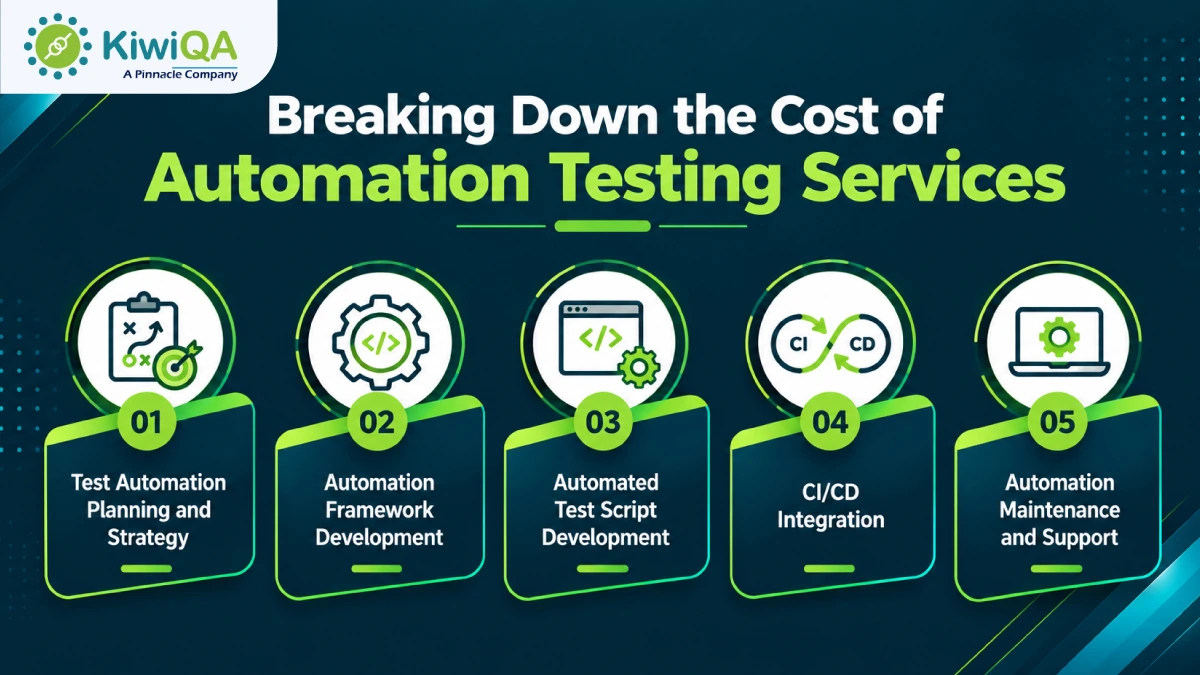
➥ Test Automation Planning and Strategy
Before development starts, the testing strategy is established through test automation planning. Requirement analysis is used to find opportunities for automation, and then tools are chosen according to application type, technology, scalability, and budget.
A clear plan assures that the testing procedure is in line with project objectives and helps companies avoid unnecessary automation expenses. Planning and strategy costs may range from $1,000 to $5,000, depending on project scope.
➥ Automation Framework Development
Scalable and maintainable testing is made possible by the development of automation frameworks. It involves creating reusable components, defining coding standards, and developing the framework architecture.
To ensure that scripts can effectively access, arrange, and preserve the necessary test data across various testing environments, test data management is also taken into consideration. Framework development may cost around $5,000 to $20,000, depending on complexity and technology requirements.
➥ Automated Test Script Development
Appropriate human test cases are transformed into automated scripts through automated test script development. Reusable scripts can be developed by an automation testing services company to improve consistency throughout test cycles and minimize repetitive testing labor.
The quantity of test cases, application complexity, necessary coverage, scripting language, and degree of script reuse all affect costs. This phase may cost approximately $3,000 to $15,000 or more for larger test suites.
➥ CI/CD Integration
Development and deployment pipelines are connected to automated testing through CI/CD integration. It involves setting up automated test execution and connecting testing tools with systems like Jenkins, GitHub Actions, or Azure DevOps.
This allows teams to conduct tests throughout the development and deployment phases. It assists in early detection of flaws and minimizes software release delays.CI/CD integration may add approximately $2,000 to $8,000 to the overall automation testing budget.
➥ Automation Maintenance and Support
Test scripts are kept trustworthy as applications change thanks to automation maintenance. When features, interfaces, workflows, or test data change, regular upgrades could be necessary.
In order to ensure precise and reliable automation results, support staff also look into failed tests, determine whether they are caused by flaws or script problems, and make necessary modifications. Ongoing maintenance and support for Automation test cost around $1,000 to $5,000 per month, depending on testing volume and application changes.
Automation Testing Cost by Application Type
→ Web Application Testing
Regression testing and browser compatibility across supported operating systems and browsers are the main goals of web application automation. Critical workflows can be repeatedly validated by automated suites following each release.
Web apps test automation cost can range from $15,000 to $40,000 for a typical US project, depending on browser needs, test coverage, and application complexity.
→ Mobile Application Testing
Applications for iOS and Android on various devices, operating systems, and screen sizes are covered by mobile automation. Because teams may demand real-device or cloud-based testing environments, device compatibility raises testing requirements.
Depending on device coverage and application complexity, a typical mobile automation project in the US could cost between $15,000 and $40,000.
→ API Automation Testing
Without significantly depending on the user interface, API automation verifies endpoints, responses, authentication, data management, and integrations. It can offer regression coverage that is more accurate and quicker.
Depending on the quantity of APIs, integrations, and test scenarios, API automation projects may normally cost between $10,000 and $30,000 in the US.
→ Enterprise Application Testing
Complex workflows, several user roles, databases, legacy systems, and third-party connections are frequently found in enterprise applications. Therefore, more comprehensive frameworks and test environments are needed for automation.
Depending on the size of the application, integrations, compliance requirements, and testing coverage, enterprise automated testing cost might cost anywhere from $50,000 to $200,000 or more.
→ E-commerce Application Testing
Shopping carts, product searches, checkout procedures, payment workflows, promotions, and order management are all commonly included in e-commerce automation. Comprehensive coverage is crucial because failures can have a direct impact on revenue.
Depending on features, connectors, and the complexity of the payment process, an average e-commerce automation project in the US could cost between $12,000 and $35,000.
Automation Testing Cost by Engagement Model
➥ In-House Automation Testing Team
Establishing an internal team gives you more control over security, communication, and testing procedures. However, companies have to pay for hiring, training, infrastructure, tools, and salaries.
Organizations can determine whether hiring an internal team is cost-effective for their long-term testing needs by working with a test automation consultancy. For a small-to-medium US team, annual costs can range from approximately $150,000 to $400,000+, depending on team size and expertise.
➥ Outsourced Automation Testing
Businesses can get skilled QA specialists without keeping a full-time internal staff by outsourcing automated testing. Project scope, testing complexity, team location, and length of engagement all affect costs.
This model offers access to specialist automation technologies and expertise while lowering infrastructure and recruitment costs.US outsourcing rates commonly range from approximately $40 to $150+ per hour, depending on provider expertise and location.
➥ Dedicated Testing Team
A team of automation experts who work only on a client’s project is known as a dedicated testing team. This architecture works well for long-term or constantly changing applications that need reliable testing assistance.
Budgeting is more predictable because businesses usually make monthly payments based on team size, experience, and length of engagement. A dedicated team may cost approximately 10,000–30,000+ per month in the US, depending on team composition.
➥ Fixed-Price Testing Project
Before work starts, a fixed-price model specifies the testing scope, schedule, and budget. When deliverables and requirements are well-defined, it functions effectively.
While testing providers take on more responsibility for achieving agreed-upon deliverables within the allocated budget and timetable, businesses benefit from predictable expenses. Typical fixed-price automation testing budget may range from $10,000 to $50,000+, depending on scope and complexity.
➥ Time-and-Material Model
Businesses are charged according to the actual number of hours performed and resources utilized during the project under the time-and-material approach. When requirements change, or testing needs are hard to predict in advance, it provides flexibility.
The size of the team, the number of testing hours, the complexity of the project, and changing needs can all affect costs. Automation testing rates can range from approximately $40 to $150+ per hour in the US, based on expertise and project requirements.
Also Read : AI-Driven Automation Testing Roadmap: What Business Leaders Need to Prepare
How to Calculate Your Automation Testing Budget
➥ Key Cost Components
Think about infrastructure, maintenance, support, automation tools, test script development, and framework configuration. Depending on the complexity of the program and the scope of testing, an initial automation expense for a medium-sized application in the USA might be between $20,000 and $50,000.
➥ Simple Cost Calculation Formula
Total Cost = Setup & Development + Tools & Infrastructure + Maintenance is a clear method. For example, a budget of $25,000 for development, $5,000 for infrastructure and tools, and $5,000 for maintenance equals an estimated $35,000 for automation testing.
➥ Example Automation Testing Budget
Businesses may budget between $35,000 and $50,000 for an initial automation project for a medium-sized application. Although real costs vary depending on project requirements, this may cover framework development, automated scripts, tools, infrastructure, CI/CD integration, and initial upkeep.
Ready to Reduce Your Automation Testing Costs?
Automation testing costs vary depending on project scope, app complexity, maintenance, and tool requirements. However, the initial investment may be higher than manual testing. An experienced automation testing company can help optimize costs through the right tools, team models, and testing strategy while focusing on ROI and long-term business values.
key-takeaways
- Automation testing costs vary: Project size, application complexity, testing requirements, and overall scope determine the budget.
- Expertise affects costs: The experience and technical expertise of the automation testing team can influence the overall investment.
- Application type matters: Web, mobile, API, e-commerce, and enterprise applications have different testing requirements and complexities.
- Setup involves multiple components: Planning, framework development, test script creation, CI/CD integration, tools, and infrastructure contribute to the initial investment.
- Maintenance is ongoing: Test scripts, frameworks, and testing environments require regular updates as applications evolve.
- Choose the right engagement model: In-house teams, outsourcing, dedicated teams, and fixed-price projects provide different levels of control and flexibility.
- Automation provides long-term value: Faster execution, improved test coverage, reduced repetitive work, and frequent releases can help optimize testing efforts.
- Plan the budget carefully: Consider development, tools, infrastructure, integration, and maintenance requirements before selecting an automation testing solution.