
Does your logistics suffer from issues like shipment delays, inaccurate delivery information, wrong routing, or system breakdowns in transportation? Today’s supply chain environment is so fast-moving that even a small glitch in a Transportation Management System (TMS) can lead to delayed shipments, increased transportation costs, dissatisfied customers, and other operational disruptions. For businesses that rely heavily on transportation networks, having systems that perform accurately, securely, and efficiently at all times is critical. This is where logistics testing services become indispensable. Along with this, software compatibility testing plays a key role in ensuring that logistics applications and TMS platforms function smoothly across different devices, operating systems, browsers, and integrated environments without performance issues.
Especially in the context of logistics nowadays, TMS is considered the heart of it. For any company, a TMS not only plans shipment but manages the entire carrier network, optimizes the delivery routes and time, tracks the entire delivery, controls freight costs, and, of course, gives you an improved visibility into your operations. But as the deliveries start getting complex, the enhanced TMSs have to handle lots of data, provide high performance, and still do it accurately.
The installation of a TMS alone does not guarantee everything will work smoothly. It is important for the organizations to test whether the system behaves well in different business scenarios, whether it can be integrated with other applications without causing problems, and finally, whether it is capable of supporting real-time decision-making. This is what drives businesses to logistics testing services as well as software testing services.
Thorough testing helps identify defects early, improves software reliability, and enhances the overall user experience. Studies show that fixing defects during the testing phase can reduce correction costs by up to 80% compared to resolving them after deployment, making quality assurance a critical factor in the success of TMS implementations, upgrades, and logistics system integrations.
This piece of advice covers how Transportation Management Systems work, why it is so critical to have testing, what the different types of testing that will be involved are, the difficulties that businesses will encounter, and how specialized logistics testing solutions can help improve supply chain as well as customer satisfaction.
Understanding Transportation Management Systems
❒ What is a Transportation Management System?
A Transportation Management System is basically a software that can substantially increase the efficiency of your supply chain by facilitating the management, optimization, and monitoring of transportation activities. You can consider this as the most important component of your operation that handles placing shipments, managing transportation resources, and giving you better delivery results.
With a TMS, companies are able to computerize their tasks involved in transportation handling and gain greater control over their logistical operation. These systems have options to allow you to not just walk through paperwork but also do more with less, trim transportation expenditure, and stand out with customer service by sharing shipment details.
When talking about TMS, we can say the main goal is to make things easier and, at the same time, improve how well you operate. It is one tool in which transportation planning, carrying out, and analyzing can be done side by side.
∘ Projecting the execution of shprocesses generatingable carriers for shipment
∘ Working out the best routes for delivery
∘ Monitoring shipments in a real-time environment
∘ Keeping track of transportation expenses
∘ Streamlining freight auditing processes
∘ Generating various types of reports relating to logistics performance
This is why, without extensive testing, there is a risk of malfunction of these features. That is the reason why Logistics Application Testing is highly recommended to make your transportation operations truly reliable.
⇒ Key Functions of a TMS Platform
Fine-tuned TMSs are equipped with a wide variety of functions to support daily operations within the logistics sector.
⤷ Among the key functions are:
∘ Planning of transportation
∘ Optimizing routing
∘ Management of carriers
∘ Scheduling of shipments
∘ Freight auditing and payment
∘ Inventory visibility
∘ Delivery tracking
∘ Reporting and analysis
However, it is mandatory for every function to go through rigorous testing so that there are no errors in processing, and smooth operations of the business take place without any interruptions.
⇒ Role in Logistics and Supply Chain Optimization
Implementation of a TMS results in reducing the manual efforts required, which in turn results in lowering transportation costs and enhancing shipment visibility.
⤷ Some of the benefits are:
∘ Acceleration of the shipment process
∘ Decrease in fuel costs
∘ Improvements in route planning
∘ Better delivery performance
∘ Customer satisfaction at a higher level
∘ Transparency across operations
Use of logistics testing consulting services is getting more popular in organizations to confirm that they experience these benefits post-implementation.
❒ Core Features of Modern TMS Solutions
⇒ Route Planning and Optimization
Route optimization can most certainly be of great help to a business through discovering the most optimal ways to deliver, while keeping costs and delivery time to a minimum.
⤷ Here is a list of points that require testing:
∘ Ways of computing a route
∘ Actual distances
∘ Plans for delivery
∘ Use of traffic information in route optimization
∘ Estimates of fuel usage
⇒ Carrier Management
Transportation software engages with different carriers and logistics providers so as to manage their relationships.
⤷ Testing touches on aspects such as:
∘ The strategy for choosing carriers
∘ Contracts and management processes
∘ Recording carrier performance
∘ Calculation of freight rates
⤷ Freight Auditing and Payment
Billing accurately is a vital point in keeping transportation costs under control.
⤷ Testing checks:
∘ Proper generation of invoices
∘ Validation of freight charges
∘ Accuracy of payment processing
∘ The functionality of cost allocation
⇒ Shipment Tracking and Visibility
Clients are always looking for real-time package update information.
⤷ Testing covers:
∘ Confirming functionalities for GPS tracking
∘ Updating shipment status
∘ Giving delivery notifications
∘ Working through exception management
Quite a number of logistics testing companies put their main focus on tracking validation, as visibility is a direct factor influencing customer satisfaction.

Why Logistics Testing Services Are Essential for TMS
Transportation Management Systems are the brain of logistics operations, and if that brain is shut down for a while or is missing or flawed, then discharge of the supply chain operations may come to a stop or be severely impacted. Companies usually build their operations using TMS to handle shipments, plan routes and schedule carriers, make freight payments, and offer live shipment updates.
How a TMS performs will impact not only the flow of logistics but also cost, customer satisfaction, and even revenue. That is why professional logistics testing services are a must to make sure a transportation system is 100% working accurately, efficiently, and reliably, regardless of any business conditions.
❒ Prevents Shipment Delays and Routing Errors
A major plus of testing your transportation systems is that it dramatically lowers shipment delays and routing mistakes. Transportation Management Systems come with powerful algorithms used to work out delivery routes, assign carriers, and schedule shipments. If there is a problem within such processes, then it will definitely affect the movement of goods throughout the supply chain.
⇒ Errors in routing can result in:
∘ Missed or delayed deliveries
∘ Higher fuel and transport expenses
∘ Suboptimal utilization of resources
∘ Customer complaints and poor services
∘ Diminished operational efficiency
❒ Ensures Accurate and Reliable Transportation Data
It is widely known that transportation operations are heavily reliant on data. Shipment planning, carrier selection, inventory management, and customer communication decisions are all dependent on the data handled by the TMS. Inaccuracies in the data will result in a bad decision, an inefficient operation, and a financial loss.
⇒ Some of the specific test areas:
∘ Accuracy of shipment information
∘ Details of the carrier and transportation
∘ Inventory synchronization
∘ Freight charge computations
∘ Delivery schedules and timelines
❒ Supports Regulatory Compliance and Risk Reduction
Many laws and regulations govern transportation and logistics, especially in terms of safety and security, documentation, and data protection. Non-compliance comes with penalties, legal actions, and loss of reputation. With transportation systems entering the digital era, compliance is becoming a bigger topic.
⇒ Tests show that organizations are able to fulfill:
∘ Requirements for safety in transportation
∘ Transportation-related industry rules and standards
∘ Requirements for data privacy and security
∘ Need to keep records and produce reports that are subject to audits
∘ Compliance with internal policies
Effective testing helps businesses validate compliance requirements, identify potential risks before they impact operations, and ensure smooth system performance. It also strengthens security by protecting sensitive transportation and customer data from cyber threats, unauthorized access, and potential breaches. By leveraging logistics software testing services, organizations can enhance system reliability, maintain regulatory compliance, and ensure operational continuity. Additionally, working with an API testing service provider ensures that all system integrations function correctly, data flows seamlessly between applications, and APIs perform reliably under different conditions.
❒ Improves Efficiency, Reliability, and Customer Satisfaction
A reliable Transportation Management System pretty much guarantees a direct association with effectiveness and customer experience. In addition to that, companies that keep their TMS in check by testing can identify problems with performers early, can streamline their procedures, and can even cope with periods of very high demand.
⇒ Testing some of the areas yields performance improvements such as:
∘ Stability and uptime of the system
∘ Speed of application processing
∘ Efficiency of workflow
∘ User experience and usability
∘ Overall transportation performance
⇒ Some of the main business advantages are:
∘ Quicker and more precise deliveries
∘ Better shipment visibility and tracking
∘ Decreased operational downtime
∘ Enhanced communication with customers
∘ Greater customer satisfaction and loyalty
Also Read: Best Automation Tools for Salesforce Testing in 2026
Common Challenges in TMS Testing
Testing transportation management systems is becoming increasingly challenging because of the complex nature of logistics application testing.
❒ Complex Supply Chain Integrations
⇒ Transportation management system integrates with:
∘ ERP systems
∘ Warehouse management systems
∘ Carrier networks
∘ E-commerce platforms
∘ Customer portals
∘ Testing all the integrations thoroughly requires careful planning and skills.
❒ Real-Time Data Processing Requirements
One of the largest consumers of real-time data is the transportation sector.
⇒ Main difficulties are:
∘ Data synchronization
∘ Tracking Updates
∘ Inventory Visibility
∘ Shipment Status Accuracy
❒ Regulatory and Compliance Requirements
The transport rules vary from one region to another.
⇒ Testing must cover:
∘ Compliance with the industry standards
∘ The documentation requirements
∘ Security standards
∘ Audit readiness
❒ Multi-Region and Multi-Carrier Operations
Operating worldwide will also bring logistical testing to a new level.
⇒ The points of difficulty are:
∘ Multiple languages
∘ Currency conversion
∘ Regional rules
∘ Carrier-specific workflows
Skilled logistics testing consulting can help organizations tackle these hurdles efficiently.
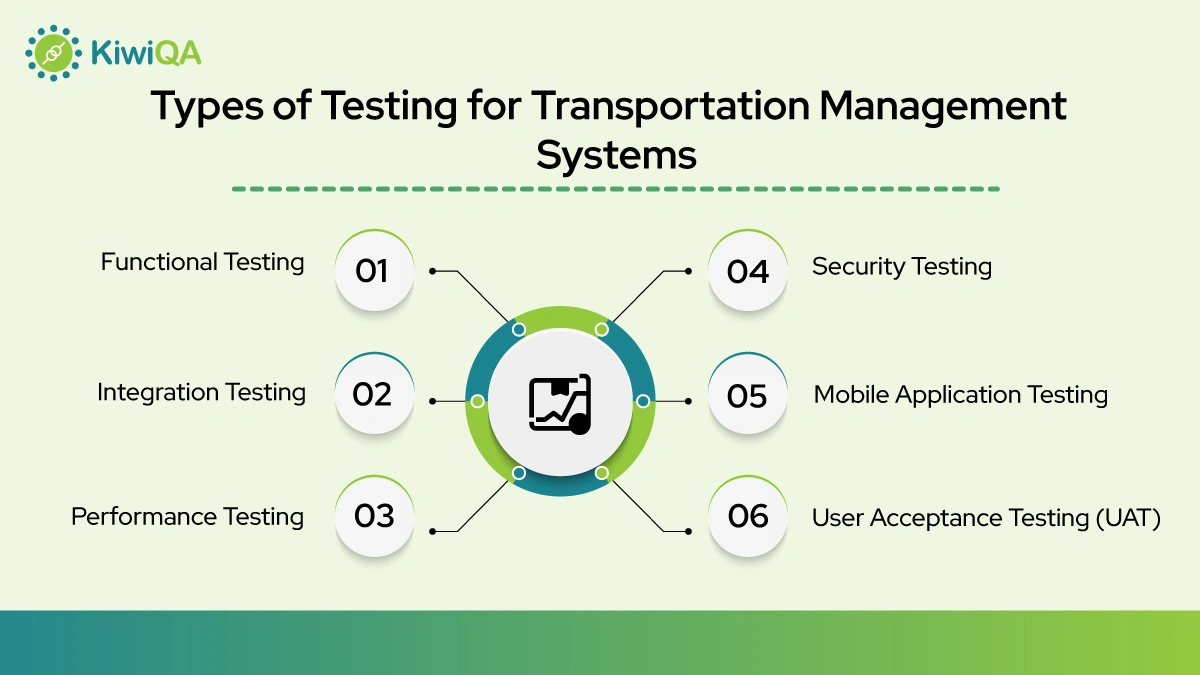
Key Types of Testing for Transportation Management Systems
◆ Functional Testing
Functional testing helps confirm that all features within the TMS are working in line with business standards.
⇒ Validation of Business Workflows
⤷ Examples of workflows tested include:
∘ Creation of shipment
∘ Assignment of carrier
∘ Route planning
∘ Freight billing
∘ Delivery confirmation
⇒ Order Creation and Shipment Processing
Every transportation order should properly progress in the system.
⤷ Testing of this aspect ensures:
∘ Entry of order
∘ Generation of shipment
∘ Scheduling of delivery
∘ Management of documentation
Logistics testing at a reliable level guarantees the continuous functioning of the processes that are business-critical.
◆ Integration Testing
Transportation systems are usually interconnected with several enterprise applications.
⇒ ERP Integration Testing
⤷ ERP integration testing checks:
∘ Synchronization of orders
∘ Exchange of financial information
∘ Updating of inventory
∘ Transfer of customer data
⇒ Warehouse Management System (WMS) Connectivity
Testing is done to check a seamless flow of information between TMS and WMS platforms.
⤷ Tests include:
∘ Inventory refresh
∘ Synchronization of shipment status
∘ Scheduling of warehouse workflows
◆ Performance Testing
Logistics platforms should be efficient in handling large amounts of transactions at any point in time.
⇒ Load Testing During Peak Shipping Periods
⤷ Load testing works on the following examples:
∘ Holiday shipping amounts
∘ Seasonal demand fluctuations
∘ Large-sized transportation operations
⇒ Response Time Measurement
⤷ Here are examples of what performance testing does:
∘ Speeds up processing of transactions
∘ Generates reports quickly
∘ Facilitates searching
∘ Efficient in running dashboards
Higher logistics software testing processes are made available to help maintain constant performance even during high times.
◆ Security Testing
Last but not least, transportation systems contain lots of confidential operating and customer information.
⇒ User Authentication Validation
⤷ Security testing makes sure:
∘ The different login steps
∘ The multi-factor authorization
∘ Managing passwords
⇒ Access Control Verification
⤷ Tests are done to see:
∘ User rights
∘ Access controls based on roles
∘ Administrative privileges
◆ Mobile Application Testing
A lot of transportation activities are done with the help of mobile apps.
⇒ Driver Application Testing
⤷ Tests cover:
∘ Navigation by the route
∘ Updates about deliveries
∘ Digital signatures
∘ Communication tools for drivers
⇒ Real-Time Tracking Functionality
⤷ Tests cover:
∘ GPS precision
∘ Updates on location
∘ Notifications
Among the reasons companies choose to perform logistics application testing, mobile logistics stands out quite often, especially as businesses also prioritize application security testing services to ensure that mobile and logistics applications remain secure, resilient, and protected against vulnerabilities while maintaining smooth functionality.
◆ User Acceptance Testing (UAT)
User acceptance testing determines whether the system can still fulfill operational needs.
⇒ End-User Workflow Validation
End-users do the real-life process verification.
⇒ Business Requirement Verification
⤷ Testing shows:
∘ Functional requirements
∘ Performance standards
∘ Compliance objectives
Choosing the Right Logistics Testing Service Provider
The choice of a testing partner is one of the key decisions for companies that are either implementing or upgrading their Transportation Management System (TMS). An experienced testing provider will support finding defects at an early stage, enhancing system reliability, lowering operational risks, and ensuring that logistics run without a hitch.
Conversely, an inexperienced provider may result in overlooking issues, postponing deployment, and increasing business costs. Businesses must carefully analyze prospective partners based on their knowledge of the industry, technical skills, and testing capacity, as well as their readiness to support long-term growth.
❒ Essential Evaluation Criteria
Organizations need to make sure that the potential testing partner not only has the technical capabilities but also possesses the industry-specific domain expertise to manage complex transportation and supply chain applications.
⇒ Industry Expertise
Transportation and logistics management systems have very specific workflows and integrations that lead to operational challenges. If a testing partner has already been exposed to this industry and features, they will know better the transportation processes and business requirements.
⤷ The areas of expertise need to be covered:
∘ Transportation Management Systems (TMS)
∘ Systems for Warehouse Management (WMS)
∘ Platforms for supply chain management
∘ Freight management solutions
∘ Carrier management systems
∘ Logistics tracking applications
Consultants who are experienced with logistics can quickly locate the source of the problem and suggest the most realistic solutions. These experts typically offer the advantages of quicker testing cycles and better-quality outcomes.
⇒ Automation Capabilities
It is well-known that logistics applications are continuously being updated, integrated, and optimized. Just doing the manual testing would not be enough to cover all cases deeply. Automation allows organizations to increase testing efficiency while also decreasing the costs and time required.
⤷ Some automation capabilities to consider are:
∘ Automated regression testing
∘ API and integration testing
∘ Performance testing automation
∘ Continuous testing support
∘ Test script maintenance
∘ Automated reporting and analytics
Many top logistics testing companies currently use sophisticated automation platforms that facilitate better test coverage, shorten release cycles, and maintain performance consistency across different environments.
❒ Questions to Ask Potential Providers
Good questioning can reveal the strength and suitability of a testing partner for organizations planning to undertake transportation and logistics projects.
⇒ Logistics Platform Experience
One good indicator of a service provider’s potential to deliver excellent testing outcomes is their experience with relevant logistics platforms. Knowing the providers’ past experience helps in looking at their technical skills and domain knowledge.
⤷ Here are some useful questions for the providers:
∘ Have you been involved in testing Transportation Management Systems?
∘ What kinds of logistics applications have you addressed?
∘ Are you familiar with multi-carrier environments?
∘ Have you worked with large-scale supply chain platforms?
∘ Can you share logistics-related case studies or success stories?
Current providers with extensive experience in logistics are better positioned to understand the unique challenges of the industry and provide testing solutions that work.
⇒ Performance Testing Expertise
Daily, transportation systems handle a large quantity of transactions and shipment updates. System-performance issues can have a direct negative effect on the efficiency of the operations and the satisfaction of customers.
⤷ Check the provider’s competencies to:
∘ Conduct load testing during the busiest hours of shipping
∘ Perform a scalability assessment
∘ Measure application response times
∘ Simulate transportation workloads
∘ Identify bottlenecks in performance
Companies with in-depth performance testing can guarantee that logistics systems will be operating in reliable conditions even when demand and transaction volumes are high.
❒ Expected Deliverables
Their role should be more than just performing test execution. Partners in professional testing ought to be able to deliver understandable insights, comprehensive reports, and feasible recommendations that would help companies enhance the quality and performance of their systems.
⇒ Defect Reports
Defect reports are usually the main focus of any testing project. It is through these reports that teams from development and operations get to know the issues, plan their fixes, and ultimately improve the quality of the application.
⤷ The essential defect report components include:
∘ Defect description
∘ Severity and priority levels
∘ Root cause analysis
∘ Step-by-step guide on reproducing issues
∘ Screenshots or other supporting evidence
∘ Resolution recommendations
Such detailed reporting leads to quicker issue fixation and better cooperation between the testing and development teams.
⇒ Performance Analysis
Performance analysis is the way to find out how the Transportation Management System operates under different working conditions.
⤷ The performance report should cover:
∘ Application response time
∘ System resource utilization
∘ Throughput measurements
∘ Scalability metrics
∘ Load testing results
∘ Performance improvement recommendations
With findings like these, companies are equipped to maximize the system’s performance and gear it for growth later.
Also Read: Top AI Chatbot QA and Testing Tools Businesses Leaders Must Use
How Logistics Testing Services Improve Supply Chain Performance
Transportation Management Systems that have been tested properly are one of the key factors that contribute to the improvement of the entire supply chain. Since a lot of stakeholders, systems, carriers, and processes are involved in logistics operations, even a tiny issue in the application can cause a chain reaction that leads to the disruption of the whole supply chain. Professional logistics testing services assist companies in discovering and fixing potential issues before they hinder the flow of everyday operations, thereby delivering more efficient workflows, better visibility, and improved business results.
Besides enhancing system reliability, thorough testing is one of the factors that lead to business gains through the transportation process. It helps companies to lessen operational risks and secure customer satisfaction. Those who implement quality assurance and logistics testing solutions are always ready for increasing transportation demands without sacrificing efficiency and operational costs.
❒ Improves Shipment Visibility and Real-Time Tracking
Considering the point of view of modern logistics, shipment visibility is one of the key aspects that make it stand out. Parties like customers, carriers, and logistics teams rely on real-time information to track deliveries and make decisions based on data. If there are any inaccuracies in tracing information, it can lead to confusion, customer complaints, and operational inefficiencies.
⇒ Testing guarantees customers access to:
∘ Precise shipment tracking details
∘ Updated status and notification on time
∘ Dependable delivery estimation
∘ Real-time location tracking
∘ Consistent tracking data across platforms
Organizations that verify their tracking processes, GPS integrations, and notification workflows with the help of testing are the ones that maintain complete shipment transparency. Increased transparency is also the way for enterprises to quickly respond to any delays, effectively communicate with their customers, and heighten trust throughout the delivery process.
❒ Reduces Operational Disruptions and System Issues
Transportation Management Systems enable the processing of a great number of transactions, shipment updates, and logistics data on a daily basis. However, if for some reason these systems break down or perform poorly, then the transport operations may very well be disrupted and thrown off track without any warning. Detailed testing serves as a means of finding system weaknesses and performance bottlenecks, which is the first step to be done before these can make an impact on business activities.
∘ System crashes and downtimes
∘ Process delays
∘ Data inconsistencies
∘ Integration failures
∘ Workflow interruptions
∘ Unexpected application errors
Checking the system behavior against different scenarios will enable companies to significantly reduce the occurrence of disruptions, thus maintaining operational continuity in transport. Higher productivity, more efficient use of resources, and above all, more dependable logistical operations are the outcomes of this.
❒ Optimizes Transportation Costs and Billing Accuracy
Among supply chain expenses, transportation costs are usually the highest. Mistakes in freight calculations, invoicing, or payment processes may not only lead to losses but also to disputes with the carriers. Extensive testing is used to make sure that all the calculations related to transportation and transaction processing are correct and accurate.
⇒ Testing covers the following aspects:
∘ Calculation of freight costs
∘ Processes of carrier billing
∘ Transportation rate management
∘ Cost allocation rules
∘ Invoice generation accuracy
∘ Payment processing workflows
Proper invoicing and cost control are two key elements of an organization’s ability to manage transportation expenses while reducing exposure to overpayments and discrepancies in accounting records. Companies that use professional logistics testing solutions often experience higher levels of financial control and operational efficiency.
Besides the listed contributions, good testing further strengthens supply chain performance through increased reliability of systems, enhanced customer experiences, and the use of data in decision-making. Companies that rely on professional logistics testing services have fewer risks, better transportation efficiencies, and a more resilient and scalable supply chain at their disposal for meeting long-term business growth goals.

Ready to Optimize Your Transportation Management System?
A Transportation Management System’s effectiveness is largely dependent on its reliability, performance, and accuracy. If it is not tested properly, there is a risk for businesses in terms of operational disruptions, shipment delays, and customer dissatisfaction.
Professional Logistics Testing Services possess the know-how to verify transportation operations, enhance system performance, ensure security, and provide seamless integrations. Organizations can greatly enhance transportation operations through comprehensive quality assurance, whether they are in need of logistics application testing, specialized logistics software, or full logistics testing consulting.
By working with experienced logistics testing companies, businesses can minimize risk, improve shipment visibility, and consistently satisfy customers while maximizing returns on transportation technology investments. As logistics networks continue to evolve, investing in reliable and expert logistics testing, advanced logistics testing solutions, and professional logistics software testing services becomes essential for long-term operational success and competitive advantage in the marketplace. Additionally, partnering with a QA security testing company ensures that applications are thoroughly evaluated for quality, security, and resilience against potential vulnerabilities before deployment.