

In the current virtual landscape, businesses track APIs during production to validate that the live endpoints are running & delivering the anticipated information to users. API testing service is a task that every business does before releasing changes to production. To verify the software app matches demands, they must be measured in both staging & development environments.
Today, 82% of businesses adopt AI-first delivery. APIs are frequently the best tool due to scalability, transparency, performance, and cost savings. In the rapidly evolving technological landscape, API is shaping the upcoming virtual economy. An API testing company acts as the backbone for digital transformation, making API testing more crucial than ever!
Understanding API Testing in the Enterprise Context
❐ What Is API Testing?
Finding out if a system’s APIs fulfill requirements for functionality, performance, and security is the goal of API testing services. The communication between various software systems and components is made possible by APIs, making it a significant component of software development and testing.
API testing is crucial since it helps guarantee that a system’s APIs are reliable and functioning properly for usage by other software programs and systems. This is especially crucial in modern application designs, as APIs are frequently utilized to facilitate integration and communication across various services and systems.
Performance bottlenecks, security flaws, and functional errors are just a few of the problems or flaws in the API implementation that can be found with the aid of API testing. By doing this, possible production issues can be avoided, and the software system’s quality and dependability can be enhanced.
In conclusion, an API testing service provider is crucial for ensuring that a system’s APIs are secure, efficient, and operating correctly, all of which are essential for the overall dependability and quality of the software system. Check out some API testing types enterprises require-
▪ Functional testing: Functional API testing confirms that endpoints operate in accordance with established business needs and standards. Functional testing ensures stable integrations and consistent user experiences across apps and associated systems by verifying that APIs carry out specified functions correctly.
▪ Performance testing: Performance API testing service provider India assesses system stability, scalability, response times, and throughput under various workload scenarios. Prior to production deployment, it detects resource limitations, latency problems, and bottlenecks.
▪ Security testing: Vulnerabilities in authentication, authorization, encryption, and data exposure processes are found through security API testing. It identifies threats like insecure endpoints, weak access controls, and injection attacks.
▪ Contract testing: Contract API testing services in India confirm that users and API providers follow established behavioral expectations and request-response architectures.
❐ Why API Testing Matters More Than Ever
Benefits of API testing guarantee that API flaws are found early in the development process rather than after deployment in contemporary DevOps and Agile setups. Teams may minimize rework, speed up release cycles, and cut expenses by early validation of endpoints, payloads, authentication, and error handling. Additionally, early API testing facilitates better developer-QA collaboration, resulting in quicker feedback loops, better code quality, and more consistent delivery schedules.
With dozens or even hundreds of APIs communicating at once, microservices architectures and third-party integrations greatly increase system complexity. The ecosystem as a whole may be upset by a little outage in one service. API testing guarantees that every service maintains constant performance, manages edge circumstances efficiently, and communicates dependably. Thorough testing across dispersed systems reduces integration problems, boosts robustness, and guarantees smooth end-to-end user experiences.
Businesses are depending more and more on partner and external APIs for analytics, payments, logistics, and authentication. Cascade failures across applications can be caused by any disturbance, an increase in latency, or a security vulnerability in these integrations. API testing helps with error response verification, fallback mechanism validation, and simulation of real-world situations. In spite of third-party dependencies, the advantages of API testing guarantee constant service delivery, preserve business continuity, and protect brand reputation.
Strong security measures must be implemented and validated by organizations in order to comply with compliance frameworks like the GDPR, PCI DSS, HIPAA, and SOC 2. API testing benefits data security, encryption, authorization, and authentication. Constant validation guarantees that audit requirements are fulfilled, sensitive data is managed securely, and regulatory fines or reputational concerns are kept to a minimum.

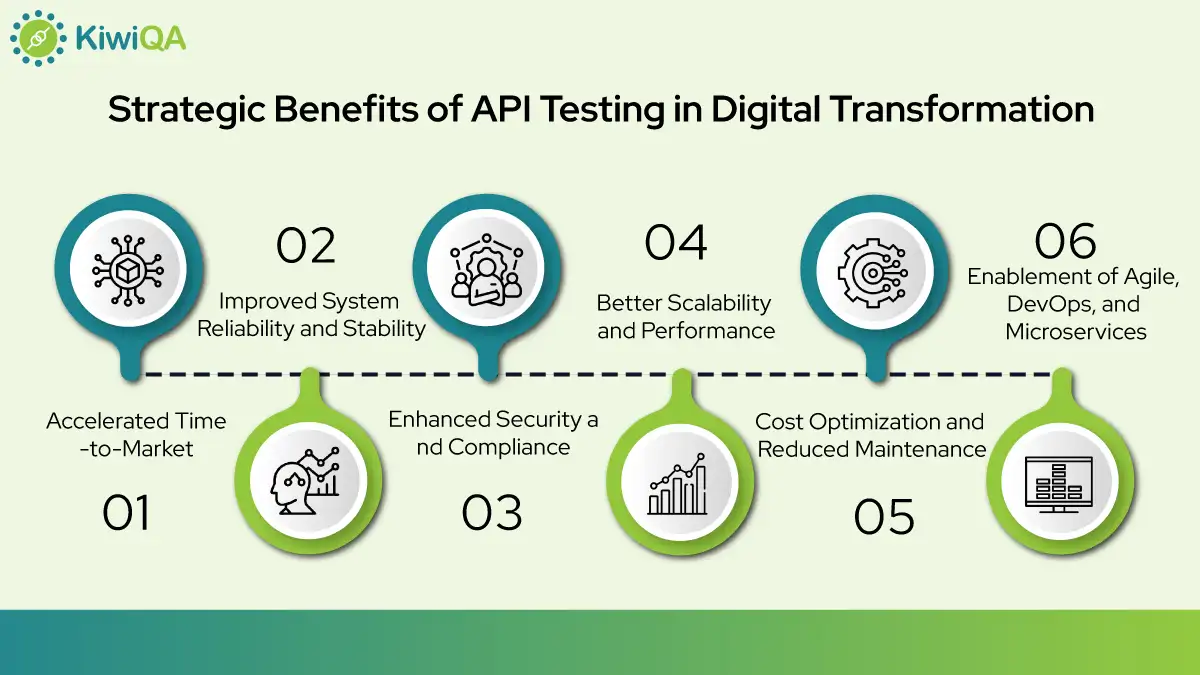
Strategic Benefits of API Testing in Digital Transformation
➯ Accelerated Time-to-Market
By guaranteeing that software components communicate dependably from the very beginning of development, API testing advantages are essential to speed up digital transformation. Teams can avoid release delays and save money by early validation. Teams can work more quickly without sacrificing quality, which guarantees reliable, scalable, and high-performing releases.
▫ Key benefits:
⤑ Reduced delays from late-stage defect discovery
Instead of finding flaws after deployment or during system testing, API testing finds them during development. This method guarantees that projects are completed on time without sacrificing quality at the last minute.
⤑ Higher deployment confidence for release teams
Before deployment, thorough automated API test coverage makes sure that data flows, business rules, and integrations work as intended. Release teams can reliably roll out upgrades with verified security, performance, and reliability tests. This increases stakeholder trust and maintains system stability.
⤑ Faster feedback loops that accelerate agile development
Instant feedback on code changes is provided by continuous API testing in CI/CD pipelines. Quick feedback iteration facilitates agile practices, which promote frequent iteration and improvement.
➯ Improved System Reliability and Stability
By verifying how apps connect across platforms, the API testing provider improves operational stability and system reliability. Even a small API failure can cause entire business workflows to be disrupted in today’s distributed systems. Thorough testing guarantees that APIs can carefully handle both expected and unforeseen situations. Proactive API testing provider protects user experience and brand reputation, guaranteeing consistent service delivery.
▫ Enterprise impact:
⤑ Fewer production incidents and emergency rollbacks
Business continuity is protected during high-traffic or mission-critical operations by minimizing unexpected failures through early identification of integration, performance, and security issues.
⤑ Higher service availability meeting stringent SLA commitments
Consistent uptime is supported by dependable APIs, which provide continuous system-to-system connectivity. By finding vulnerabilities, continuous testing assists businesses in meeting stringent SLA commitments.
⤑ Reduced mean time to resolution (MTTR) for critical incidents
Faster root cause investigation is made possible by well-tested APIs, which offer transparent error handling and monitoring information. This helps teams promptly restore services during critical incidents, lowers MTTR, and minimizes operational impact.
➯ Enhanced Security and Compliance
To protect digital ecosystems from changing cyberthreats and regulatory risks, API testing is essential. Organizations can identify vulnerabilities by methodically testing data handling procedures, encryption standards, authorization rules, and authentication techniques. Early testing guarantees that access controls work as intended across users. Governance frameworks are strengthened through ongoing verification of security configurations and compliance processes.
▫ Strategic value:
⤑ Reduced risk of data breaches and reputational damage
Thorough API security testing reduces vulnerability to online attacks by spotting flaws early. This approach lowers the risk of long-term reputational damage, operational disruption, regulatory fines, and data breaches.
⤑ Stronger trust with customers, partners, and regulatory bodies
Stakeholder confidence is increased by demonstrating regular security validation. Secure, compliant APIs increase a company’s reputation, foster client loyalty, and confidence among regulators and partners.
⤑ Lower compliance audit costs and faster certification processes
By keeping test evidence and written security rules up to date, continuous API validation expedites audit readiness. This decreases overall compliance management costs, expedites certification processes, and minimizes remediation efforts.
➯ Better Scalability and Performance
To make sure that systems can scale effectively while retaining excellent performance under a range of workloads, API testing is crucial. Organizations may enhance capacity planning, optimize infrastructure, and fine-tune setups by detecting errors. Applications are kept responsive and prepared to meet changing digital demands through ongoing performance assessment.
▫ Business outcomes:
⤑ Consistent customer experience during traffic spikes and seasonal demand peaks
Load and stress testing guarantee that APIs function accurately. During periods of high demand, consistent response times preserve user experience, lower abandonment rates, and uphold company reputation.
⤑ Infrastructure readiness for business expansion and scaling
Systems’ ability to accommodate new users, markets, and integrations is guaranteed by performance-tested APIs. Test-validated scalable architecture allows for smooth growth without any disruptions.
⤑ Optimized resource utilization, driving cost efficiency
Performance insights help in finding capacity shortages and wasteful resource use. Organizations can lower infrastructure costs while preserving high system responsiveness and dependability by optimizing server loads, database queries, and API requests.
➯ Cost Optimization and Reduced Maintenance
Through the prevention of faults from developing into costly production difficulties, API testing directly helps to long-term cost efficiency. Repeated repairs, emergency patches, and protracted debugging efforts are less necessary when integrations, data flows, and business logic are validated early.
Automated API test suites guarantee uniform coverage across releases while reducing the amount of manual QA work. Organizations can avoid the buildup of hidden technical vulnerabilities by detecting design flaws and integration gaps early. This methodical testing strategy eventually reduces maintenance costs, enhances operational stability, and builds a solid basis for ongoing digital transformation without raising support expenses.
▫ Financial advantages:
⤑ Lower QA and production support costs
Production flaws are reduced, and repetitive manual testing is decreased using automated API testing. Measurable cost reductions result from fewer critical occurrences, which also means fewer support tickets and less reliance on emergency response teams.
⤑ Improved ROI on digital transformation initiatives
System instability, rework, and project delays are all decreased via dependable APIs. In order to ensure that digital transformation projects yield quantifiable business value, faster releases and more reliable deployments optimize returns on technology investments.
⤑ Reduced technical debt accumulation, enabling sustained velocity
Continuous API validation keeps integration shortcuts and unfixed bugs from building up. Reduced technical debt facilitates more seamless updates, quicker feature releases, and long-term engineering efficiency.
Also Read: Best API Testing Service Providers in the USA for Startups and Enterprises
➯ Enablement of Agile, DevOps, and Microservices
For companies that use Agile, DevOps, and microservices, API testing is a fundamental enabler. APIs function as agreements between teams and services in distributed architectures, and their stability depends on ongoing validation. Quick iterations and secure deployments are supported by automated API tests included in CI/CD workflows.
Teams can operate autonomously without having to constantly check for cross-team dependencies by guaranteeing service reliability and backwards compatibility. While preserving governance, performance, and quality across intricate digital ecosystems, this improves cooperation, quickens release cycles, and enables businesses to innovate swiftly.
▫ Organizational benefits:
⤑ Increased team autonomy and development velocity
Teams may design and implement independently thanks to well-tested APIs, which serve as reliable contracts between services. Decreased interdependencies promote independence, optimize processes, and significantly accelerate development.
⤑ Faster innovation cycles enabling competitive advantage
Rapid product releases and experimentation are supported by dependable API ecosystems. Businesses may adjust swiftly to market demands, provide new capabilities more quickly, and keep a significant competitive advantage.
⤑ Reduced coordination overhead across distributed teams
Repeated cross-team verification is less necessary when API validation is automated. Consistent testing and clear interface contracts ease communication barriers and boost productivity amongst geographically distributed teams.
API Testing as a Business Enabler
API testing is now a critical business enabler that has a direct impact on revenue protection, customer happiness, and system reliability. Because businesses rely on third-party integrations and interconnected platforms, API failures can affect business KPIs and cause operational disruptions. Stable digital services across web, mobile, and partner ecosystems are ensured by ongoing validation of functionality, performance, and security.
By providing quick, consistent interactions, boosting trust, and lowering attrition, dependable APIs improve the customer experience. Through the facilitation of safe and smooth interfaces with outside suppliers, they also facilitate ecosystem alliances and platform-driven business models.
A key distinction in fiercely competitive digital businesses is outstanding dependability. Prioritizing API quality enables businesses to scale with confidence, innovate more quickly, and safeguard the reputation of their brands. In the end, API testing ensures digital transformation by coordinating technological performance with business results.
Best Practices for Implementing API Testing in Enterprises
⮩ Establish a Clear API Testing Strategy
Establishing a clear scope, ownership, and quantifiable success indicators that are in line with business requirements like uptime, revenue protection, and compliance is the first step in developing an efficient API testing plan. To guarantee optimal risk coverage, businesses should tie API validation to crucial user journeys and revenue-generating workflows.
To ensure uniformity among distant teams, robust governance frameworks must specify versioning guidelines, documentation procedures, and API standards. The goals of testing should also be in line with legal requirements and enterprise risk assessments. An organized approach guarantees that APIs continue to be safe, dependable, scalable, and completely in line with long-term objectives for digital transformation and business success metrics.
⮩ Shift Left and Automate
Defect leakage and rework are greatly decreased when API testing is moved earlier in the development process. In order to validate schemas, authentication, and business logic prior to integration stages, testing should start during the design and coding phases. Continuous validation and quick feedback on each code push are made possible by automated API tests integrated into CI/CD processes.
Implementing BDD and TDD improves quality right away. Before submitting pull requests, developers ought to have the authority to run API tests locally. In fast-paced Agile and DevOps environments, early automation guarantees safe, high-quality deployments, boosts release velocity, and enhances collaboration.
⮩ Leverage the Right Tools and Frameworks
Scalability, security, reporting capabilities, and integration needs all play a role in choosing the right API testing tools. Organizational maturity and architectural complexity must be taken into consideration when comparing open-source and enterprise platforms. Workflows are optimized through seamless integration with DevOps toolchains, including GitHub Actions, GitLab, Jenkins, and Azure DevOps.
Multiple API protocols, such as REST, GraphQL, SOAP, gRPC, and WebSockets, should be supported by the tools. Consistent validation across dynamic microservices architectures and intricate enterprise integrations is made possible by a scalable and adaptable framework.
⮩ Foster Collaboration Across Teams
Developers, QA engineers, security teams, and operations stakeholders must all share accountability for API quality. Service-level agreements (SLAs) and explicit API contracts improve accountability and lessen conflict between teams. Governance, automation maturity, and compliance readiness can all be improved by working with a seasoned API testing service provider.
Proactive problem-solving is ensured by integrating security and performance validation into development processes. Continuous feedback loops that link architectural choices to testing insights encourage openness and expedite resolution. Across organizational ecosystems, creativity, stability, and long-term digital growth are ultimately fueled by a collaborative culture.
Also Read: How the Advantages of API Testing Drive Faster Product Releases?
Challenges and How to Overcome Them
⮩ Common API Testing Challenges
APIs frequently depend on shared databases, environment-specific customizations, and interconnected services in distributed architectures. It becomes difficult to maintain reusable and consistent test data across development, staging, and production-like environments. False positives or untrustworthy test results may originate from inaccurate datasets, malfunctioning dependencies, or incompatible settings.
Execution timelines get even more complex when several teams coordinate environment availability. To guarantee reliable, repeatable API testing, businesses need to make investments in data masking, synthetic data generation, environment virtualization, and configuration management procedures. Defect diagnosis becomes much more time- and resource-intensive, and testing accuracy decreases in the absence of established data governance.
Testing procedures are made considerably more unpredictable by third-party APIs. Organizations frequently don’t have access to the provider’s internal modifications, rate caps, or performance limitations. It is challenging to properly validate edge cases or incorrect answers when documentation is lacking or out of date. Realistic performance or security testing may be limited by constrained sandbox settings. Furthermore, updates to external APIs could happen suddenly and disrupt integrations. An organization can use contract testing and frequent tracking approaches to limit risks.
Rapidly evolving, independently deployable services are a feature of microservices architectures. API test suites must be updated frequently due to endpoint changes, schema upgrades, and frequent releases. Automated scripts can easily become fragile or out-of-date if adequate version control and modular test architecture are not implemented.
It could be difficult for teams to keep coverage uniform across services with varying release schedules. Maintaining backwards compatibility and avoiding regression problems gets increasingly difficult as deployment frequency rises. To preserve accuracy without reducing the rate of innovation, businesses need to implement scalable test automation frameworks, contract testing procedures, and strong change management procedures.
Enterprise API testing is made more difficult by dynamic endpoints, changing service contracts, and changing API versions. Versioning strategies need to allow for innovation while maintaining backwards compatibility, yet poor management might cause dependent services to stop working. To avoid integration issues, team contract modifications necessitate coordinated updates and validation.
Complexity is further increased by testing time-sensitive data, tokens, and dynamic parameters. Mismatches can lead to cascade production problems in the absence of robust API governance and automated contract validation. To ensure stability across interconnected service ecosystems, organizations need to adopt consumer-driven contract testing, systematic version control, and clear documentation standards.
⮩ Mitigation Strategies
◇ Service virtualization and mocking:
During testing, teams can mimic unavailable or third-party services by using API mocking and service virtualization. Organizations can test integrations independently of external systems by simulating expected responses, edge cases, delay behaviors, and failure scenarios. Even in situations where external APIs have rate constraints, outages, or restricted sandbox access, this guarantees reliable, repeatable test execution. Additionally, performance simulations and negative testing that would not be possible in real-world settings are made possible by virtualized services. With dependable validation coverage, teams are able to increase control, lower external risks, and speed up development cycles.
◇ Contract testing:
Contract testing by an API testing service provider company guarantees that APIs fulfill the requirements established by customers and service providers. Organizations avoid breaking changes prior to deployment by validating data formats, behavioral agreements, and request-response architectures. Every time services change, automated verification is made possible by tools like Pact.
In microservices situations where independent teams routinely deploy, this strategy is very beneficial. Contract testing increases confidence in continuous delivery pipelines, improves backwards compatibility, and lowers integration problems. Producing legal service agreements drives collaboration between teams.
◇ Strong governance:
Across enterprise ecosystems, consistency, traceability, and maintainability are guaranteed by strong API governance. Endpoints, payload formats, authentication rules, and error codes are all included in thorough documentation, which lowers integration risks and ambiguity. Unambiguous versioning guidelines facilitate innovation while maintaining backwards compatibility.
Standardized validation criteria, enhanced coverage visibility, and reusable test cases are guaranteed by maintaining centralized test catalogues. Additionally, governance frameworks match business priorities and compliance needs with API design and testing. Businesses may avoid duplication, minimize faults resulting from inconsistent implementations, and provide a scalable foundation for long-term API lifecycle management by implementing organized oversight.
◇ Environment management:
Unreliable test results and deployment problems are frequently caused by inconsistent environments. Development, staging, and production runtime environments can be made consistent by utilizing orchestration systems like Kubernetes and containerization technologies like Docker.
By further standardizing setups, infrastructure-as-code techniques lessen configuration drift and human mistakes. Scalable and reproducible settings for API validation are guaranteed via automated provisioning. Collaboration amongst dispersed DevOps teams is improved, setup times are sped up, and dependability is increased with this standardized environment management.
◇ Test data management:
Realistic validation without disclosing private information is ensured by efficient test data management. Teams may produce scalable, production-like datasets that are suited to different test situations with the help of synthetic data generation. Data masking techniques enhance regulatory compliance by protecting sensitive financial records and PII. Organizations may lower security risks, improve compliance readiness, and enable scalable API testing without sacrificing data privacy or operational efficiency by implementing governance rules and segregating test data from real systems.

Turning API Testing into a Competitive Advantage—Let’s Build It Together
Today’s industry leaders are revolutionizing APIs into revenue-generating assets. Whether you aim for the comprehensive roadmap or an API assessment, by hiring an expert, businesses can ensure measurable business outcomes. By hiring API testing services in India, businesses can opt for a scalable & sustainable choice.