

Summarize this blog post with:


Quick Summary
Enterprise software testing helps organisations deliver secure, reliable, and high-performing applications. It identifies software defects, strengthens data protection, improves application performance, and ensures a seamless user experience. This guide covers the 12 key types of enterprise application testing, common testing challenges, essential services, and tips for choosing the right software testing partner. Beyond identifying defects, enterprise testing ensures that applications meet business requirements, support growing user demands, and integrate smoothly with existing systems. By adopting the right testing strategies, organisations can reduce operational risks, maintain software quality, and deliver consistent digital experiences as their business grows.
- Complete List of Enterprise Software Testing Services
- What Is Enterprise Software Testing?
- Why Do Businesses Need Enterprise Software Testing Services?
- Benefits of Outsourcing Enterprise Software Testing Services
- Complete List of Enterprise Software Testing Services
- 1. Functional Testing
- 2. Automation Testing
- 3. Performance Testing
- 4. Security Testing
- 5. Load Testing
- 6. API Testing
- 7. Regression Testing
- 8. Integration Testing
- 9. Penetration Testing
- 10. Compatibility Testing
- 11. Accessibility Testing
- 12. Usability Testing
- Key Challenges in Enterprise Software Testing
- ⮚ Complex Application Architecture
- ⮚ Large Volumes of Data
- ⮚ Security and Compliance Requirements
- ⮚ Frequent Software Updates
- ⮚ Limited Testing Resources
- How to Choose the Right Enterprise Software Testing Services
- Emerging Trends in Enterprise Software Testing
- ⮚ AI-Powered Test Automation
- ⮚ Shift-Left Testing
- ⮚ Cloud-Based Testing
- ⮚ Continuous Testing
- ⮚ Risk-Based Testing
- Ready to Improve Your Enterprise Software Quality?
Complete List of Enterprise Software Testing Services
Modern businesses depend on large, connected software platforms to run daily operations. In the event of a core system failure, companies lose money, experience downtime and lose customer confidence. It’s no longer an option for growing organizations to invest in reliable software testing services. Rigorous quality assurance enhances software reliability, safeguards user information, and ensures optimal performance during high workloads. According to IBM’s Cost of a Data Breach Report, the average cost of data breaches in India increased by 13%, highlighting the importance of robust software testing in identifying vulnerabilities and preventing security risks. This guide will introduce you to enterprise application testing, explain why organisations need it, explore the 12 key types of testing, discuss common challenges, and help you choose the right testing partner for your business.
What Is Enterprise Software Testing?
Enterprise application testing is the process of verifying large-scale software for businesses is secure, functions correctly, and is able to manage high user traffic without crashing. Corporate platforms integrate with databases, cloud platforms, payment gateways and third-party applications, whereas consumer applications do not.
These systems are validated by a quality assurance team that conducts scheduled checks on each software layer, from the backend APIs to the screens of the users. Enterprise testing services help guarantee that each workflow operates flawlessly before the change is implemented, as 1 small bug in an ERP or CRM can be the end of the world for scores of departments.
Why Do Businesses Need Enterprise Software Testing Services?
Many big organizations deal with high volumes of data and are servicing thousands of users at the same time. Professional testing ensures software quality, security and performance. The best software testing companies detect possible problems at an early stage, minimize risks and provide the reliability of software programs.
Enterprise testing services can also assist businesses in avoiding costly downtime, safeguarding sensitive data and ensuring smooth operations. Performance and security monitoring ensure proper operation and help applications evolve with increasing workloads. Reliable enterprise application testing solutions help businesses to scale their operations without any hesitations and provide them consistent digital experiences.
Also Read: How Much Does Software Testing Cost in 2027?
Benefits of Outsourcing Enterprise Software Testing Services
Businesses are able to gain an advantage over creating a large in-house QA team from scratch by joining forces with external enterprise application testing service providers.
➥ Quickly recruit QA experts: With immediate access to automation, security, API, and performance engineering experts.
➥ Lower software testing cost: Eliminate the high costs associated with hiring full-time employees, training employees and paying for expensive testing tool licenses.
➥ Enhance test efficiency: Built-in frameworks that reduce test preparation up to 40% by dedicated QA engineers.
➥ Rapid software releases: Continuous testing cycles ensure greater software stability while keeping pace with releases.
➥ Improved software quality: Testers look at your product in a fresh and unbiased way, uncovering areas that you may have overlooked.
Focus on core business activities: Your internal engineers can concentrate on building innovative features while a software testing services company handles validation.
Complete List of Enterprise Software Testing Services
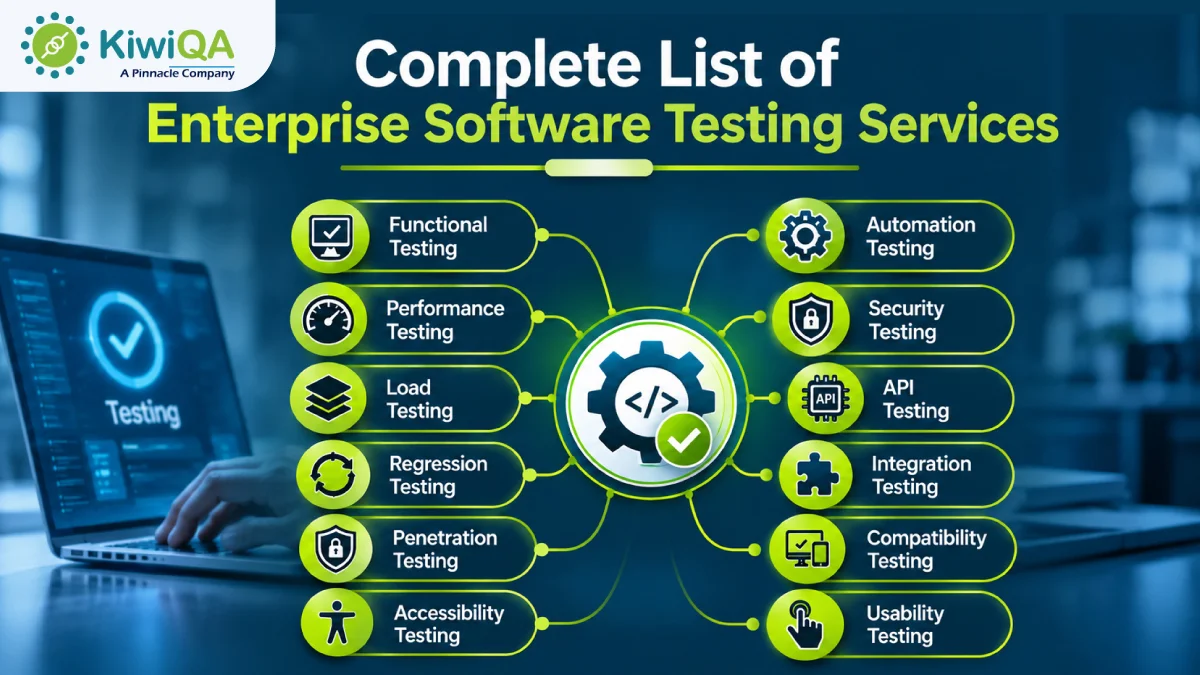
Many specialized test methods are needed to complete a quality strategy. The top enterprise application testing vendors offer the following 12 basic services:
1. Functional Testing
Functional testing ensures that each and every function in your software functions based on the business rules. The testers ensure that the system generates the desired results when users log in, submit forms and calculate, or make payments.
2. Automation Testing
Automation Testing involves executing the repetitive test cases automatically with scripts and specific tools. With enterprise applications testing services for automation, teams reduce manual effort, accelerate release cycles and attain greater test coverage.
3. Performance Testing
Performance testing measures the speed and stability of the application in its regular operating range. It records the time required for the response, server resource consumption, and system speed, eliminating bottlenecks.
4. Security Testing
During a security test, vulnerabilities in your code, networks, and databases are discovered. Complete enterprise application testing services can be used to confirm user authentication, data security and access controls to prevent unauthorized access.
5. Load Testing
Load Testing is intended to test your system with thousands of simultaneous users. It demonstrates the behavior of your infrastructure under load, like during holiday sales or end-of-month payroll, to prevent servers from crashing.
6. API Testing
The modern platforms are based on Application Programming Interfaces (APIs) that serve as connectors between services. API testing directly tests these connections behind the scenes to ensure that the data is accurate, the response is timely and there are no errors.
7. Regression Testing
Old functions may get broken due to accidents when developers add a new feature or fix a bug. Regression testing is the process of running previous test suites after each change to the code to verify that the previous functions are still being performed correctly.
8. Integration Testing
Large companies employ several tools, which have to communicate with each other. Integration testing ensures that distinct modules interact seamlessly and data is exchanged without any errors, including those with your CRM, billing software, and inventory database.
9. Penetration Testing
In a penetration test, an ethical hacker tries out a real-world attack on your software. This hands-on assessment reveals any vulnerabilities that the malicious actors might exploit before they do.
10. Compatibility Testing
Software is used by employees and customers on a variety of browsers, operating systems, and mobile devices. Compatibility testing helps assure that your application will render and behave exactly the same on every screen and platform.
11. Accessibility Testing
Accessibility testing ensures the software is accessible to individuals with visual, hearing or physical disability. It helps to ensure your digital products are accessible and legally compliant, such as with WCAG and treat all users fairly.
12. Usability Testing
Usability testing involves observing real users using your software to see how usable it is. Analyzing the menus that are confusing and/or the workflow that is slow will allow teams to create a cleaner, more user-friendly interface.
Key Challenges in Enterprise Software Testing
The challenges of testing large corporate platforms are different and demand tailored planning and adept enterprise applications testing services.
⮚ Complex Application Architecture
Legacy mainframes, third-party plugins, and cloud microservices typically work together in enterprise platforms. Creating a detailed business workflow across dozens of systems that connect is a technical challenge, and that’s where an experienced software testing services company comes in.
⮚ Large Volumes of Data
There are millions of records that are being processed by corporations every day. A significant logistical challenge is to create realistic test data without compromising private information from the customers and ensure that this information is accurate throughout the integrated databases.
⮚ Security and Compliance Requirements
Industries such as health care, banking, and retail need to adhere to various regulations, including HIPAA, GDPR, and PCI-DSS. There is a need to ensure that technical security and legal compliance are tested at each release.
⮚ Frequent Software Updates
Agile development teams release code updates weekly, or even daily. It is important to have ongoing coordination to ensure test suites are continually updated to prevent hidden bugs in new releases.
⮚ Limited Testing Resources
Internal IT teams are often pressed for time to launch and lack security, automation or load engineering expertise. It takes only a short amount of time to meet these skill gaps through working closely with a dedicated enterprise application testing service provider.
How to Choose the Right Enterprise Software Testing Services
Choosing the right enterprise application testing company will help you realize your quality costs. Here are six steps to consider when looking at vendors:
➥ Know your business needs: Determine what software priorities, expected release dates, and requirements you have before contacting vendors.
➥ Test budgets on critical software functionality: Prioritize testing against high-risk software operations like checkout, billing and data security.
➥ Analyze security and performance requirements: Verify that the provider has successfully managed load tests for high-usage environments and audited data protection.
➥ Talk about automation testing: Inquire with the vendor how they manage to combine manual exploratory testing and scripts to reduce the cost of long-term maintenance.
➥ Review the testing tools or technologies: Ensure that the software testing services provider has current CI/CD pipelines, cloud device farms and your required technologies.
➥ Choose experienced testing professionals: Review case studies and client feedback to confirm the enterprise application testing company has solved similar challenges in your industry.
Also Read: Top Enterprise Software Testing Companies in India
Emerging Trends in Enterprise Software Testing
Quality assurance is evolving as the new technologies of cloud and AI come to the fore. Here are the top 5 trends in enterprise testing services right now:
⮚ AI-Powered Test Automation
Teams can reduce test maintenance up to 50% through AI-generated test cases from user stories and auto-repair of broken scripts for changes to the user interface.
⮚ Shift-Left Testing
Shift-left testing brings quality testing up front in the software lifecycle. When caught early in design/development, code errors can eliminate up to 40% of bugs after release.
⮚ Cloud-Based Testing
Cloud platforms offer access to thousands of virtual servers, browsers and mobile devices as needed. Scale environments up or down at the click of a button, without the need for any physical equipment.
⮚ Continuous Testing
Continuous testing is embedded in the CI/CD process and automatically triggers tests with each developer’s commit. This provides instant feedback and enables fast and accurate software releases.
⮚ Risk-Based Testing
Risk-based testing prioritizes modules that have the most business value or the highest number of defects in the past. This way, you can achieve the highest quality even in a rushed schedule.
Ready to Improve Your Enterprise Software Quality?
The essential component of every modern business can be considered to be high performing and bug free software. Structured software testing services and enterprise applications testing services help organizations avoid significant downtime, protect critical data, and provide a smooth digital experience for users.
From the need for comprehensive test automation to security evaluations or expert advice from a trusted software testing consultancy, having the right testing partner is essential. Avoid relying on a downtime event to reveal flaws, work with an established enterprise application testing company, software testing consultancy, and best software testing companies now to create resilient and scalable software that can contribute to long-term business growth.
key-takeaways
- Improved Software Quality: Identify bugs and defects before they affect end users.
- Enhanced Security: Protect enterprise applications and sensitive business data from security threats.
- Better Performance: Ensure applications perform reliably under heavy workloads.
- Multiple Testing Types: Explore functional, performance, security, compatibility, usability, and other essential testing approaches.
- Reduced Business Risks: Detect potential issues early to minimise downtime and costly failures.
- Seamless User Experience: Deliver consistent application performance across devices, platforms, and environments.
- Right Testing Partner: Choose an experienced QA partner with the expertise, tools, and testing strategies your business needs.