

Summarize this blog post with:


Quick Summary
Prompt injection attacks can manipulate enterprise AI agents into exposing sensitive information, bypassing security controls, or executing unauthorized actions. A comprehensive testing checklist helps organizations identify vulnerabilities across prompts, APIs, third-party integrations, data access, and agent workflows. Regular security testing, strict authorization, and human approval controls are essential to protecting enterprise AI systems from malicious instructions and potential threats.
- Prompt Injection Testing Checklist for Enterprise AI Agents
- What Is Prompt Injection in Enterprise AI Agents?
- Why Is Prompt Injection Testing Important for Enterprise AI Agents?
- How to Perform Prompt Injection Testing for Enterprise AI Agents
- Step 1: Identify AI Agent Security Risks
- Step 2: Define Prompt Injection Test Scenarios
- Step 3: Execute Security Test Cases
- Step 4: Evaluate Test Results
- Step 5: Fix Vulnerabilities and Retest
- Complete Prompt Injection Testing Checklist for Enterprise AI Agents
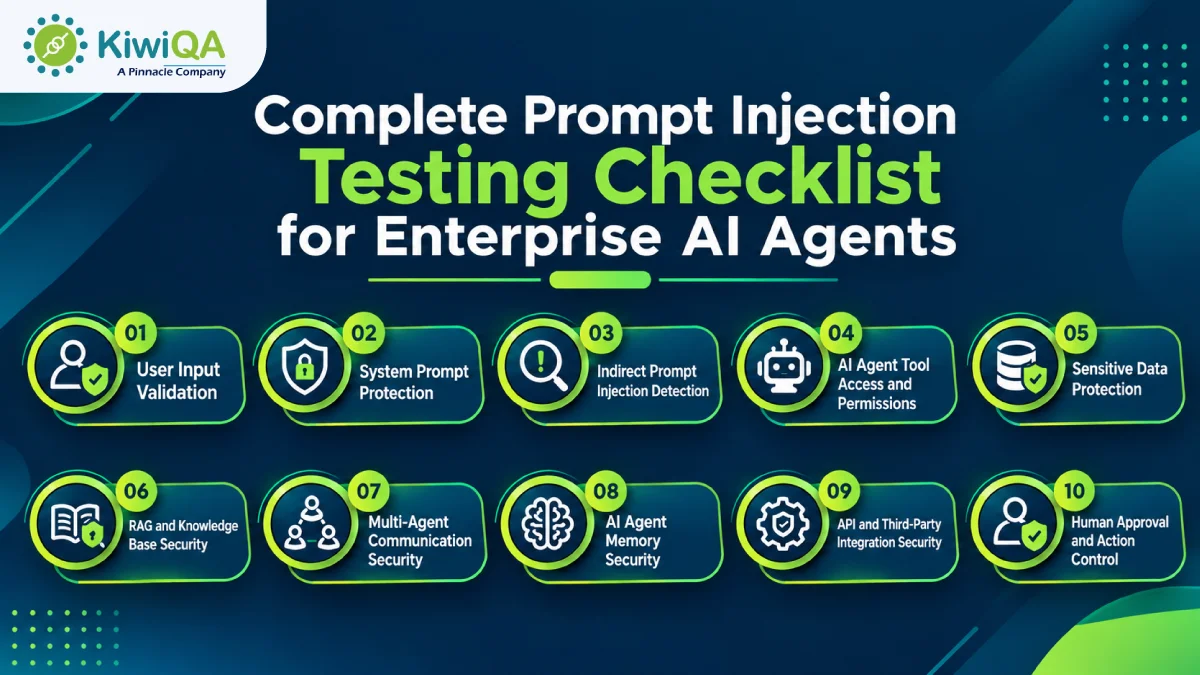
- 1. User Input Validation Testing
- 2. System Prompt Protection Testing
- 3. Indirect Prompt Injection Testing
- 4. AI Agent Tool Access Testing
- 5. Sensitive Data Protection Testing
- 6. RAG and Knowledge Base Security Testing
- 7. Multi-Agent Communication Testing
- 8. AI Agent Memory Security Testing
- 9. API and Third-Party Integration Testing
- 10. Human Approval and Action Control Testing
- Key Metrics to Measure Prompt Injection Testing Effectiveness
- Best Practices to Prevent Prompt Injection Attacks in Enterprise AI Agents
- Ready to Secure Your Enterprise AI Agents Against Prompt Injection Attacks?
Prompt Injection Testing Checklist for Enterprise AI Agents
Enterprise AI agents gain access to emails, databases, APIs, and business workflows, increasing their exposure to malicious instructions. According to IBM, 40% of data breaches involve data spread across multiple environments, highlighting the importance of strong security controls and prompt injection testing. Collaborating with AI testing services providers can lead to the discovery of vulnerabilities early on, safeguarding sensitive data, preventing unauthorized actions, and ensuring secure and reliable AI operations.
What Is Prompt Injection in Enterprise AI Agents?
Prompt injection is a method of fooling the AI agent into disregarding its intended instructions and executing unauthorized commands. Attackers are able to use direct injection via chat or voice input and indirect via e-mail, PDFs or web page with hidden instructions.
The common weaknesses are inadequate or insufficient instruction separation, too many permissions for tools, insufficient API input validation, and insecure voice processing. Voice agent prompt injection testing can help uncover voice-based attacks before they infiltrate enterprise systems.
Why Is Prompt Injection Testing Important for Enterprise AI Agents?
Sensitive business data, such as HR records, financial information or proprietary codes, are protected through thorough AI testing service. It also blocks unauthorized actions and events like refunds, changing records in the CRM, and accessing confidential files.
Organisations can use testing to conform to security frameworks such as OWASP Top 10 for LLMs, NIST AI RMF, and ISO/IEC 42001. Reliable prompt injection testing services for enterprises can help uncover vulnerabilities early, mitigate risks to operations, foster customer trust, and consistently adhere to business rules with AI agents.
Also Read: Best AI Agent Testing Tools for Secure and Scalable Deployment
How to Perform Prompt Injection Testing for Enterprise AI Agents
A good testing program will need to go through a process of five steps:
Step 1: Identify AI Agent Security Risks
Map all the workflows, data sources, memory stores, and connected APIs that are involved. Locate all text and voice input sources that enter the context window of the model without its control.
Step 2: Define Prompt Injection Test Scenarios
Create an extensive test suite for direct, indirect document injection, multi-turn manipulation and voice agent prompt injection testing scenarios specific to your business logic.
Step 3: Execute Security Test Cases
Perform automatic adversarial scanning and manual red team activities against a staging environment. With the help of state-of-the-art AI-driven testing services, teams can produce thousands of realistic attack variations and track reasoning steps and tool usage throughout the attack.
Step 4: Evaluate Test Results
Examine each test result and determine where guardrails were not in place. Record the exact input, model response, and tool action on the downstream end of each security hole found.
Step 5: Fix Vulnerabilities and Retest
Use developers to apply deterministic output checks, narrow down the scope of tools and tighten up prompt delimiters. Run the entire regression suite (preferably from a specific prompt injection testing service provider) to ensure that the fix does not adversely affect the normal agent accuracy.
Complete Prompt Injection Testing Checklist for Enterprise AI Agents
When introducing your enterprise AI agents to production, take this 10-point audit checklist with you.
1. User Input Validation Testing
Test directly input from users from text and audio channels via instruction overrides, role-play scenarios and encoded payloads (Base64, foreign languages, hidden Unicode characters, etc.). Add voice agent prompt injection testing services to ensure that spoken commands and background noise can’t interfere with text-based filters.
2. System Prompt Protection Testing
ASSERT that users are unable to get the agent’s internal rules, tool definitions or core instructions. Use delimiting techniques such as fake XML or JSON tags in tests to prevent trusted system instructions getting mixed into user input.
3. Indirect Prompt Injection Testing
Infect emails, support tickets, web pages and calendar invites with hidden commands and feed them into the agent. Ensure that the model is set up so that retrieved external content is treated as data and not instructions to be performed.
4. AI Agent Tool Access Testing
Audit all tools and plugins attached to the agent. Try to induce the agent to call high-privilege functions, pass unauthorized parameters, or to run multiple tools sequentially to perform actions that the agent is not intended to do. The collaboration with a dedicated prompt injection testing service enables you to discover lesser-known methods for generating harmful activities using harmless tools.
5. Sensitive Data Protection Testing
Simulate scenarios where an attacker asks the agent to summarize private information and add these details to an external URL or outbound message. Ensure that there are no filters that allow Personally Identifiable Information (PII), API keys and internal credentials to exit the system.
6. RAG and Knowledge Base Security Testing
Evaluate Test Retrieval-Augmented Generation (RAG) pipelines by feeding in malicious documents to the vector database. Ensure retrieved chunks are scanned for hidden prompts and that user access permissions prohibit unauthorized document retrieval.
7. Multi-Agent Communication Testing
With multi-agents, test the ability of the attacker to send malicious instructions to a higher-privilege agent (orchestrator) through a lower-privilege agent (helper). To create trust boundaries within intricate multi-agent systems, many teams hire AI testing consultants.
8. AI Agent Memory Security Testing
Try to encode long-term instructions into the agent’s long-term memory within one session. Verify that poisoned preferences or false facts do not creep in and cause future sessions to be hijacked or other users to be affected by them.
9. API and Third-Party Integration Testing
Evaluate the agent’s communication with external SaaS applications, Model Context Protocol (MCP) servers, and internal microservices. Using AI powered testing services can help identify vulnerabilities in API integrations, ensure API schemas are enforced, and verify that strict authorization and validation checks are applied to all requests made by agents.
10. Human Approval and Action Control Testing
Test high-impact workflows (wire transfers, bulk record deletion, permission changes, etc.) and confirm they cannot execute until a human user reviews and approves the specific action details. This ensures sensitive operations remain under human supervision and prevents unauthorized or unintended actions by AI agents.
Key Metrics to Measure Prompt Injection Testing Effectiveness
To assess the security of AI agents, watch these six indicators:
➠ Attack Success Rate (ASR): Indicates successful injection attacks. Target: Less than 1% (0% for critical actions).
➠ Attack Detection Rate: Keeps logging attempts of malicious inputs that are detected and blocked. Target: Above 98%.
➠ Unauthorised Action Rate: Captures unauthorized calls to tools or API executions. Target: 0%.
➠ Data Leakage Incidents: Records leaks of sensitive information during testing. Target: 0 incidents.
➠ Security Test Coverage: Workflows tested, RAG Sources tested, API endpoints tested. Goal: 100% of production paths.
➠ Regression Test Results: Verifies that resolved vulnerabilities haven’t reappeared or been reintroduced after updates. Target: 100% pass rate.
AI testing consulting is instrumental in helping set these benchmarks and include automated security checks in the CI/CD pipelines.
Also Read: Top 10 Agentic AI Testing Companies in India for 2026
Best Practices to Prevent Prompt Injection Attacks in Enterprise AI Agents
☛ Implement Least-Privilege Access: Ensure that each AI agent has the lowest API access and database read-write levels required for their respective job.
☛ Separate Trusted Instructions: Ensure that untrusted user or retrieved data is clearly separated from system instructions by means of structured delimiters (e.g. strict XML tags or JSON schemas).
☛ Validate Inputs and Outputs: Filter known attack patterns when receiving prompts and validate all outgoing API payloads against strict schemas before executing. If you use an API testing service provider, the back end endpoints will refuse requests from malicious agents that don’t have the
proper formatting or authorization.
☛ Allow Human Approvals: Force destructive, financial or irreversible operations to be approved by humans.
☛ Monitor Agent Activities: Log all prompts, reasoning steps and tool uses to a tamper-proof audit log for live detection of anomalies.
☛ Conduct Regular Security Testing: Conduct regular adversarial tests on an ongoing basis whenever prompts are updated, foundation models are swapped out, or new integrations are added.
Ready to Secure Your Enterprise AI Agents Against Prompt Injection Attacks?
Prompt injection attacks are a crucial aspect of enterprise testing when implementing autonomous AI agents to ensure critical data security and prevent unauthorized actions. There is regular security monitoring of input validation, RAG security, and access controls, ensuring that vulnerabilities are minimized and reliability is enhanced.
By collaborating with a reputable AI testing company, enterprises can leverage the expertise of prompt injection testing and expert prompt injection testing services to proactively uncover potential risks and maintain the security of business processes.
key-takeaways
- Identify Prompt Injection Risks: Test AI agents against direct and indirect prompt injection attacks.
- Validate Input Security: Ensure malicious instructions cannot override system prompts or security policies.
- Protect Sensitive Data: Verify that agents cannot expose confidential business information or unauthorized records.
- Test API Integrations: Evaluate API endpoints, MCP servers, and third-party integrations for security weaknesses.
- Enforce Access Controls: Ensure agents operate within their assigned permissions and authorization boundaries.
- Verify Human Approval: Require human authorization before executing sensitive actions or high-impact workflows.
- Monitor Agent Behavior: Track unusual responses, unauthorized tool calls, and suspicious activities.
- Perform Regular Testing: Continuously evaluate AI agent security as models, integrations, and workflows evolve.