
In today’s business environment, cybersecurity impacts virtually every facet of operations. Businesses depend on web applications, mobile applications, APIs, cloud platforms, and third-party services to support their day-to-day business. Each connection can also serve as another avenue through which attackers can move.
A reputable security testing services company can help businesses find weaknesses before attackers use them. Security testing is not a substitute for security firewalls, access control, or monitoring. Rather, it is a way to determine if those controls are effective when someone attempts to evade them.
Data breaches are extremely expensive, with the latest reports indicating an average worldwide loss exceeding $4.88 million for an organization. Non-compliance can lead to legal and business issues, particularly for companies dealing with healthcare, payment, or personal information. Therefore, it is crucial for organizations to select an experienced security testing company to gain insights into their actual security risks and implement meaningful measures to mitigate them.
Why Businesses Need Security Testing Services in 2026
Businesses are now deploying and developing software more quickly than ever. Meanwhile, attackers exploit application, identity, cloud and third-party system weaknesses. CISA maintains a Known Exploited Vulnerabilities catalog that details evidence of attacks that exploit the listed vulnerabilities, making it important to focus on vulnerabilities with an exploitation risk.
❒ Increasing Cybersecurity Threats
Ransomware, phishing, and credential attacks continue to be a real threat. Cloud services, SaaS platforms and APIs are additional targets for attackers as they frequently link valuable data and business processes. Third-party integrations pose additional risks as an organization may rely on software and services which it cannot fully control. Security testing can help teams look at these connections rather than assuming the security of all elements.
API security is a special topic. The OWASP’s 2023 API Security Top 10 lists broken authorization and broken authentication and other API-specific risks. In addition, OWASP highlights that three out of five of its API risks are related to authorization.
❒ Regulatory and Compliance Requirements
Security testing is also used to fulfill regulatory and contractual needs. GDPR regulates the personal data of individuals who live in the European Union and may affect organizations outside of the EU. Under HIPAA, covered organizations and business associates must implement safeguards to ensure the security of electronic protected health information.
PCI DSS specifies security requirements for organizations handling payment card data, SOC 2 tests against its Trust Services Criteria. ISO/IEC 27001 specifies the
requirements for implementing an ISMS and provides a continuous information security risk identification and management process.
❒ Rapid Adoption of Emerging Technologies
The attack surface has evolved with the use of AI applications, cloud-native platforms, IoT devices, APIs and microservices. Most modern applications are not “stand-alone” applications. They communicate with each other via APIs, rely on third-party libraries, and commonly span multiple cloud services.
That makes testing a bit more complicated. An application’s security can’t be judged by its secure login page alone. Testers need to look at authentication, authorization, data flows, integrations, configurations, and how different components work together.
How to Choose the Right Security Testing Company
The right security testing services company should be aligned with your technology, industry, risk level and compliance requirements. Don’t choose a provider simply because they have a long list of testing tools. Look at its methodology, tester experience, reporting quality, certifications and ability to explain technical findings in business terms.
❋ Identify Your Security Testing Requirements
Firstly, determine what is to be tested. You might be looking at application security, network security, cloud security, API security and/or compliance testing. For example, a web application might require penetration testing or secure code review, and a cloud platform might require configuration or identity and container testing.
A clear scope also makes it easier to compare proposals. Inquire about whether the provider will test the production, staging, or both; what systems will be included and which actions will not be. NIST SP 800-115 suggests a systematic process for planning, performing, and reporting on technical security testing.
❋ Review Industry-Specific Experience
Testing can be more useful if there is industry experience. Patient information is sensitive data that must be handled carefully in a healthcare system. Financial and banking operations require robust transaction, authentication and authorization controls. Retail or eCommerce systems must have security measures in place to safeguard customer data and payment information. Deep API, cloud, and application testing is critical for SaaS and tech enterprises.
Public-sector projects may also involve specific security frameworks and procurement requirements. When comparing a security testing company, request relevant case studies and examples of comparable settings, as well as a generic listing of services.
❋ Check Certifications and Compliance Expertise
Search for OSCP, CISSP, CEH, CISA, CREST and GIAC certified professionals. These certifications have different uses. One is practical penetration testing (OSCP), and the other is widespread security leadership and governance (CISSP). CISA emphasizes auditing and controls, while the GIAC certifications address specific technical security disciplines.
Don’t rely on a certification as proof of quality. Inquire about the actual crew of certified professionals who will be working on your project and the amount of relevant experience they possess.
❋ Understand the Testing Methodology
Automated tools can efficiently test large areas within a short period, and skilled testers can find the uncommon behavior and business-logic defects.
Inquire about the team’s approach to black-box, white-box and grey-box testing. You should also inquire about alignment with OWASP and NIST guidance, risk prioritization, and retesting. A robust process should go from scope and reconnaissance to testing, analysis, reporting and verification.
❋ Evaluate the Quality of Security Reports
A report should make the technical and business teams aware of what to focus on. It should contain an executive summary, vulnerability description, severity, proof of concept, business impact, and practical remediation recommendations.
A good report should also explain affected assets and reproduction steps without creating unnecessary confusion. Most importantly, the report should allow your team to make a decision about what to repair first.
❋ Compare Pricing and Engagement Models
There are varying models for engagement. With clearly defined assessments, fixed price projects can be effective. Use hourly engagements if there is a possibility of scope changes. Dedicated teams are ideal for businesses with frequent testing needs.
Subscription models and continuous testing can cater to DevSecOps teams that are deploying software on a regular basis. Look beyond just the price, and compare scope, tester experience, reporting, retesting and support each proposal offers.
Also Read: Top 10 Security Testing Companies in India (Edition 2026)
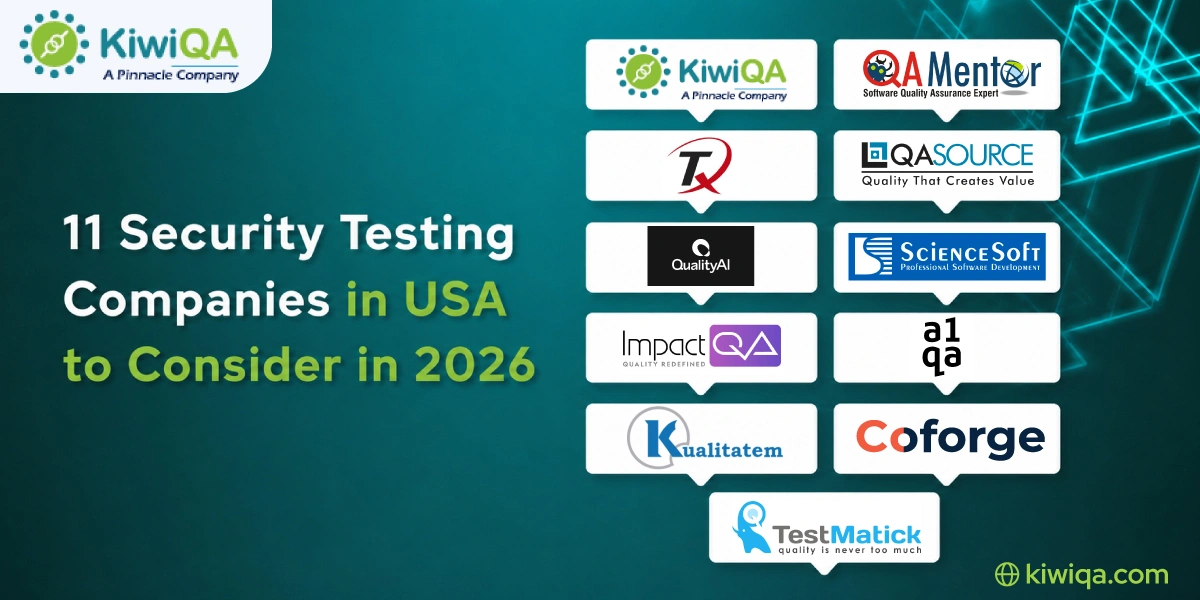
11 Security Testing Companies in USA for 2026
Here is a curated list of the best security testing companies in the USA based on their published testing capabilities, years of experience, industry coverage, and certifications.
1. KiwiQA
KiwiQA offers independent software testing in automation, manual testing, mobile, cloud, performance and security. They use a proprietary, home-grown framework called K-FAST for intelligent automation and K-SPARC for deep performance testing.
⮱ Best For: For startups and expanding businesses, cost-effective solutions with automated testing frameworks can be beneficial.
⮱ Pros: Highly flexible engagement models and proven in-house testing frameworks.
| Key Points | Services Provided |
|---|---|
| Founded Year: 2009 | Security Testing |
| Number of Employees: 51-200 | SEO Testing |
| Location: India ( Serving in USA) | SAP Testing |
| LinkedIn: View Profile | CRM Testing |
| Website: KiwiQA | AI Testing |
2. QA Mentor
Established in 2010, QA Mentor is a NY-based company that offers a wide variety of QA and testing services. This high-end software security testing company routinely assists startups and Fortune 500 companies when they have to launch high-performing and secure software products.
⮱ Best For: Companies that want a hybrid onshore/offshore model with tight budgets.
⮱ Pros: They offer extremely customizable testing packages starting at competitive rates.
| Key Points | Services Provided |
|---|---|
| Founded Year: 2010 | Security Testing |
| Number of Employees: 201-500 | Compatability Testing |
| Location: USA | Automation Testing |
| LinkedIn: View Profile | Game Testing |
3. TestingXperts
TestingXperts, or Tx, has more than 25 years of quality assurance leadership and is aggressively operating out of 13 global offices. They have successfully delivered more than 60 Testing Centers of Excellence and routinely support Fortune 500 businesses through their enterprise-level transformations.
⮱ Best For: Large enterprises that are going through massive digital and cloud transformation.
⮱ Pros: Deep expertise in AI-driven DevSecOps and a massive global footprint for fast response times.
| Key Points | Services Provided |
|---|---|
| Founded Year: 2013 | Security Testing |
| Number of Employees: 1,001-5,000 | Performance Testing |
| Location: USA | Mobile Testing |
| LinkedIn: View Profile | Cloud Testing |
4. QASource
QASource has an on-demand team of skilled software testing engineers that can support you to scale your security efforts in an instant. They have 25 years of vast expertise and are particularly focused on SaaS, cloud services, finance, healthcare, and legal sectors.
⮱ Best For: SaaS and financial organizations that must quickly scale up (or down).
⮱ Pros: Incredible flexibility in team scaling and highly tailored security protocols.
| Key Points | Services Provided |
|---|---|
| Founded Year:2000 | Security Testing |
| Number of Employees: 1,001-5,000 | Mobile App Testing |
| Location: USA | Performance Testing |
| LinkedIn: View Profile | Test Automation |
5. QualityAI

QualityAI positions itself as an AI-first quality engineering company. It aims at designing quality early and minimizing risk throughout the technology life cycle.
⮱ Best For: Organizations looking to embrace security in the DevOps lifecycle and incorporate AI directly into their CI/CD pipelines.
⮱ Pros: Industry-leading AI integration and strong partnerships with tools like Tricentis.
| Key Points | Services Provided |
|---|---|
| Founded Year: 1997 | Security Testing |
| Number of Employees: 5,001-10,000 | Functional Testing |
| Location: USA | non-functional testing |
| LinkedIn: View Profile | software testing |
6. ScienceSoft
ScienceSoft joins the cybersecurity table with 37 years of rich and technical expertise in AI and software engineering. They have successfully delivered more than 4,300 projects in the areas of advanced cybersecurity services, AI transformation, and complex data analytics.
⮱ Best For: Healthcare and financial institutions that need extensive, regulatory-focused compliance testing.
⮱ Pros: Decades of proven experience and certified ethical hackers capable of finding complex, chained exploits.
| Key Points | Services Provided |
|---|---|
| Founded Year: 1989 | Security testing |
| Number of Employees: 501-1,000 | Cybersecurity |
| Location: USA | Penetration Testing |
| LinkedIn: View Profile | SIEM Services |
7. ImpactQA
As an AI-powered quality engineering firm, ImpactQA delivers global excellence with more than 14 years of continuous success. They are an application security testing company, offering end-to-end AI software testing for complex web, mobile, cloud, and ERP applications at highly competitive rates.
⮱ Best For: Global enterprises looking for a follow-the-sun delivery model to speed up testing cycles.
⮱ Pros: Highly cost-effective rates without compromising quality, often much cheaper than Western markets.
| Key Points | Services Provided |
|---|---|
| Founded Year: 2012 | Security Testing |
| Number of Employees: 201-500 | Software Testing |
| Location: USA | Accessibility Testing |
| LinkedIn: View Profile | AI Testing |
8. a1qa
Since 2003, a1qa has been offering software testing services. They are a 100% ISO certified pure play testing provider and provide the best QA solutions in any complex environment/industry. They manage both intricate manual testing and advanced automated services efficiently.
⮱ Best For: Businesses seeking a pure-play QA provider instead of an IT services provider.
⮱ Pros: Specialized in quality assurance; known for having proactive and diligent testers.
| Key Points | Services Provided |
|---|---|
| Founded Year: 2003 | security testing |
| Number of Employees: 1,001-5,000 | functional testing |
| Location: USA | AI-powered testing |
| LinkedIn: View Profile | AI testing |
9. Kualitatem
Kualitatem offers web and mobile penetration testing, cybersecurity audits, security code reviews, and vulnerability-focused testing. The firm makes a point of identifying vulnerabilities before hackers do, and it also helps businesses meet compliance mandates.
⮱ Best For: Highly-regulated industries where manual testing is required.
⮱ Pros: Best-in-class manual testing capabilities that can identify deep vulnerabilities, and it is backed by top-tier process maturity.
| Key Points | Services Provided |
|---|---|
| Founded Year: 2010 | Security Testing |
| Number of Employees: 201-500 | Automation Testing |
| Location: USA | Performance Testing |
| LinkedIn: View Profile | Functional Testing |
10. Coforge
Cigniti is known for its transparency and technical credibility. They utilize dedicated, secure mobile and robotics labs to provide digital assurance for Fortune 500 companies.
⮱ Best For: Large global companies requiring a large volume of physical testing labs.
⮱ Pros: Cutting-edge physical testing environments and strong analyst recognition.
| Key Points | Services Provided |
|---|---|
| Founded Year: 1992 | Security Testing |
| Number of Employees: 10,001+ | Regression Testing |
| Location: USA | Functional Testing |
| LinkedIn: View Profile | DevOps Testing |
11. TestMatick
According to Clutch, TestMatick is among the highest-rated software testing firms in the world. The company pledges prompt response and claims that its QA team can take testing tasks within an hour of receiving them.
⮱ Best For: Tech companies that need rapid testing, but without weeks of contract negotiations.
⮱ Pros: Onboarding is extremely quick, there is no initial bureaucracy, and they even provide a free pilot project.
| Key Points | Services Provided |
|---|---|
| Founded Year: 2009 | Security Testing |
| Number of Employees: 51-200 | Web App Testing |
| Location: USA | Usability Testing |
| LinkedIn: View Profile | AI Testing |
Security Testing Services Offered by These Companies
Different security testing companies in the USA have different components to their services, so businesses should check what is included in each proposal. Popular services include penetration testing, vulnerability assessment, application security, API security, cloud security, and compliance testing.
❒ Penetration Testing
Penetration testing is the process of allowing simulated attacks on authorized systems. Experts conduct web application penetration testing and mobile application penetration testing to break into your systems just like a real hacker would. They also perform tricky social engineering testing, network penetration testing, and cloud penetration testing to test the effectiveness of your employees against phishing scams.
Security testing services should define written authorization and the rules of engagement before testing. Black box testing provides little internal information to the tester while white box testing provides extensive knowledge and grey box testing falls somewhere in between.
❒ Vulnerability Assessment
Vulnerability assessment is typically done with both automated and manual validation. The process looks for weaknesses and validates and prioritizes findings based on risk.
Security testing companies in the USA offer transparent risk prioritization, in-depth remediation advice, and rigorous retesting and verification to ensure your systems are truly secure.
❒ Application Security Testing
Providers conduct static application security testing, which involves analyzing the application code, or dynamic application security testing, which involves testing applications during runtime. Secure code reviews can be used to identify weaknesses before deployment, and software composition analysis can be used to identify risks in third-party components.
This multi-layered strategy ensures that security is taken care of throughout the software development lifecycle, rather than at the time of software release.
❒ API Security Testing
API testing verifies authentication, authorization, data exposure, rate limits, and individual endpoints. The API Security Top 10 by OWASP points to challenges like broken object-level authorization and broken authentication. To test data pipelines for authentication and authorization, you need high-quality software security testing services.
Testers can also check for excessive data exposure, security misconfiguration, and unsafe use of third-party APIs. These checks are important because APIs frequently make a direct link between applications and vital business information.
❒ Cloud Security Testing
Cloud testing can analyze configuration, identity and access management, containers, Kubernetes environments and serverless applications. Testers can also measure cloud compliance and detect any over-permissioned access or services exposed.
Cloud security requirements need continuous auditing, because teams often make changes to the configurations and deploy new workloads, as well as additional services.
❒ Compliance Security Testing
Security assessment teams conduct rigorous HIPAA security assessments to ensure the utmost protection of patient information, and deep PCI DSS testing to ensure the protection of massive payment pipelines.
They also perform comprehensive SOC 2 readiness assessments, ISO 27001 audits, and GDPR related security controls to keep you from facing huge financial penalties.
Also Read: Complete List of Security Testing Services for Web & Mobile Applications
Security Testing Trends to Watch in 2026
Security testing will continue to become increasingly integrated with software development and operations. A web application security testing company validates security with the help of AI, continuous testing, APIs, cloud-native architectures and identity controls.
❋ AI-Powered Security Testing
AI can automate vulnerability identification, threat detection, and risk prioritization. It can analyze large volumes of testing data and guide the teams to prioritize results that are significant.
But AI shouldn’t replace skilled security professionals. Human testers still have to confirm results, comprehend business rules and assess real-world consequences.
❋ Continuous Security Testing
Annual testing alone may not be enough for applications that change every week. Today, top engineering teams advocate for the integration of security into CI/CD pipelines as well as full DevSecOps implementation. In the case of applications that change weekly, a yearly security test cannot offer total visibility.
Continuous testing can be used to embed security tests within CI/CD pipelines and DevSecOps. Teams can observe newly identified vulnerabilities and evaluate the key changes prior to deployment or production.
❋ Increased API Security Testing
Advanced security testing services are actively needed by businesses to ensure authentication and access-control testing is strictly adhered to on all endpoints. Testing should include authentication, authorization, and access control for various user roles.
It should also ensure sensitive data exposure and rate limits. API testing should therefore be an integral part of modern application security and not be an add-on to software security testing services.
❋ Cloud-Native Security Testing
Traditional security tools may not cover the risks created by containers, Kubernetes, and serverless workloads. Testing methods should match the architecture being assessed. To secure your modern digital workloads, you must identify specific security practices that need to be in place in your containers and Kubernetes environments.
This may be more complicated in multi-cloud setups, where controls and configurations vary between different clouds. For this reason, security teams should evaluate the entire cloud environment and its associated components, and not just test a single cloud account.
❋ Zero-Trust Security Assessments
In contrast to traditional security models that assume users and devices are trusted if they’re inside a network, Zero Trust is about establishing identity and access. With strict zero-trust principles, you have to explicitly confirm each and every network request regardless of its origin.
Testers perform identity verification testing, rigorous network segmentation testing, and comprehensive access control testing to ensure that a compromise in one specific department can’t creep up the network to other departments.
Ready to Strengthen Your Business with Security Testing?
Security testing provides a real-world approach to identifying vulnerabilities before attackers make them real-world problems. It can mitigate exposure, facilitate compliance, and increase confidence for applications, APIs, and cloud systems. The best programs incorporate automated scanning, professional manual testing, transparent reporting and retesting following remediation.
When considering a security testing service provider, don’t just consider the service catalog. Assess relevant experiences, qualifications of the testers, test methodology, quality of reporting, test compliance, and the level of support provided. A provider equipped with the knowledge of your technology and business risks can help you transform security testing from an audit to a valuable component of your security strategy.