

With over 3.7 billion smartphone users worldwide & millions of apps out there, securing a mobile app is no longer an option. Security testing services have become a necessity as privacy breaches are hampered by attackers. These breaches can be anything like XSS, data leaks, and malware attacks. Later, it will broadly hamper the brand name & client retention. By hiring the best testing partner, a business can ensure that the app risks are minimized and improve QA.
According to the Veracode State of Software Security Report, 25% of applications contain high-risk vulnerabilities, making security testing a non-negotiable action for businesses. Security breaches in applications not only disrupt user experience but also put sensitive data, privacy, and compliance at risk. Implementing comprehensive security testing services helps organisations identify vulnerabilities early, reduce cyber threats, and ensure safer applications across multiple industry verticals.
What is Security Testing?
✥ Definition & Purpose
The main goal of security testing is to make sure that applications are safe from unauthorized access, data breaches, and cyberattacks. It aims to preserve the safety, integrity & accessibility to information. Security testing is the process of assessing software, systems, or networks to find vulnerabilities and risks that could affect data and functionality.
✥ Key Objectives of Security Testing
⮩ Confidentiality
Sensitive data is only accessible by the authorized team thanks to confidentiality. To stop illegal access, data leakage, or exposure, security testing confirms encryption, access controls, and data protection measures.
⮩ Integrity
Integrity guarantees that information is correct, consistent, and unchanged throughout transmission or storage. Security testing ensures data reliability and trustworthiness across systems by looking for weaknesses that could permit unauthorized adjustments.
⮩ Authentication
Before allowing access, authentication confirms the legitimacy of users, systems, or applications. To verify that users who are authorized may access resources, security testing assesses login procedures, MFA, and credential management.
⮩ Authorization
The tasks that are allowed to be carried out are determined by authorization. By stopping users from accessing data outside their authorized powers, security testing guarantees that appropriate role-based access controls are in place.
⮩ Availability
Verify that systems are available when needed. Security testing ensures ongoing access and dependable performance for users by assessing resistance against DDoS assaults and system failures.
Why Security Testing is Essential for Web & Mobile Apps
✥ Increasing cyberattacks (data breaches, ransomware)
Cyberattacks are evolving regularly due to the quick expansion of digital platforms. Hackers often take advantage of flaws in mobile and web applications to obtain private data without authorization. Before attackers can take advantage of these flaws, security testing helps find them. Businesses can avoid monetary losses, operational disruptions, and legal repercussions by proactively addressing risks. The security testing company guarantees stakeholders and users a safer online environment.
✥ Compliance requirements (GDPR, HIPAA, etc.)
Strict data protection laws like GDPR and HIPAA must be followed by organizations in order to stay out of trouble. These rules mandate that companies put robust security measures in place to safeguard private user data. By finding weaknesses in data processing, storage, and access rules, the security testing services company guarantees that programs adhere to compliance standards. Frequent testing lowers compliance risks, keeps organizations up to date, and shows their dedication to upholding safe and legally compliant systems.
✥ Protecting brand reputation
A single security breach can seriously harm a firm’s reputation & slow down consumers’ confidence. Consumers anticipate safe online experiences, and any breach in data security may result in diminished trust and client loss. By finding and addressing vulnerabilities before they are exploited, security testing is essential to protecting a brand’s reputation. Businesses can establish credibility, retain client loyalty, and establish themselves as a trustworthy business in a cutthroat market by guaranteeing strong application security.
✥ Securing user data and transactions
Sensitive user data, such as financial transactions, login passwords, and personal information, is frequently handled by web and mobile applications. Cybercriminals might easily target this data when there is a lack of security practices. Security testing solutions guarantee the correct implementation and operation of authorization, authentication, and encryption systems. It lowers the possibility of fraud or unauthorized access by protecting data while it’s in transit and at rest. In the end, it guarantees secure transactions and safe user interactions, boosting user confidence overall.
Complete List of Security Testing Services
1. Vulnerability Assessment (VA)
The methodical process of locating, evaluating, and ranking security flaws in an IT environment is known as vulnerability assessment. To find known vulnerabilities in networks, systems, and applications, it mostly uses automated scanning techniques. These programs identify possible dangers by comparing system configurations.
VA goes beyond detection to include risk prioritization, which assists companies in concentrating on the most important weaknesses that might have an effect on business operations. Another crucial element is routine security audits, which guarantee that when systems change, new vulnerabilities are found.
In contrast to penetration testing, VA, by a security testing service provider, offers a thorough analysis of security flaws rather than actively exploiting them. It is a crucial initial step in any cybersecurity plan, allowing companies to reduce attack surfaces. It is necessary to maintain a proactive security posture and fulfill industry regulations through ongoing evaluation and monitoring.
2. Penetration Testing (Pen Testing)
To search & take advantage of security flaws in systems, apps, or networks, penetration testing simulates actual cyberattacks. This approach actively examines how vulnerabilities might be exploited by attackers. To find hidden threats and assess how well current security measures are working, security professionals use a variety of methods.
Black-box testing, in which testers have no prior knowledge of the system; white-box testing, in which complete system information is provided; and grey-box testing, which includes both approaches, are the three main categories into which pen testing is usually divided.
These tests assist organizations in determining exploitable entry points and comprehending the possible consequences of a breach. Penetration testing delivers actionable insights, enhances defenses, and guarantees that vulnerabilities are appropriately corrected before they hamper users.
3. Web Application Security Testing
Finding errors in web-based programs that an attacker could exploit is the aim of security testing services. Sensitive information and user sessions may be compromised by common attacks like SQL injection, XSS, and CSRF. In order to guarantee safe authorization and authentication procedures, testers also assess session management systems.
Finding flaws in the application’s logic, code, and configuration that can allow unwanted access or data breaches is the aim. This testing is essential for preserving data integrity, safeguarding user information, and guaranteeing adherence to security requirements. Frequent testing enables businesses to properly defend their online presence and keep ahead of emerging threats.
4. Mobile Application Security Testing
The purpose of mobile application security testing is to assess the security of apps that operate on iOS and Android. In order to find vulnerabilities that can reveal private user information, it involves analyzing the application’s code, data storage systems, and communication channels.
Reverse engineering protection, which makes it difficult for hackers to break down and examine the application, and secure data storage validation, which stops illegal access to locally stored data, are important areas. Because mobile apps frequently depend on other services for functionality, testing also covers API and backend security.
Security experts also evaluate solutions for handling permits, authentication, and encryption. Because mobile usage is increasing so quickly, protecting mobile applications is essential to avoiding financial fraud, data leakage, and reputational harm. Thorough testing guarantees that mobile applications offer a secure user experience and are resistant to changing threats.
5. API Security Testing
The goal of API security testing is to protect APIs, which serve as gateways for communication between various software systems. Attackers frequently target APIs since they have direct accessibility to data. To make sure that only authorized people and systems may access the API, this testing assesses authorization and authentication methods. In order to stop threats and excessive usage, the business performs this testing.
Determining data exposure risks and making sure that private information is not inadvertently disclosed through API responses is another crucial component. To find vulnerabilities, testers examine endpoint security, error handling, and input validation. Strong API security testing is necessary to protect data integrity, uphold system dependability, and stop unwanted access. APIs are crucial to modern systems, particularly in microservices and cloud-based architectures.
Also Read: Top 10 Security Testing Companies in India (Edition 2026)
6. Network Security Testing
Network security testing assesses how secure a company’s servers, routers, switches, and firewalls are. It seeks to find weaknesses that can permit illegal access or interfere with network functions. Important elements include assessing intrusion detection and prevention systems (IDS/IPS) for their efficacy in recognizing and mitigating threats, as well as testing firewalls to guarantee correct configuration and rule enforcement.
In order to find vulnerabilities like open ports, out-of-date protocols, or incorrectly configured devices, testers also examine network setups. Organizations can increase their overall network defenses and identify possible attack entry points with the use of this testing. Businesses may prevent data breaches, preserve system availability, and guarantee secure communication through this best mobile app security testing service. It is essential for an all-encompassing cybersecurity plan.
7. Cloud Security Testing
Finding weaknesses in cloud environments, including platforms, infrastructure, and apps hosted on cloud services, is the main goal of cloud security testing. This includes inadequate access restrictions, unprotected ports, and incorrectly configured storage. Another crucial area is IAM, which makes sure that services and users have the right permissions.
Testing also assesses the security of data storage to guarantee that private data is encrypted. Securing cloud environments is good to prevent data leaks, ensure compliance, and uphold confidence. Frequent cloud security testing enables companies to detect threats and manage secure dynamic cloud infrastructures.
8. Compliance Security Testing
Compliance security testing makes sure that an organization’s data handling methods adhere to industry-specific standards. This comprises frameworks that specify stringent standards for data safety and managing security. Validating controls, rules, and procedures to make sure they meet compliance standards is part of the testing process.
In order to meet particular regulatory requirements, it also incorporates industry-specific validation. One important result is audit readiness, which helps companies be ready for external audits by finding gaps. Compliance assessment limits the financial errors but also drives users’ trust. Regular compliance security testing is crucial for guaranteeing strong protection of sensitive data as requirements continue to change.
Best Practices for Effective Security Testing
✥ Regular testing cycles
Security testing needs to be a continuous procedure that is incorporated into the SDLC. Frequent testing cycles help in the discovery of new vulnerabilities and ensure that security flaws are quickly fixed. Businesses may maintain a solid security posture and remain safe from evolving cyber threats by hiring a security testing service provider. They can implement planned assessments and real-time testing procedures.
✥ Combine manual + automated testing.
Both testing approaches are used in an efficient security testing strategy. While human testing helps in identifying intricate and logic-based security problems, automated techniques are effective at swiftly identifying known vulnerabilities. This combination guarantees thorough coverage and in-depth risk analysis. Organizations can strengthen their defense against complex cyberattacks, increase accuracy, and improve testing efficiency by utilizing both approaches.
✥ Keep systems updated
Strong security requires regular updates to systems. Patch management on a regular basis guarantees that security flaws are quickly fixed. Systems may become vulnerable to attacks if upgrades are ignored. Businesses may lower risks, enhance system performance, and guarantee conformance with the most recent security requirements.
✥ Employee awareness & training
The prime cause of security breaches is human mistakes. It is essential to teach employees about safe data management, phishing, and cybersecurity best practices. Frequent training sessions enable members to identify possible hazards and take proper action.
✥ Follow secure coding standards
Developers can create applications with security in mind from the beginning by following secure coding guidelines. The likelihood of vulnerabilities is decreased by procedures including safe data processing, appropriate authentication, and input validation. Common security threats are handled during development when recognized criteria, such as OWASP, are followed. Organizations may minimize risks and produce safer, more reliable systems by incorporating security into the coding process.
How to Choose the Right Security Testing Service
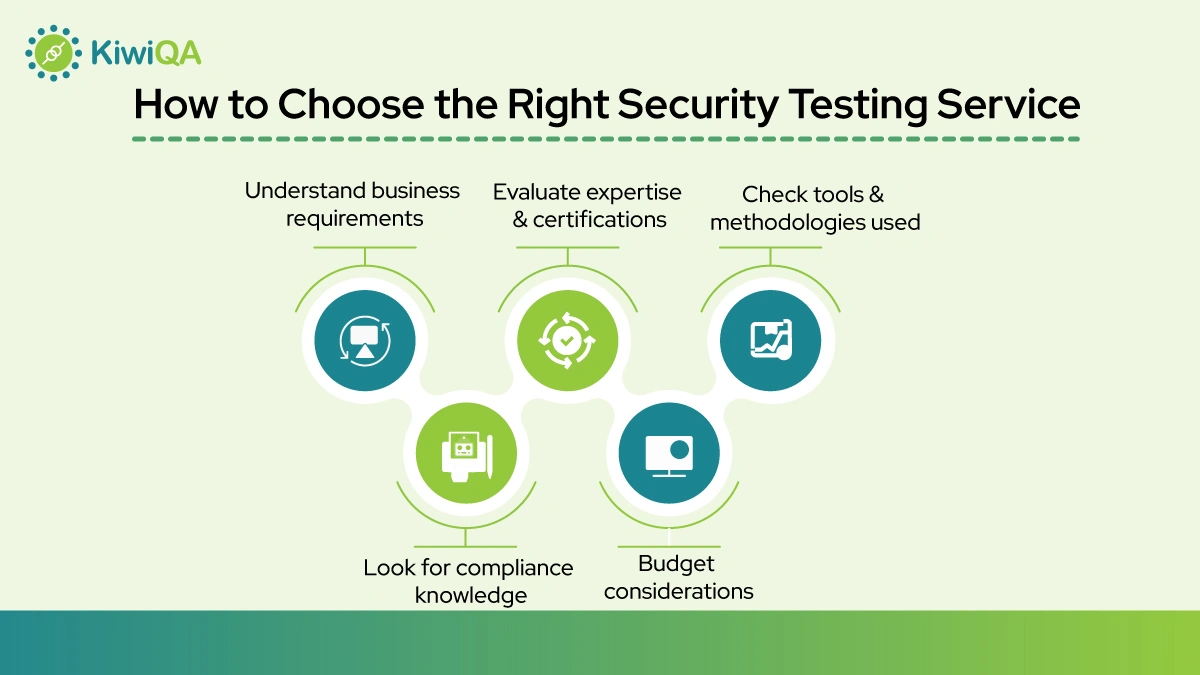
✥ Understand business requirements
Clearly describe your app type, risk exposure, and business needs before choosing a security testing service. Determine if you need security testing for the web, mobile, network, or cloud. Take into account your user base, industry-specific risks, and data sensitivity. You can select a provider who can effectively mitigate risks and align with your overall cybersecurity and business objectives by having a comprehensive grasp of your needs.
✥ Evaluate expertise & certifications
For accurate results, the security testing provider’s experience is essential. Seek out experts with accredited certificates. Teams with more experience are better able to mimic real-world attack scenarios and find complicated vulnerabilities. Assessing their technical expertise, industry experience, and prior projects guarantees that you are working with a provider who can give thorough and precise security.
✥ Check tools & methodologies used
To successfully identify vulnerabilities, a reputable security testing service should employ cutting-edge tools and trusted techniques. Make sure they use both automated and manual testing methods and adhere to industry standards. While manual testing reveals complicated problems, modern techniques assist in identifying recognized risks. Comprehending their methodology guarantees comprehensive testing coverage, precise outcomes, and enhanced security against changing cybersecurity risks.
✥ Look for compliance knowledge
A security testing service provider should be well-versed in legal requirements. This guarantees that your apps fulfill industry-specific and legal criteria. An expert with compliance experience can find weaknesses in your security system and suggest fixes. Customers and stakeholders will find your company more credible and trustworthy as a result of avoiding fines.
✥ Budget considerations
When selecting a security testing provider, budget is crucial, but quality shouldn’t be sacrificed. Choose a system that satisfies your security requirements and is reasonably priced. Investing in a trustworthy cybersecurity testing service is a wise and economical choice for long-term company safety since it can stop expensive breaches in the future.
Also Read: End-to-End Testing Strategy for Enterprise Cloud Platforms
Benefits of Security Testing Services
✥ Reduced risk of cyberattacks
Vulnerabilities are found and fixed by security testing services before attackers can take advantage of them. Businesses may drastically lower their exposure to risks like ransomware, malware, and data breaches by proactively evaluating systems, networks, and applications. Defenses are strengthened, and attack surfaces are reduced by ongoing testing and monitoring. By ensuring that possible threats are dealt with early on, this proactive strategy improves overall security and lowers the possibility of successful cyberattacks.
✥ Improved customer trust
When using digital platforms, consumers anticipate the security of their financial & personal data. By ensuring that apps are well-protected, security testing lowers the likelihood of data leaks. Users become more loyal and trusting when a firm assures them that their data is in secure hands. Strong security procedures also improve brand trust, which helps companies build enduring client interactions.
✥ Regulatory compliance
Security testing service assists businesses in adhering to industry standards and laws, including PCI-DSS, GDPR, and HIPAA. Strict procedures are needed to guarantee privacy and safeguard sensitive data under these requirements. Frequent testing guarantees that systems follow necessary regulations and find compliance holes. Maintaining compliance shows a company’s dedication to upholding strict security and data protection standards in addition to preventing legal penalties and fines.
✥ Cost savings from early detection
It is cost-efficient to search & reveal security concerns prior to SDLC before an error occurs. The best application security testing services help avoid costly outages, data loss, legal problems, and reputational harm. Early detection minimizes business disruptions and lowers repair efforts. By preventing cyber emergencies, investing in security testing eventually results in long-term savings.
Ready to Secure Your Web & Mobile Applications from Real Threats?
Mobile app security isn’t a post-launch task, and it must be integrated early into the development cycle. If you want to automate your code analysis and error scanning, selecting the right kind of testing is necessary to keep the app secure against threats. By hiring the best security testing company, you can tailor your business goals. Hire a company that uses a combination of automated and manual tools & serve a precise/actionable report.